
Nuclear Deterrence and the Risk of Miscalculation
Last updated 04:36 AM EDT • Read time: 5m
The Latin adage Si vis pacem, para bellum warns: ‘If you want peace, prepare for war.’ Given the heightened risk of war between China and the United States, we might take heed of this ancient wisdom. It is better to deter wars than wage them.
Part of the tragedy of the two world wars was that the principal aggressors who initiated or escalated them did so against objectively more powerful enemies. So, in theory, such aggression should have been easy to deter.
In 1914, Germany launched an unprovoked assault on neutral Belgium, bringing Belgium’s ally Great Britain into the war. Thus, after the opening gambits of World War I, the alliance of Germany and Austria-Hungary found itself at war against an objectively more powerful alliance of Russia, France and Great Britain.
In 1939, Poland had security guarantees from Britain and France, an alliance more powerful than Nazi Germany alone, but Hitler attacked Poland anyway. In 1941, Hitler attacked the Soviet Union, a much bigger and more populous country than Germany. Later that year, Japan attacked the world’s greatest industrial power, the U.S., by bombing Pearl Harbor. Thus, the alliance of Germany, Italy and Japan was at war against a much more powerful alliance of the British Empire, the Soviet Union and the United States.
The overconfidence and misjudgement displayed by Germany and Japan in the two world wars were in large measure attributable to a perception of a lack of resolve on the part of their foes.
In 1914, it wasn’t clear that Britain would fight on the side of Russia and France, and the British had made woefully inadequate preparations to do so.
In 1939, Hitler had been appeased for years, which made the British and French security guarantees to Poland seem hollow. The Soviet Union had fought poorly in the 1939–40 Winter War with Finland, and Hitler perceived that one kick would knock the whole rotten structure down. Japan thought that, with the U.S. fleet destroyed, an indulgent and lazy America would seek a peace treaty rather than fight it out.
Since 1945, there’s been a ‘long peace’. There have been no big international wars and overt military conflict between nations has grown increasingly rare.
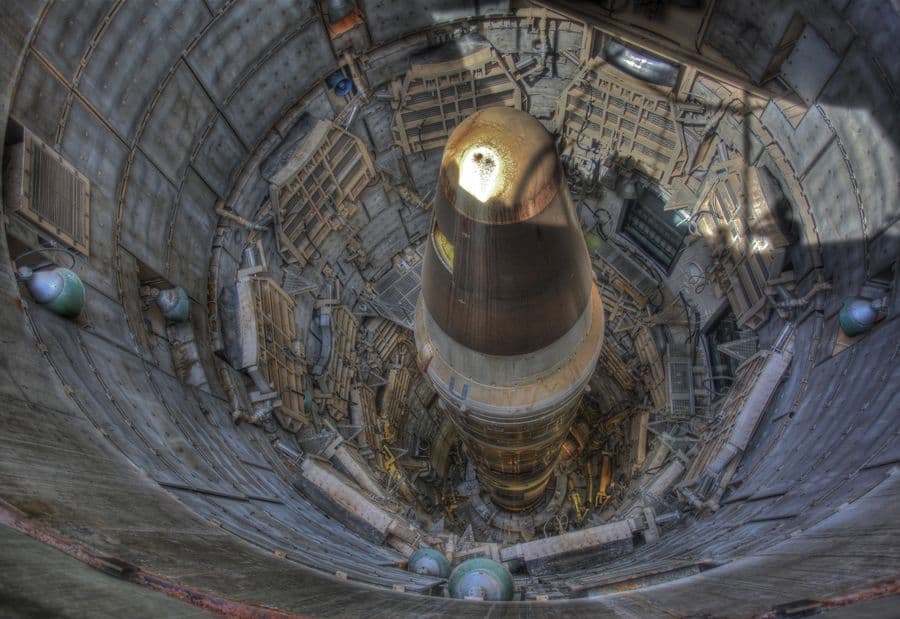
Nuclear weapons have changed the risk–benefit calculus for aggressors. It is difficult to misjudge a nation’s military capability if it has nuclear weapons, and such a misjudgement risks a mutually destructive Armageddon. Thus, the two superpowers and their alliances never directly fought each other during the Cold War.
Both China and the U.S. have nuclear weapons today, so is there any reason to doubt that deterrence will continue to prevail?
A hot war between China and the U.S. is mostly likely to break out over the issue of Taiwan. Nuclear weapons alone are unlikely to deter such a conflict.
If the risk of nuclear annihilation could deter all acts of aggression, then nobody would ever attack a nuclear-armed foe. But nuclear-armed U.S. military forces have previously been attacked by North Korea, China, North Vietnam, Iraq and the Taliban. Egypt and Syria attacked nuclear-armed Israel in 1973.
Would a country invade an island it claims as its own that is allied to a nuclear-armed nation on the other side of the world? It’s happened before, when Argentina invaded the Falkland Islands, a colonial territory of nuclear-armed Britain, in 1982.
Nuclear weapons haven’t been used in anger since 1945 and a taboo has long since developed over initiating their use. Nuclear weapons are only likely to ever be used if a nuclear-armed nation is facing an existential threat. The reality is that, in all the above examples, no existential threat existed for the nuclear-armed power.
Is the loss of Taiwan an existential threat to the U.S.? If Washington is unwilling to initiate the use of nuclear weapons to prevent Taiwan’s loss, how will China be deterred?
Even if the U.S. still retains the conventional capabilities to defeat China, the history of the 20th century suggests that what is truly important is the aggressor’s perception of the other side’s willingness to fight. This is where the recent debacle in Afghanistan is so dangerous.
After capitulating to the Taliban, who in the leadership of the Chinese Communist Party thinks Joe Biden would be willing to risk the lives of thousands of Americans to defend Taiwan? They might be calculating that, if Taiwan can only ever be brought back into the fold of the mainland by force, doing so before Biden leaves office will be the most opportune time.
Of course, the loss in Afghanistan might have the same impact on Biden that the loss of Czechoslovakia had on British Prime Minister Neville Chamberlain in 1939—a determination not to be embarrassed again.
The danger in the capitulation to the Taliban may not be that it has made America weak, but that it has made America appear weak. The issue may not be that Taiwan could be lost, but that China will misjudge American resolve, in which case the long peace will be at an end.
John Storey, a lawyer and military historian, is the author of Big wars: why do they happen and when will the next one be? released earlier this month by Hybrid Publishers.
This article appeared originally at The Strategist (ASPI).
The First Test of Peace Lies in Ukraine's Borderlands
By Dennis T. Cosgrove • RealClearDefense
The VFW’s Gambling Addiction Victimizes Veterans
By Jack Yoest • RealClearDefense
Superintelligence Exposes a Gap in the Law of Delegated Authority
By Sue Ghosh Stricklett • RealClearDefense
When the Network Goes Dark, Who Controls the Battlefield?
By Jonathan K. Corrado • RealClearDefense
We Cannot Build Tomorrow's Weapons With Yesterday's Alloys
By Joseph F. Krause • RealClearDefense
When the Network Goes Dark, Who Controls the Battlefield?
By Jonathan K. Corrado • RealClearDefense
Air Force Should Buy 250 Blended-Wing Tankers, as 2027 Demo Looms
By A&SF Mag.
Long Deployments to Be Navy Standard For Next Couple Years
By Mongilio, USNI NewsWhen the Network Goes Dark, Who Controls the Battlefield?
By Jonathan Corrado, RCD
Marines Deploy Neros Archer Drone in Live Fire Exercise for First Time
By USNI News