
Taiwan: Will We or Won't We?
Last updated 03:20 AM EDT • Read time: 5m
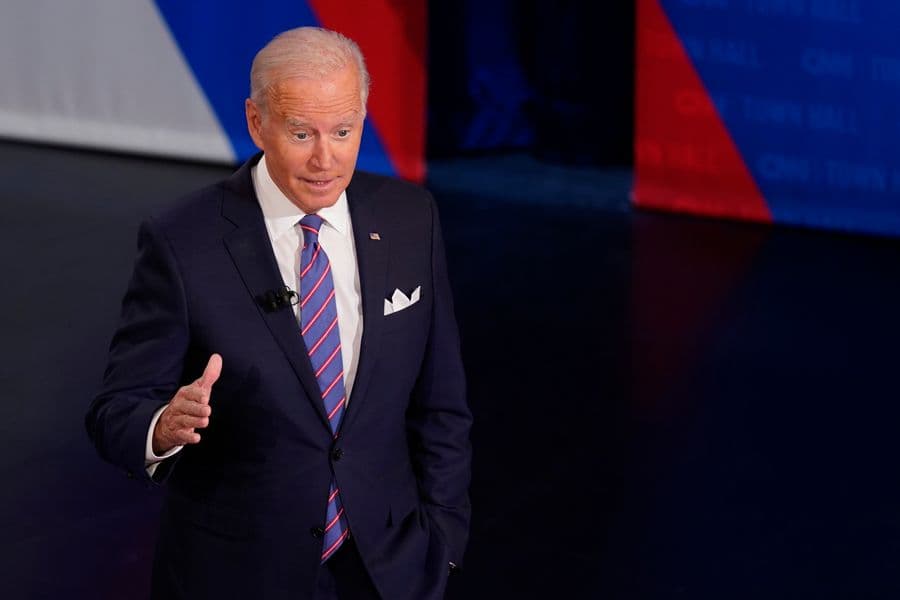
Much ink has been spilt about President Biden’s recent statement about a U.S. commitment to defending Taiwan if attacked by China, as well as the clarification issued by the White House afterward:
The U.S. defense relationship with Taiwan is guided by the Taiwan Relations Act. We will uphold our commitment under the Act, we will continue to support Taiwan's self-defense, and we will continue to oppose any unilateral changes to the status quo.[i]
Which is exactly right. Unlike NATO and the countries that the President referred to, the United States does not have a security treaty with Taiwan. What the U.S. has is the Taiwan Relations Act[ii], so let's see what the Act commits the U.S. to regarding the defense of Taiwan…
The relevant sections of the Act are 2.b.4 and 3.c. Section 2.b.4 states:
to consider any effort to determine the future of Taiwan by other than peaceful means, including by boycotts or embargoes, a threat to the peace and security of the Western Pacific area and of grave concern to the United States;
So what does “grave concern” mean? The U.S. does not have some checklist or dictionary that defines what a "grave concern" might be, but it is clear that in this globalized world, any hard-power threat to Taiwan, be it military or economic in nature, would have a profound effect on both the U.S. and world economies.
Section 3.c states the following:
The President is directed to inform Congress promptly of any threat to the security or the social or economic system of the people on Taiwan and any danger to the interests of the United States arising therefrom. The President and Congress shall determine appropriate action by the United States in response to any such danger in accordance with constitutional processes.
Similar to the text of mutual defense treaties the U.S. has with other nations, there is no “automatic” response should China threaten Taiwan in some way.[iii] For the sake of discussion, let’s assume the nature of the threat is an armed attack by China on Taiwan. In this case, what are the “constitutional processes” mentioned in the Act? Following a strict interpretation of the Constitution, Congress could decide to declare war on China and direct the President, as Commander in Chief, to take military action to defend Taiwan.
But Congress hasn’t declared war on another country since 1941, and even then, it was asked to recognize that "a state of war exists between the U.S. and the Empire of Japan." That hasn't stopped the U.S. from using military force, however. Virtually every President has claimed that their powers as Commander in Chief of the armed forces give them the executive authority to use military power, not just to defend the U.S. against attack, but to defend U.S. interests, however broadly defined. Therefore, in response to a military attack against Taiwan, a president might decide unilaterally to take military action to defend Taiwan. At some point, Congress would have to get involved, either to belatedly authorize the money necessary to continue military action or to attempt to use the War Powers Act to restrict the President's ability to continue that action.
Another possibility is that a president decides that an armed attack against Taiwan should not be responded to with military force. After all, there is nothing in either the Taiwan Relations Act or the Constitution that requires the President to take unilateral military action to defend Taiwan. It is rare in the discourse to hear this option discussed, but it is certainly possible.
There is yet another possible response, which the Act clearly prescribes: 1) the president, who controls the intelligence resources necessary to make such a determination, is directed to inform Congress of any threat to Taiwan, and 2) working together, the executive and legislative branches are to determine the appropriate national response, given the broad range of instruments of national power[iv], for the existing situation.
The elected head of the executive branch in a democratic republic working together with the elected legislative body to determine a national response to a crisis? Hey, that’s what the Act says…
Anthony Cowden is the Managing Director of Stari Consulting Services
Notes:
[i] https://www.reuters.com/world/asia-pacific/biden-says-united-states-would-come-taiwans-defense-2021-10-22/
[ii] https://www.ait.org.tw/our-relationship/policy-history/key-u-s-foreign-policy-documents-region/taiwan-relations-act/
[iii] Take, for example, the text of the Treaty of Mutual Cooperation and Security Between Japan and the United States of America:
“Each Party recognizes that an armed attack against either Party in the territories under the administration of Japan would be dangerous to its own peace and safety and declares that it would act to meet the common danger in accordance with its constitutional provisions and processes.” Or from the North Atlantic Treaty Article V: “The Parties agree that an armed attack against one or more of them in Europe or North America shall be considered an attack against them all, and consequently they agree that, if such an armed attack occurs, each of them, in exercise of the right of individual or collective self-defense recognised by Article 51 of the Charter of the United Nations, will assist the Party or Parties so attacked by taking forthwith, individually and in concert with the other Parties, such action as it deems necessary, including the use of armed force, to restore and maintain the security of the North Atlantic area.
[iv] “DIME”: Diplomatic, Informational, Military, and Economic; or the longer “DIME-FIL”, which adds Financial, Intelligence, and Legal.

In Pursuit of Nuclear Abolition
By Peter Huessy • RealClearDefense
Innovation Alone Won’t Prepare the U.S. for the Future Battlefield
By Joshua Segal • RealClearDefense
The sUAS Tactical Trifecta
By Bryan T. Woody • RealClearDefense
The Revolutionary War: When Strategic Options Share the Same Weakness
By Henry Yep • RealClearDefense
The Houthis Are Testing the Limits of Collective Defense
By Saima Afzal • RealClearDefense

Who Shoots Down the Drone Over the Shipyard?
By John Ferrari & Dillon Prochnicki • RealClearDefense
Northrop Grumman Breaks Out the Big Guns at AUSA
By Daniel Terrill, Defense News
Army Pursuing Diverse Array of New Anti-Air Interceptors
By Trevithick, The WarZoneWho Shoots Down the Drone Over the Shipyard?
By John Ferrari & Dillon Prochnicki, RCD
F-35C Lands for the First Time on a Ford-Class Aircraft Carrier
By The Aviationist