
Russia's Game in North Africa
Published Jan. 20, 2022 • Read time: 6m
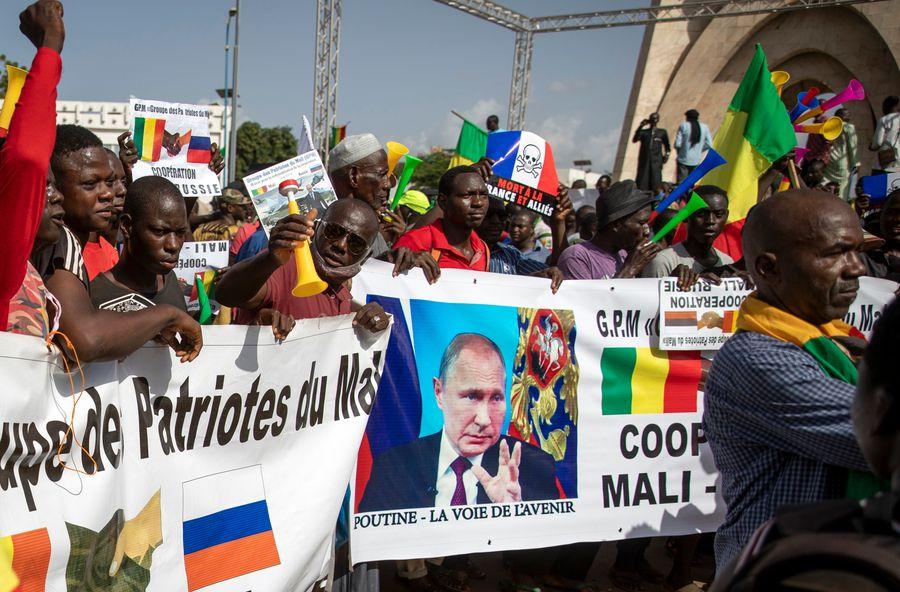
Russia's assault on international order is global in scope. Apart from Europe, it also is on prominent view in the Middle East, North and Sub-Saharan Africa, most recently in Mali, whose government has contracted with the Vagner private military company, ostensibly for protection against Islamic insurgents. Russia’s move here is merely part of its larger and uninterrupted offensive across Africa. Beyond the agreement with Mali, Moscow recently acquired a naval base in Sudan, sold arms to Nigeria, and has interfered in African governments across that continent. In many of these engagements, Moscow has had a proxy to work with. Libya has worked with General Khalifa Hafter’s militia, in Sudan and Egypt with the local government, and throughout the continent with political leaders and movements who gave it entrée and a quasi-legitimacy or cachet in local circles. Indeed, in many Islamic countries, the UAE consciously acted as an enabler of Russian penetration across Africa. The same thing is happening in Mali.
A recent Algerian report has charged that Algeria has now decided to provide much of the financial support owed by the Malian government – itself the result of a coup – for the Vagner PMC. Although the Algerian government has denied this report, it nonetheless comports with the past trajectory of Russo-Algerian relations. Significantly this report makes a great deal of sense if we understand that Russia, as noted above, is trying to devise innovative and especially inexpensive ways of projecting power in Africa through the help of proxies and enablers. Algeria's decision obviously involves prior diplomatic coordination with Mali and Russia and comports with Algeria's long-running strategic partnership with Russia. Algeria, for example, has long been an important regional customer for Russian weapons. E.G., Moscow sold forty-two Mi-28N combat helicopters and eight Mi-26 transport helicopters to Algeria between 2013 and 2015. Subsequently, in 2020 Algeria purchased 14 stealth fighters from Russia.
But there is more to this relationship than arms sales, which serve Russia as a point of entrée into local governments, armed forces, and economies throughout Africa. Already in 2018, Russian assertiveness led the UN to renew the mandate for a UN peacekeeping force (MINURSO) in the long-running Western Sahara conflict between Algeria, Morocco, and their proxies for only six months rather than a year. Moscow's support for this atypical UN stance apparently can be traced to its mounting tensions with Paris and Washington due to Russian interventions in Syria and Libya. Russian policy in Africa also very consciously aims to antagonize France. Thus, there is no little amount of Schadenfreude (Joy at another's sorrow) in Moscow at France's discomfiture, and the Russian pressure here no doubt adds to Moscow’s overall ability to place pressure on France regarding European issues, which are obviously much more important to Russia. Thus African rivalries among the great powers and their proxies are tied to European security, not only in this way but also through Moscow's quest for economic leverage and bases in Africa from which it can then threaten European targets and interests.
Mali figures in this complex series of interactions because Algeria evidently aims to become a major if not the main foreign player there now that the French forces in Mali have withdrawn due to friction with the government in Bamako, itself another government that came to power through a coup opposed by Paris. Likewise, Moscow's gambit, major if not in Mali, has apparently garnered Algerian support owing to difficult Franco-Algerian relations. Algeria here vis not merely motivated by its many affinities with Russia and the fact of arms sales, vaccine sales, energy deals, etc., with Russia, but also by parallel or even overlapping interests. For Algeria, deployment of Wagner’s troops could be the long-hoed for means of resolving terrorism in the Sahel. At the same time, rapprochement with Russian troops could also signify both governments' choice in the conflict between Algiers and Rabat over the Western Sahara issue. Finally, it appears that Algeria, affronted by France, would exploit Russian influence in the Sahel to counterbalance France.
These operating forces provide more than enough reason for Algeria to coordinate with Russia on behalf of the new government in Mali and against France. At the same time, Russia not only gains influence and leverage across the Sahel, but it also can parlay that leverage and influence into gains and pressure against France in Europe. But these signs of Russo-Algerian collaboration point to abiding Russian tactics in Africa, the search for enablers and proxies, the simultaneous effort to support one side with whom it has affinities in ongoing inter-state or civil conflicts while also trying to insert itself as a “mediator” in these conflicts. Thus in the Western Sahara or Polisario conflict, it supports Algeria while insisting on a Russian role in resolving that conflict. So, despite the intensity of the current crisis in European security triggered by Russia, we cannot overlook or neglect the fact that Moscow is challenging international order in North Africa, and here it has partners, if not allies.
Stephen J. Blank, Ph.D., is Senior Fellow at FPRI’s Eurasia Program. He has published over 1500 articles and monographs on Soviet/Russian, U.S., Asian, and European military and foreign policies, testified frequently before Congress on Russia, China, and Central Asia, consulted for the Central Intelligence Agency, major think tanks and foundations, chaired major international conferences in the U.S. and in Florence; Prague; and London, and has been a commentator on foreign affairs in the media in the U.S. and abroad. He has also advised major corporations on investing in Russia and is a consultant for the Gerson Lehrmann Group. He has published or edited 15 books, most recently Russo-Chinese Energy Relations: Politics in Command (London: Global Markets Briefing, 2006). He has also published Natural Allies? Regional Security in Asia and Prospects for Indo-American Strategic Cooperation (Carlisle, PA: Strategic Studies Institute, U.S. Army War College, 2005). He is currently completing a book entitled Light From the East: Russia’s Quest for Great Power Status in Asia to be published in 2014 by Ashgate. Dr. Blank is also the author of The Sorcerer as Apprentice: Stalin’s Commissariat of Nationalities (Greenwood, 1994); and the co-editor of The Soviet Military and the Future (Greenwood, 1992).

The Army’s AI Cyber Defenders Need a Proven Stand-Down Order
By Gleb Tsipursky • RealClearDefense
After the Silence
By Chase Skylar DeMayo • RealClearDefense
Defense Chip Procurement Needs a Recovery Test
By Percy Yixuanchen Yu • RealClearDefense
FORTRESS America Must Measure Missions, Not Megawatts
By Burak Oktenli • RealClearDefense
After the Midterms, the Right Strategy Against Iran
By Lance Gordon • RealClearDefense
After the Silence
By Chase Skylar DeMayo • RealClearDefense
Underwater Arms Race Puts U.S. Naval Supremacy at Risk
By Tom O'Connor, Newsweek
New Facilities To Pump Out Upgraded F/A-18E/F Super Hornets
By Trevithick, WarZone
U.S. Navy Expands Tomahawk Warhead Production
By Naval News Staff, Naval News
SSN(X) Attack Boat Will be a Swift, Lethal Mothership for Undersea Drones
By USNI N.