
Increasingly Vulnerable Logistics
Published April 13, 2022 • Read time: 7m
Air Force: Find a Bridge Tanker or Risk Defeat
In late March Air Force Secretary Frank Kendall indicated the service would be buying more KC-46 refueling aircraft instead of allowing for a competition to invest in a potentially more capable ‘bridge’ tanker. “As we’ve looked at our requirements,” Kendall said, “the likelihood of a competition has come down.” The Air Force’s FY2023 budget briefer and proposed 2023 force structure nominally keeps the tanker fleet the same, while shifting the fleet’s emphasis to the KC-46, and retiring older tankers as part of a “Divest to Invest” strategy. More broadly, as Defense Secretary Lloyd Austin and Chairman Mark Milley confirmed, the Air Force will commit to Divest to Invest, shrinking its number of airframes to free up funds for future programs. All this points to the death of the bridge tanker program.
With all respect, the Air Force should look again.
Without a robust tanker fleet, American combat aviation will experience a window of vulnerability in the mid to late 2020s—precisely when Chinese regional aggression is most likely.
Given the demands of the Indo-Pacific fight, the Air Force can’t afford not to acquire a more capable tanker. A realistic assessment of the terrain and the threat shows why.
The Indo-Pacific theatre dwarfs the European
The U.S. military faces a particularly thorny Indo-Pacific strategic problem: it seeks to defend American allies along the First Island Chain, secure the South China Sea’s maritime exits, and if possible, prevent Taiwan from falling into the PRC’s hands. But it must achieve these objectives over truly vast distances relative to other theatres of the world.
Europe from the Atlantic to the Urals is slightly under 4 million square miles. By contrast the Pacific Ocean is around 60 million square miles. London is less than 2,000 miles from any other European NATO capital. By contrast, Tokyo is more than 5,000 miles from California by air. The U.S. maintains bases in the Pacific’s few islands and archipelagoes, in Hawaii and Guam. But few major landmasses exist between the First and Second Island Chains and the central and eastern Pacific. Once aircraft take off, or ships put to sea, they must fly or sail to one of a handful of major bases for refueling or repair.
While the utility of the comprehensive U.S. base network is undeniable, it cannot substitute for a tanker fleet because America’s Indo-Pacific allies also confront a tyranny of distance.
To counter this geographic reality, the U.S. Air Force’s tanker fleet provides America with a decisive combat advantage in its ability to project tactical and strategic airpower over long distance. However, the Air Force has shown scant interest in expanding its tanker fleet. Without a concerted effort to expand these forces, the U.S. military’s combat elements are at risk of being cut off from refuel and resupply. This would make them useless in a high-end Sino-American conflict.
Range extension is power projection
The true lynchpin of American military power is its range extension capabilities, its airborne refueling fleet. It is also the least appreciated aspect of U.S. air combat power.
The Air Force, Navy and Marine Corps all emphasize tactical aviation over long-range strike aircraft. Since the Cold War’s conclusion, the U.S. has phased out interdiction and attack aircraft like the A-6 Intruder and F-111 Aardvark, instead turning to modified tactical fighters. As airframes narrowed, the Navy shed its carrier-launched tankers, and the Navy and Air Force their purpose-built electronic attack and anti-submarine aircraft, shunting those missions off to modified fighter airframes. Thus, a gap exists between long-range strike and patrol airframes, namely the Navy’s maritime patrol aircraft and the Air Force’s heavy bombers, and a host of F-15s, F-16s, F/A-18s, F-22s, and increasingly F-35s.
To be sure, American tactical aviation has significant advantages: U.S. fighter pilots are the world’s best trained, and the Ukraine War demonstrates that even with inferior equipment, Western-trained pilots remain superior to their Russian counterparts. The same is likely true of Chinese pilots. But apart from the F-15, all U.S. fighter variants have a combat range of 500 to 700 miles.
And while the U.S. has a growing but limited number of long-range missiles – for the foreseeable future, the U.S. will rely on its Tomahawk reserves to hold at risk Chinese ships and ground targets, with an average range of around 800 miles – tankers would still be needed to ferry fighter aircraft from Japanese bases or Guam.
Although Kadena Air Base is near enough to the Taiwan Strait to preclude tanker operations, the assumption that it will survive as a viable airfield beyond a war’s first few days is open to question. Nor can the U.S. evade this problem by tacking toward UCAVs for use in high-end combat. Here again, a robust tanker fleet is crucial and would in fact let American manufacturers create more heavily armed UCAVs with a lower fuel emphasis.
But only if enough tankers exist to support this fleet.
The U.S. tanker fleet has shrunk to 473 airframes from 701 at the Cold War’s end, while peacetime operational tempo has increased. Tankers are on average half a century old. Even in peacetime, U.S. tanking ability is stretched to the limit, and age is abrading the force, as sporadic crashes in the C-130 fleet demonstrate. In a Sino-American conflict, this tanker force must be entirely redirected to ferrying Pacific fighters. If American aircraft engage in fighter combat near or over the Taiwan Strait, this tanker fleet can be expected to experience losses, at just the time it needs to support additional fighter aircraft even farther forward.
The value of competition and building a bridge
The Air Force’s apparent plan to simply move forward with a modified KC-46 isn’t a viable solution as acknowledged by the Pentagon’s most senior leadership. That move would essentially preclude the opportunity to invest in a more capable and much needed platform.
As Secretary Austin told lawmakers on the House Armed Services Committee on April 5, “Refueling capability is a significant part of our strategic advantage. Investing in the next generation is the right thing to do.”
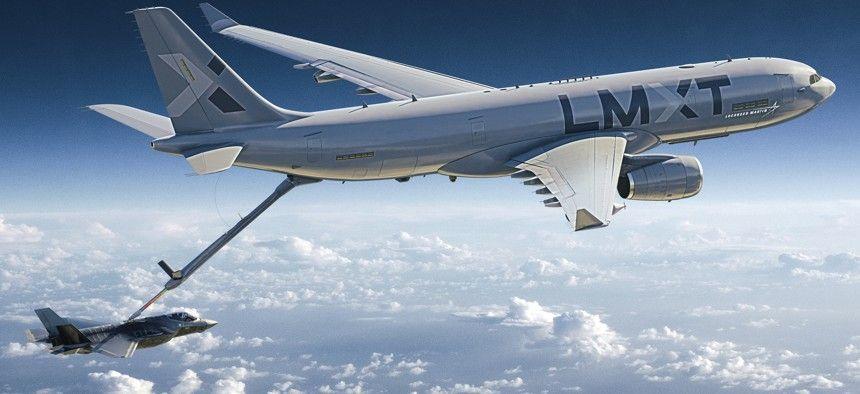
If the Air Force allows for a competition to build a bridge aircraft, there are two likely candidates: a modified KC-46 and the Next Generation Tanker (LMXT). The KC-46 is cheaper, allowing for more aircraft to be procured. But it is cheaper because it is smaller. The LMXT has a longer range, with greater gas give relative to the KC-46, which would allow it to reach far-flung Pacific airfields. Additionally, LMXT’s shorter takeoff distance allows it to access more airfields than the KC-46.
More than most, Secretary Kendall undoubtedly understands the value of competition. Indeed, as part of his confirmation hearing he reaffirmed the importance saying, “We need an industrial base that can meet growing war fighter readiness requirements… and posture for future threats. At the heart of achieving those goals is the availability of competition from industry – in any form.”
The Air Force should match words with action and demand a competition for a bridge tanker. Geography requires it. Leadership recognizes it. And the warfighters deserve it. If that’s not enough, here’s a final consideration: failing to compete is risking defeat.”
Seth Cropsey is founder and president of Yorktown Institute. He served as a naval officer and as deputy Undersecretary of the Navy and is the author of Mayday and Seablindness.
After the Midterms, the Right Strategy Against Iran
By Lance Gordon • RealClearDefense
The Color Revolution Came Home
By Emzari Gelashvili • RealClearDefense
When Access Becomes the Fight
By Richard Byno • RealClearDefense
What the 2026 Midterm Results Mean for U.S. Strategic Competition with Rivals
By Dean Chen • RealClearDefense
Measurable by Design: Project Meridian
By Alex Willard • RealClearDefense
New USAF Force Design Bets on Technology
By Stephen Losey, Air & Space Forces
DoD Pushes $450M in Loans To Bolster U.S. Space Companies
By Hitchens, BrDefense
The U.S. Navy Needs a New Battlecruiser. Will It Get One?
By Sadler & Ouellette, NatInt
U.S. Army Rehearses Rapid HIMARS Rocket Launcher Deployment
By Global Defense N.
Coding Commander's Intent into Unmanned Systems
By Thomas Baumstark, Proceedings