
The Color Revolution Came Home
Last updated 07:01 AM EST • Read time: 20m
Join the Conversation
0About a month before Georgia's Rose Revolution in 2003, an order came down from the minister of state security. It was verbal. We were to destroy everything we had on the opposition, above all on Mikheil Saakashvili's National Movement.
Classified documents were torn out of the files by hand. The secret registry altered its logs and voided the registration numbers. A second verbal order followed: stop all work on the opposition, including agent work. We waited for the protests.
I thought of those orders again this fall, when a researcher who posts as DataRepublican began publishing what she says are hundreds of recorded calls and thousands of documents. They come from former officers of USAID's democracy office, retired national security officials, and protest coalitions. She says one of the groups, Renew to Thrive, put them online by accident. On those recordings, people whose job was to assess democracy abroad talk about the legitimacy of our own government.
I have seen this film. I watched it from inside the state.
By the fall of 2003, there was little counterintelligence left to stop. The ministry had been turned into an anti-smuggling service, chasing cargo from Ergneti, the smuggling bazaar on the South Ossetian line, day and night. On counterintelligence, the leadership wanted fictitious reports, to keep up appearances. In my department and directorate, I was the only operative still doing the real work.
The rot was older. I had joined the ministry in 1996. Its files held nothing on the criminal "informals" of the early 1990s, who later operated under the names of the National Guard, the Mkhedrioni militia, and the military police. I knew dozens of their members. When I began working on them, my department head stopped me. The leadership, he said, was not interested.
The leadership was a closed circle of Soviet-era cadres. Igor Giorgadze, a career KGB officer, ran the ministry until 1995. That year, at Georgia's request, Interpol put him on its wanted list, accused of masterminding an attempt on the life of Eduard Shevardnadze, then Georgia's head of state. He denies it. He resurfaced in Moscow. Russia never handed him over. It gave him refugee status. In 2016, Interpol took him off the list. Georgia's prosecutors said that status was the reason.
The ministry passed to Shota Kviraia, a Soviet militia veteran and former interior minister. Kviraia had been raised to high office at the initiative of Jaba Ioseliani, the leader of the Mkhedrioni. I was hired on Kviraia's watch. In 1997, he was dismissed over a wiretapping scandal and emigrated to Moscow, where he died in 2011. Georgia's Interpressnews reported at his death that, by various accounts, he had continued working for Russia's special services there.
As far as I could see, most new officers bought their jobs. Clean officers like me were perhaps one in a hundred. We were the window dressing.
On Nov. 2, 2003, Georgia held a parliamentary election that international observers said fell short of democratic standards. The protests came. My ministry was charged with protecting the constitutional order. It did nothing to protect it. Its inaction helped the crowd. The Interior Ministry, as far as I could see, knew nothing of our orders. Its police had the opposite orders: stop the protests. That made it all look real.
On Nov. 22, the crowd marched on parliament. The cordons around it did not hold. The protesters walked into the chamber as Shevardnadze was addressing the new parliament's first session, Saakashvili holding a rose.
Moscow sent its foreign minister, Igor Ivanov. He met the opposition, walked among the protesters, and saw Shevardnadze. On Nov. 23, Shevardnadze resigned. According to our operational information at the time, Ivanov had come because the Kremlin wanted Aslan Abashidze, the pro-Russian ruler of Adjara, to succeed Shevardnadze.
The revolution had three leaders. In our service, two of them, Zurab Zhvania and Nino Burjanadze, were seen as closer to Moscow. Saakashvili was seen as Washington's man. Our information said Washington used the first two to stand with the third, and that Moscow's services played along. Then the presidency went to Saakashvili. Washington had outplayed Moscow. Zhvania died in 2005, before time could test that view. Burjanadze's later path tested it. In 2010, she joined Vladimir Putin in Moscow to lay the cornerstone for a replica of Kutaisi's World War II memorial, which Saakashvili's government had blown up.
Moscow did not let go of Abashidze. When the revolution's youth movement took its campaign to Adjara, Russia's Foreign Ministry warned on Jan. 20, 2004, that attempts by "extremist-minded forces in Georgia, in particular from the organization Kmara," to cause tensions there were "extremely dangerous." In May, Abashidze stepped down after overnight talks with the same Igor Ivanov, by then secretary of Russia's Security Council, and left for Moscow.
Our minister took the same road. Valery Khaburdzania had run the Ministry of State Security since November 2001. In 2004, he moved to Moscow. In 2013, he watched the inauguration of President Giorgi Margvelashvili from the honorary box in Tbilisi. "I must confess," he said, "I represented Russia."
His account of 2003 is worth reading next to mine. In April 2013, Moscow's Moskovsky Komsomolets asked him whether Georgia's security services had ever hunted for spies at the U.S. Embassy. "Why?" he answered. "When I came to the ministry, the Americans ran everything there." In the fall of 2003, he recalled, he had urged the country's leadership to give in to the opposition over "only six seats." "The Americans were then betting on Nino Burjanadze," he said. "I know this 100 percent, but don't ask me how."
I read that line two ways. One reading fits what we saw in 2003: the Americans let Moscow believe they were betting on someone Moscow could live with, and then Saakashvili took the presidency. The other reading is about 2013. That year, Burjanadze led a party widely seen as pro-Russian. Now a former security minister, speaking from Moscow, said it was the Americans who had been betting on her. Whatever his intent, the line did her a favor.
The paper's introduction noted that Shevardnadze himself had recalled, not without malice, how his security chief opened the session hall to the revolutionaries. Then why, the interviewer asked, had he helped the Rose Revolution? "That's a lie," Khaburdzania answered. When the crowd advanced on the troops around parliament, he said, they "simply parted." He was standing by the door of the chamber when people began to break it. "What are you doing?" he says he asked them. He insists he never opened it: "What did that door matter when all of parliament was already full of people?"
In July 2013, speaking from Moscow, he told the Georgian site Saqinform that in the tense days of the revolution, CIA officers came to see him "practically every day." The ministry had worked with the agency before, he said, but this time it overstepped. "The intelligence service openly supported the United National Movement." Its demand was that no force be used against the protesters. Its officers carried passes that let them into every unit of the ministry without permission. They contacted his staff and often gave them assignments directly. When he tried to take the passes away, the CIA station chief grew so angry that he brought the U.S. ambassador himself "to sort out the matter."
I saw Americans move through the ministry freely, treated with deference. None of them ever gave me an assignment. None introduced himself as CIA. But there was an order about them, too. It was verbal: hands off the Americans.
In 2020, Khaburdzania posted photographs of the American and German ambassadors in Tbilisi. With ambassadors like these in his day, he wrote, and a less stubborn president, Shevardnadze would still be in power, "and I would still be in Beria's office."
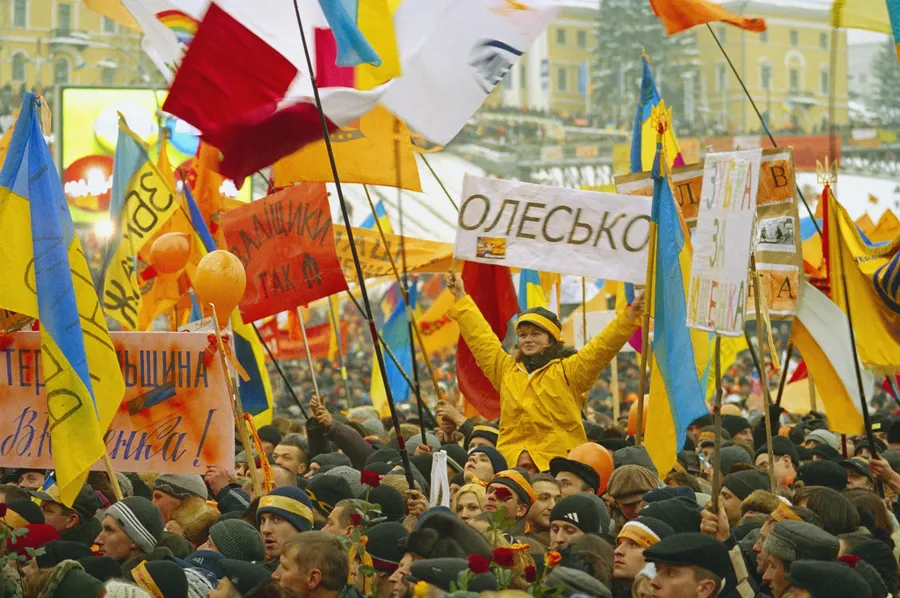
The West remembered all this as a spontaneous uprising. It was not spontaneous. The anger was real; I had watched the rot for seven years. But inside the state, the uprising was helped by orders that left no paper trail. Outside, it ran on an imported method, financed in part from abroad. It took three weeks.
The method came of age in Serbia. In 2000, a student movement called Otpor, "resistance," helped bring down Slobodan Milosevic, and Washington helped Otpor. The New York Times Magazine reported USAID's figure: $25 million appropriated for Serbia that year alone. Several hundred thousand dollars went directly to Otpor for "demonstration-support material, like T-shirts and stickers." An official of the National Endowment for Democracy put it plainly: "Otpor was certainly the largest recipient." That spring, the International Republican Institute brought more than 20 Otpor leaders to the Budapest Hilton, where a retired U.S. Army colonel, Robert Helvey, taught them nonviolent resistance from the work of Gene Sharp.
Then the method traveled. In Georgia, it found the ground ready. From 1996 on, I had watched American foundations, nonprofits, and government programs arrive with grants and seminars. Above all, they created and funded local NGOs. Georgia's youth movement, Kmara, "enough," appeared in April 2003. George Soros's Open Society Institute paid for young Georgian activists to travel abroad, where they met Otpor's veterans. Otpor also came to Georgia. "They just told the story of how they did it," a Kmara activist told Radio Free Europe. Democracy assistance, largely American-funded, paid for election monitoring and exit polls. When the official results diverged from those numbers, the crowd had its argument.
A year later, Ukraine. Kmara ran seminars for the Ukrainian opposition, and Otpor trained young Ukrainians "how to set up an organization, how to open local chapters, how to create a 'brand,'" one of its activists, Aleksandar Maric, said. The Associated Press reported that the Bush administration had spent more than $65 million over two years "to aid political organizations in Ukraine." The exit poll, it added, was funded by the embassies of the United States and seven other countries. Washington insisted its money went "to the process," not to candidates. Moscow played the same game with more money: one Ukrainian institute estimated that Viktor Yanukovych's campaign received $800 million from Russia.
The sums were small by Washington's standards. Radio Free Europe later concluded that claims of direct foreign funding were often exaggerated. The sums did not need to be large. The method was cheap. That was its genius.
The formula was the same each time. An election people could be told was stolen. An independent count to say so. A trained youth movement with a brand. A television channel. A crowd large enough to make the government blink. Harvard's Erica Chenoweth later gave the crowd a number. In Chenoweth's data, nonviolent campaigns whose biggest protest drew 3.5 percent of the population almost always won.
I also know what the method leaves behind.
After the revolution, Irakli Okruashvili, the new governor of my region, Shida Kartli, came to our directorate with Khaburdzania. The government had changed, they told us. We would now do counterintelligence, with real funding and no corruption. What followed were police operations with the governor, who trusted us, he said, more than the police. Soon he became prosecutor general and took Khaburdzania's team with him.
Then a new regional chief arrived, a man even the old ministry had fired. At a night meeting, he gave us ten days to list the criminals and corrupt officials who had slipped into the new government. I brought him mine the next morning. For years, against orders, I had kept my own records in a black folder in my safe. The folder went up the chain. In a reorganization, every officer went into the reserve to be reappointed. I was not. Officially, no one told me why. Unofficially, a source close to the top did: I knew too much. The chief later confirmed it to me in the yard of his house. For four months, I was out of work, and my former colleagues were forbidden to speak to me.
By then, the revolution's winners were at war with each other, and, I was told, officers who knew things were in demand. The new security minister, Vano Merabishvili, had my file pulled and let me choose my post. I chose my old one.
The feud outlived the revolution. In 2016, Okruashvili testified in court against Merabishvili and Saakashvili. In 2020, Okruashvili and Merabishvili were held in the same prison. In the case over the violent breakup of opposition protests in November 2007, Saakashvili's lawyer called Burjanadze the main witness against him. She told the court the crackdown was "a catastrophic mistake" and that Saakashvili had never denied to her or to his team that he organized it. Two days after the crackdown, she had defended it as speaker of parliament. The country, she told lawmakers, had to be saved from a coup. "It was not easy for us to make this decision," she said, "not for the president, not for me." Saakashvili denied any link to the decision to break up the protests. He put all the blame on his interior minister at the time: Merabishvili. Saakashvili has been a prisoner since 2021.
The revolution changed the owners of the files. It did not change what the files were for.
A revolution needs a government, and the foundations helped build one. In 2004, a fund created by Soros's Open Society Institute and the U.N. Development Program paid salary supplements to Georgia's new leadership. The president, the speaker, and the prime minister received $1,500 a month; ministers and the prosecutor general, $1,200. Some 5,000 officials were to receive top-ups, with the focus on law enforcement. The NGOs that trained the revolution became the bench from which ministers, deputies, and editors were drawn.
Part of my own pay as a state security officer came from Bidzina Ivanishvili, a billionaire who had made his fortune in Russia. After the Rose Revolution, our salary supplements were paid through his Cartu Bank. In 2011, he said that when the public thought Soros was financing the government, he had in fact paid most of that sum himself. In 2012, he explained on Georgian television why the fund carried Soros's name instead of his own. He had business in Russia, he said, "and Russia would not have liked this." That year, he founded Georgian Dream and took power.
Today, that bench sits on both sides of Georgian politics. The opposition that came out of the Rose Revolution and the Georgian Dream government that replaced it grew up in the same foundations and the same NGO culture. Georgian Dream now wages war on Soros's foundations. As I wrote in the Washington Examiner, it is a war fought between people who came out of the same donor world. They hate each other. They agree on one thing. Both attack President Donald Trump, then his administration, then the Republican Party, and finally the United States itself. I described that ladder in these pages in August, in "Teaching the Most Pro-American Nation to Hate America." In October, I wrote that the opposition hates Trump more than it fears Putin. Willingly or not, the result serves Moscow politically, Beijing economically, and Tehran, whose networks now operate in Georgia with little resistance.
Back in Washington, the method had become a profession. USAID's office for democracy, human rights, and governance, known as DRG, packaged it into a portable toolkit: monitors for elections, money for courts and independent media, grants for civil society. Its officers worked in countries they judged to be sliding toward authoritarianism and helped the forces they judged to be democratic.
In 2025, the Trump administration shut USAID down. On July 1, 2025, its remaining programs moved to the State Department. The toolkit did not disappear. Neither did the people who carried it. They had lost their government posts, not their training.
According to DataRepublican, when USAID closed, a group of its former democracy officers regrouped as the Democracy Renewal Group, keeping the old initials. With Renew to Thrive, a network of former USAID and USAID-funded NGO officials, they drafted a plan called Renew American Democracy. Its strategy rests on four B's: block, bridge, belong, and build.
The recordings explain the last word. "We can take that breakdown moment and leverage it for a big structural reform, you know, refounding moment," Danielle Reiff, a former USAID democracy officer, says on one call. In March, she said: "I'm foreseeing a crisis of legitimacy around the November election." A midterm "meltdown," she added, "could be a real window of opportunity for us." In September, according to a transcript published by Know the Times, she floated "maybe we'll have an Article 5 constitutional convention at some point, maybe an Article 7 constitutional convention at some point." Article V governs amendments. Article VII governed the ratification of the Constitution itself, in 1787 and 1788. At a 2025 meeting of the 22nd Century Initiative, one participant said what many of them seem to feel: "We were never allowed to analyze the United States in this way before."
The plan even has a name for the aftermath: "the day after tomorrow." Mike Smith, a retired rear admiral, founded National Security Leaders for America, a network of more than 1,400 retired military and intelligence officials. In August, Reiff recounted his reaction, according to Know the Times: "Oh, you guys have the day-after-tomorrow plan." Smith, the Daily Caller reported, runs the "Insurrection Act Working Group" with Reiff.
The aftermath begins at a red line. According to DataRepublican, the red lines are things the administration might do, such as invoking the Insurrection Act against protesters. In March, Reiff floated "an important convening, maybe like a third continental Congress," to declare the red lines. There have been two. The second declared independence. "If these red lines in our democracy are crossed," she said, "we will move into an extra constitutional process." Paul Zeitz, who co-coordinates Renew American Democracy, described "an options memo that we created for governors." If Washington is "deemed to be illegitimate by whatever crossing of whatever red lines, and everyone agrees to that," he said, "then the governors become the leading governing authority under the current republic framework of our Constitution." Organizers speak of a "situation room" to watch the red lines.
They also sought advice abroad. "We used to be the ones, you know, with a lot of money and sharing our model," Reiff told foreign advisers on a July 9 call. Now, she said, they were "stepping up to provide a similar level of guidance and support for us." On the same call, Rasťo Kužel of MEMO 98, a Slovak monitoring group launched with support from the National Democratic Institute, recommended "prebunking and inoculation." Raša Nedeljkov of CRTA, a Serbian NGO, said Americans had taught him, "two decades ago," to be "present at every polling station."
In 2000, Washington paid for Serbian students to learn how to bring down their government. In 2026, Serbian activists are advising Americans about ours.
Caution was part of my old profession, so here is what the files do not show.
As of this writing, no major independent outlet has authenticated the archive. A smaller one, Midpoint News, checked every quote in 11 of the recordings, frame by frame. The content, it found, "holds up," though every clip is an excerpt. As far as I can find, no one on the recordings has publicly disputed the archive's authenticity. Renew to Thrive and National Security Leaders for America did not respond to the Daily Caller's requests for comment. Critics will note that DataRepublican, whose name is Jennica Pounds, began working for the Department of War as a special government employee in July. She has confirmed it. That tells us who released the tapes. It does not change a word on them.
DataRepublican says the network means to turn a disputed election into a crisis of legitimacy. That is her inference. No published recording shows anyone proposing to start unrest. Protests, lawsuits, and governors who refuse to cooperate with Washington are lawful, and much of what is on the tapes is ordinary opposition politics in unusually candid language. Even DataRepublican writes that most of the people involved "believe they're saving democracy." She also found that few Democratic officials used the network's talking points, and no hidden shared offices or bookkeepers behind the groups.
There is also a defensive reading. The Washington Post reported on Oct. 20 that roughly 10 current and former national security officials have been quietly advising officials in 10 states. Among the subjects: what to do if the administration sends troops or immigration agents to polling places. The chairman of the Joint Chiefs, Gen. Dan Caine, has written that the military "has no plans to send Federal military personnel or Federalized members of the National Guard to polling places."
Both things can be true. People can fear the White House and still be wrong to write, in private, the conditions under which they will stop recognizing it.
For two decades, the Kremlin has called every protest on its borders a "color revolution" made in Washington. In 2019, Gen. Valery Gerasimov, chief of Russia's General Staff, accused the West of secretly preparing mass protests and "color revolutions" to overthrow governments. Moscow used that charge to justify repression at home and aggression abroad. Many of us dismissed it as propaganda. Much of it was. But a claim is not false because of who makes it. In 1943, Nazi Germany announced that the Soviets had shot thousands of Polish officers at Katyn. London and Washington went along with Moscow's denial. In 1990, Moscow admitted it.
Now Moscow has a gift. Americans who ran the programs are on tape describing them as a method for deciding when a government has lost its legitimacy, and planning for the day their own does. Russian television will play these recordings for years, with Georgian and Ukrainian subtitles.
That is the counterintelligence lesson. The method never really targeted governments. It targeted legitimacy. Whoever defines legitimacy decides when the crowd is right and the ballot is wrong. In Georgia, the foundations helped define it in 2003. Two decades later, the people they raised decided that the American president did not deserve their respect, and they taught the most pro-American nation in the region to curse its best friend.
DataRepublican put it in one sentence: people who spent their careers deciding when other countries' governments had lost their legitimacy "wrote that test for ours, in private." Nobody, she notes, voted on their red lines.
In Tbilisi, the method needed four things: an election that could be called stolen, a crowd ready to say so, an audience abroad ready to agree, and a security service told to look away. America has voted. Somewhere, a situation room is still watching for a red line.
DataRepublican's primer ends with a question: Who decides when your government is legitimate? Georgians learned the answer in 2003.
Draw your own conclusions.
Emzari Gelashvili is a San Francisco–based geopolitical analyst and columnist who monitors Russian-language media. From 1996 to 2008, he held senior positions in Georgia's Ministry of State Security, Ministry of Defense, and Ministry of Internal Affairs, with a counterintelligence career focused on Russian and Iranian intelligence operations, and he was a member of the Georgian Parliament from 2008 to 2012. His work appears in Newsweek, the Hill, the Washington Examiner, RealClearDefense, and RealClearWorld, and at emzargelashvili.substack.com.

After the Midterms, the Right Strategy Against Iran
By Lance Gordon • RealClearDefense
The Color Revolution Came Home
By Emzari Gelashvili • RealClearDefense
When Access Becomes the Fight
By Richard Byno • RealClearDefense
What the 2026 Midterm Results Mean for U.S. Strategic Competition with Rivals
By Dean Chen • RealClearDefense
Measurable by Design: Project Meridian
By Alex Willard • RealClearDefense

New USAF Force Design Bets on Technology
By Stephen Losey, Air & Space Forces
DoD Pushes $450M in Loans To Bolster U.S. Space Companies
By Hitchens, BrDefense
The U.S. Navy Needs a New Battlecruiser. Will It Get One?
By Sadler & Ouellette, NatInt
U.S. Army Rehearses Rapid HIMARS Rocket Launcher Deployment
By Global Defense N.
Coding Commander's Intent into Unmanned Systems
By Thomas Baumstark, Proceedings