
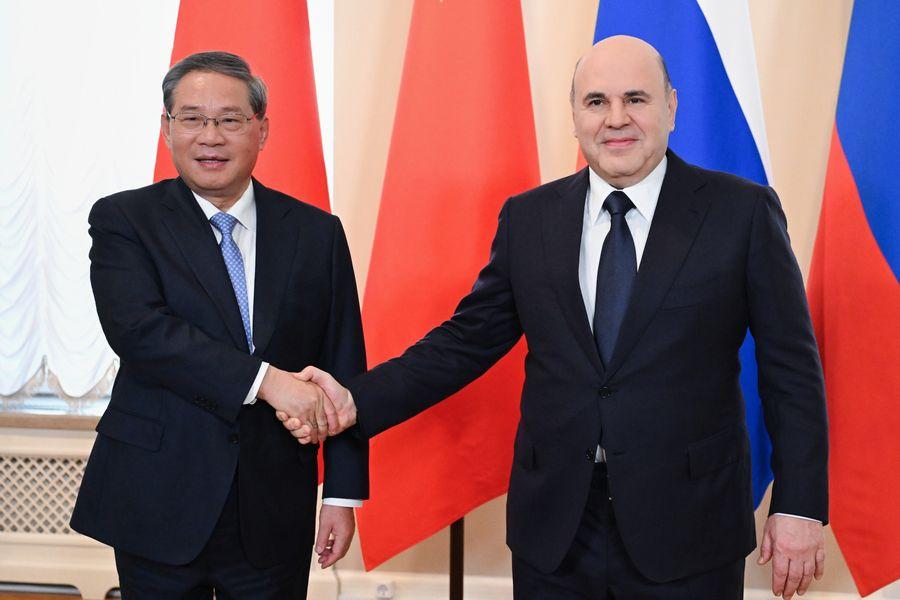
Russian Prime Minister Mikhail Mishustin, right, and Chinese Premier Li Qiang pose for a photo during their meeting at the Boris Yeltsin Presidential Library in St. Petersburg, Russia, Wednesday, Oct. 21, 2026. (Alexander Miridonov, Sputnik, Government Pool Photo via AP)
What the 2026 Midterm Results Mean for U.S. Strategic Competition with Rivals
Last updated 06:59 AM EST • Read time: 11m
Join the Conversation
0The U.S. midterm elections on November 3, 2026, produced a Red Wipeout. The Democratic Party not only seized a decisive control of both chambers of the U.S. Congress—the best results they have had since 2008—but also achieved stunning victories in traditionally red-states where Donald Trump also won by double-digit margins in 2024 like Texas, South Carolina, Mississippi, Ohio, Iowa, and Kansas.
On top of a seismic shift to the Democrats from a coalition of electorates who strongly supported Trump and the Republicans in 2024, the voters voiced a stinging repudiation of the drawn-out war in Iran and the consequential affordability crisis. The results may potentially shatter the president’s political grip over Washington and limit his seemingly unrestrained power in policies like trade, immigration, and the economy.
However, what do the midterms mean for U.S. strategic competition with its top geopolitical nemeses like China, Russia, Iran, and North Korea? Conventional wisdom offers that U.S. foreign policy decisions remain the sole prerogatives of the American president. Regardless of changes in the domestic political landscape, national security interest will continue to be the main guidepost for the White House in dealing with allies and adversaries abroad. Analysts have predicted that Trump would persist with further military escalation against Iran, while seeking greater accommodation with China, Russia, and North Korea to lock in lasting changes for a unilateralist international order.
It is reasonable to see these trends persisting given Trump’s belief in strong executive authority and tendency to double down under pressure. But changes coming to Washington in the wake of the U.S. midterm elections, including the imperative demands to refocus on the threats posed by America’s foreign adversaries, will see much of Washington’s grand strategy shifted back toward principled strategic competition over the next two years irrespective of the president’s wishes.
In contrast to Trump’s midterm defeat in 2018, when the Democrats only captured a thin majority in the House of Representatives whereas the GOP retained their control of the Senate, the Democrats’ flip this time is much more resounding. The popular mandate for Congress to clearly reassert their control over the president’s impetuous policies is unequivocal. The GOP’s electoral rout, one of the worst midterm defeats since Watergate, also appears likely to serve as a catalyst for a reshuffling within the administration that would alter its conduct of foreign affairs including a potential ouster of Secretary of Defense Pete Hegseth. Hegseth’s tenure at the Pentagon, defined by conflict with traditional U.S. allies and Congress, has offered the president both freedom and encouragement to pursue foreign policy objectives using military means, even when these missions were ill defined and disconnected from broader national interests. Any future replacement to lead the DOD is likely to be a more conventional candidate that is deferential to congressional oversight and accountability.
None of these factors suggest the president would easily concede to his Democratic opponents, whose majorities in Congress are not veto and filibuster-proof. Nevertheless, there is a robust bipartisan consensus that the United States needs to wind down its war with Iran and chart a less conciliatory approach to the PRC, Russia, and North Korea, that defends core American interests and preserves elements of the traditional American global leadership. This shift in national mood, combined with a demand for new leadership and greater institutional accountability suggests the final two years of the Trump presidency may feature a foreign policy that more closely resembles that of his first term, with more disciplined policies reined in by sensible security hawks and congressional scrutiny.
Trump’s first term National Security Strategy paper (published in December 2017) identified China and Russia as “revisionist powers” and both North Korea and Iran as “rogue states,” seeking to erode the U.S.-led rules-based international order. The NSS called for “strategic competition” using comprehensive elements of U.S. national power, beyond simply military capability, to tackle challenges posed by America’s major geostrategic rivals. The idea of strategic competition guided the initial Trump term and carried over into the Biden administration.
However, the framework appears to have been largely discarded in the past two years in favor of a mix of impulsive and frequently contradictory policy decisions that were entertained by political loyalists and a disengaged Congress. The agreement by Presidents Trump and Xi Jinping to build a new Sino-American relationship predicated on “constructive strategic stability” appeared to replace strategic competition with a 19th century-style great power concert and spheres of influence arrangement between China, Russia, and the U.S.
The shortcomings of the second Trump administration’s ad hoc approach to great power rivalry have been most obvious with the war with Iran. From the very beginning, Operation Epic Fury, launched in February 2026, has been a military action in search of a strategy. And as a result none of the initial aims of the war, which have ranged from regime change to denuclearization, have been achieved. Nine months later, the Iranian regime, while substantially weakened, is more militant and hardline and capable of holding on to power through force for the foreseeable future. The Iranian military, despite significant losses, still possesses more than enough ballistic missiles and drones to threaten regional maritime shipping through the Strait of Hormuz and hold the critical infrastructure of U.S. regional allies at risk. And ultimately the regime still maintains its stockpiles of highly enriched uranium as well as the domestic expertise to rebuild its battered nuclear program in more fortified facilities such as Pickaxe Mountain.
Renewed bombing is unlikely to meaningfully alter these dynamics, but that does not mean the U.S. is without options for addressing these challenges. Progress restoring the oil and gas exports of Gulf Cooperation Council states and curbing those of Iran suggests that over time the strategic balance could shift again and the regime could be ground down. However, to be successful the ongoing regional security operation and economic pressure campaign will need to be maintained over the course of many months, or even years, and will ultimately require a more comprehensive strategy for attracting and sustaining the support of U.S. allies and weakening that of Iran’s backers.
Achieving a satisfactory end to the war with Iran will necessitate a new approach to its chief great power ally Russia. Trump’s conciliatory approach to Russian President Vladimir Putin has done nothing to dissuade the Kremlin from backstopping the Iranian regime or supporting its war effort. Continued accommodation through warm diplomatic gestures, sanctions waivers, hints of renewed economic cooperation, and pressure on Ukraine will provide diminishing marginal returns as it feeds the Kremlin’s appetite for further concessions and Ukraine moves to become less dependent on U.S. security assistance. The midterm elections are likely to serve as a key impetus for a return to strategic competition with Russia that is needed to both deter it from backing Iran and bring an end to its war against Ukraine. The bipartisan Congressional consensus on the importance of defending Ukraine and pressuring Russia, has repeatedly pushed back on attempts by the administration to coerce Kyiv into an unfavorable settlement to the war. The incoming Congress will only strengthen this consensus, and will impose growing constraints on the President’s dealings with the Kremlin regardless of his wishes. An early indication of how these constraints will play out can be seen in the abrupt turnabout of Russian tankers bound for the U.S. as part of the president’s diesel waiver policy out of fear of threatened Congressional investigations.
Beyond Russia, the new Congress is also likely to shift U.S. policy toward China back to the more rivalrous approach carried out by the first Trump and Biden years. Though two more Trump-Xi meetings are expected at the APEC and G-20 summits in November and December, respectively, the new Democratic-controlled Congress in 2027 is likely to resume a push for a series of Taiwan-friendly initiatives, including pressuring the Trump administration to proceed with the suspended $14 billion arms package and passing legislation that codifies President Reagan’s 1982 Six Assurances to Taiwan to formalize America’s enduring support for the island democracy’s self-defense and political autonomy. The congressional pro-Taiwan stances have in the past put the U.S. executive branch in a contentious spot with Beijing, as shown by the House Speaker Nancy Pelosi's trip to Taiwan in 2022. Trump may still prioritize amicable relations with Xi, but his hands would be tied by a Congress more resolved to bind his transactional proclivities toward America’s greatest geopolitical competitor.
In addition, there could also be tighter scrutiny and restrictions on AI and closing the loopholes of exporting cutting-edge Nvidia AI chips to China. More significantly, Beijing has been instrumental in sustaining, albeit implicitly, the economic, technological and military lifelines for both Russia’s war with Ukraine and Iran’s war with the United States. Trump has downplayed these incidents to maintain cordial relations with Xi. But now he may have lesser reservations about China, especially that Beijing hasn’t reciprocated his conciliatory moves and continued to slow-walk on their earlier pledges to lift restrictions on critical rare earth minerals exports to the U.S. and purchase American agricultural products.
The implications of long-term superpower rivalry with China, and acute global upheaval posed by Iran and Russia, have largely overshadowed North Korea as a major U.S. adversary in recent years but it too will need to be contended with in a systematic way in the coming years. Bolstered by growing economic support from both Russia and China, North Korea’s economy is experiencing its third consecutive year of economic growth exceeding three percent. It is translating that economic dividend into a continued expansion of its nuclear program and modernization of its armed forces. Pyongyang’s new military might, partly a product of Russian technical assistance, is being put to use in increasingly provocative behaviors directed against South Korea and Japan. Trump’s attempts to deal with an increasingly assertive Kim Jong-un through both neglect and an implied recognition of its nuclear power status have also not yielded any results. The administration already appears to have reversed course on reductions in military exercises with South Korea and enhanced congressional powers may press the administration for a more realist long-term approach to the DPRK. Greater predictability in policy will help foster greater U.S., South Korean, and Japanese maritime security cooperation that has resulted from organic demand for greater joint shipbuilding projects and been catalyzed by North Korean threats.
The so-called “axis of upheaval” of China, Russia, DPRK and Iran is likely to strengthen their ties while acting more aggressively on various fronts. Moscow may resist any diplomatic compromise with Zelenskyy to end the Russia-Ukraine war as dragging out the conflict allows Putin to consolidate his territorial gains; Beijing may persist in normalizing its gray-zone and cognitive warfare campaigns on Taiwan to wear down the island’s confidence and sow internal divisions; Tehran may prolong the tensions across the Strait of Hormuz, despite economic pains, to gain greater negotiating leverage over the Trump White House and the Middle East neighbors; and Pyongyang may continue with its nuclear and ballistic missile tests to further destabilize the strategic interests of the United States, Japan, and South Korea in the region.
The demands imposed by increasingly close ties between Russia, China, Iran, and North Korea will also play a key role in necessitating a return to disciplined strategic competition. Growing cooperation between all four countries organized explicitly around opposition to the U.S., has ultimately rendered Trump's preferred policy of unilateral dealmaking ineffectual. To be sure, Trump’s unorthodoxy on foreign policy could stymie our expectations. But these strategic challenges could further narrow Trump’s maneuvering space and prompt the administration and the new Congress to take up responses more in line with historic American national security interests.
Dean Chen is professor of political science at Ramapo College of New Jersey. He is a former Fulbrignt U.S. Scholar and the author of U.S.-China Rivalry and Taiwan’s Mainland Policy: Security, Nationalism, and the 1992 Consensus (Palgrave Macmillan, 2017) and U.S.-China-Taiwan in the Age of Trump and Biden: Towards a Nationalist Strategy (Routledge, 2022).
Dan White is an independent foreign policy analyst based in the New York Metro Area. Dan is a former member of The Wilson Center and The Kennan Institute, a former Army Officer, and a veteran of the War in Afghanistan. Dan maintains a newsletter, OPFOR Journal, which analyzes strategic competitions with Russia, China, Iran, and North Korea.
After the Midterms, the Right Strategy Against Iran
By Lance Gordon • RealClearDefense
The Color Revolution Came Home
By Emzari Gelashvili • RealClearDefense
When Access Becomes the Fight
By Richard Byno • RealClearDefense
What the 2026 Midterm Results Mean for U.S. Strategic Competition with Rivals
By Dean Chen • RealClearDefense
Measurable by Design: Project Meridian
By Alex Willard • RealClearDefense
New USAF Force Design Bets on Technology
By Stephen Losey, Air & Space Forces
DoD Pushes $450M in Loans To Bolster U.S. Space Companies
By Hitchens, BrDefense
The U.S. Navy Needs a New Battlecruiser. Will It Get One?
By Sadler & Ouellette, NatInt
U.S. Army Rehearses Rapid HIMARS Rocket Launcher Deployment
By Global Defense N.
Coding Commander's Intent into Unmanned Systems
By Thomas Baumstark, Proceedings