
How Germany Became Russia's Chief Enabler
Published Oct. 19, 2022 • Read time: 4m
United States President Ronald Reagan, United Kingdom Prime Minister Margaret Thatcher, Pope John Paul II, and Soviet Union President Mikhail Gorbachev are typically the four people who most praise for ending the Cold War. After them, many would say German Chancellor Helmut Kohl deserves credit. His navigation in reunifying Germany played a pivotal role in freeing millions of Europeans from communism. When Reagan delivered his “tear down this wall” line, Kohl was sitting on stage right behind him. Given Germany’s history in the Cold War, most would think that the nation would follow the lead of many Eastern European nations and counter Russia. Unfortunately, since the Cold War, Germany has repeatedly coddled and emboldened Russia.
Despite Kohl’s leadership in the Cold War, Germany’s empowerment of Russia started with him. This likely did not come from malfeasance on Kohl’s part. Kohl was the chancellor of Germany throughout the dissolution of the Soviet Union. Gorbachev’s successor, Boris Yeltsin, tried a series of reforms to try to make a post-Soviet Russia thrive. A separate piece could go through whether Yeltsin was a good leader, but regardless, Yeltsin and Kohl developed a close relationship. Kohl likely felt a paternal need to help Russia thrive. It also made sense for the world at the time, if Russia completely fell apart, it could have created global problems. Kohl’s support kept Russia afloat.
Kohl’s controversy arose after he left office. When Russia annexed Crimea in 2014, Kohl criticized Western hostilities towards Russia, saying, “[t]here's been a lack of sensitivity in dealing with our Russian neighbor, especially President Putin.” Given the West’s lackluster response to the annexation, it is hard to imagine what more Kohl wanted. In the aftermath of the annexation, Putin spoke with Kohl several times to try to win Germany’s support.
Moscow Considers Deploying Nuclear Weapons in Space
Russian Missiles Land in Poland As Europe Held Military Drills Nearby
The Summit as Mirror
Moscow Expresses Warnings on Kaliningrad Defense Against NATO
Kohl’s successor, Gerhard Schröder, proved even more destructive. Schröder was chancellor when Yeltsin controversially “appointed” Putin “acting president.” Despite these warning signs, Schröder pursued the illogical goal of ending nuclear power in Germany, and then offsetted this energy loss with a “$5.7 billion pipeline” from Russia. In 2004, Putin started trying to influence Ukraine’s elections. Schröder undermined the European Union’s criticism of Putin’s actions by claiming the elections had no flaws and that Putin believed in democracy.
Right after Schröder left office in 2005, his “illogical” decisions on energy started to make sense…for him. Schröder took a position with the gas company, Gazprom, from the deal that he set up with Russia. The position reportedly paid him as much as $1 million a year. Close to 20 years later, Schröder remains close with Putin and Gazprom. Schröder refuses to apologize for his relationships, and recently had a friendly visit with Putin, amidst Russia’s atrocities.
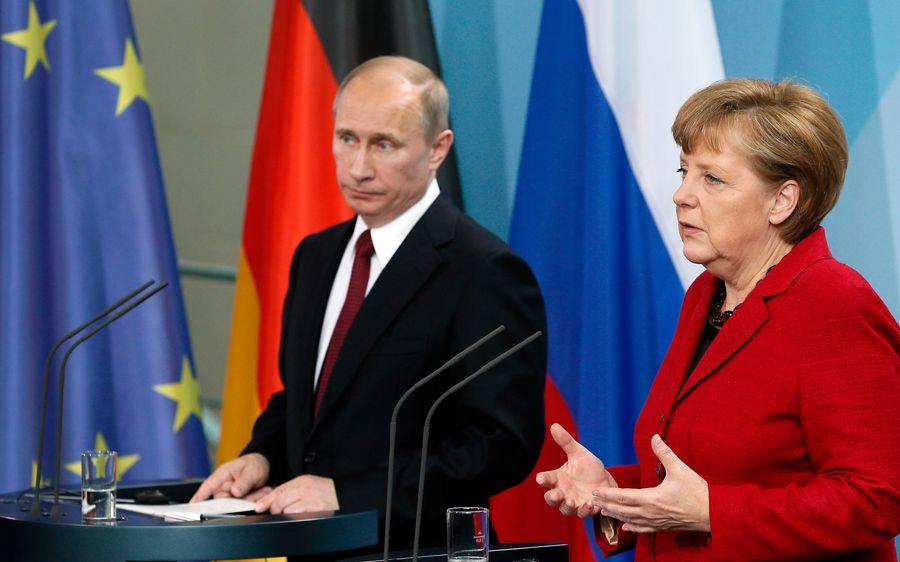
Angela Merkel drove Schröder from power. Merkel grew up in Eastern Germany, so many hoped she would understand the importance of freedom. Merkel initially showed promise with Russia when she condemned Putin’s annexation of Crimea and threatened sanctions. Kohl and Schröder criticized her for this response. Despite this acknowledgement of Putin as a threat, Merkel pursued a second energy deal for Germany with Russia. The United States and many experts objected to this deal, but Merkel ignored them. In 2018, Heiko Maas, a key diplomat under Merkel, laughed at then-US President Trump when Trump said in a speech at the UN, that Germany could end up reliant on Russia for energy. Today, Maas has not commented on the matter, and Merkel will not admit she was wrong.
Merkel’s successor, Olaf Scholz, has been in office for less than a year. Many have criticized Scholz for doing the bare minimum on Russia and even blocking proactive measures, while leaders from other countries, like Finland and Estonia, take the lead. Scholz’s administrations recently faced embarrassment when they had to fire the head of their cybersecurity, Arne Schönbohm, amid media reports of Schönbohm’s ties to Russian intelligence. Schönbohm received the position during Merkel’s administration.
All post-Cold War German chancellors have a stain on their record for enabling Russia. But why? All the chancellors had their own agendas, but all have purported to do their actions for national interest. Now all of Europe is in a terrible situation, including Germany. Additionally, the German public has seemingly asked for this. In 2014, polls showed Germans did not want Merkel to do more on Russia after Putin’s actions in Ukraine. Recent polls show Germans do support action against Russia, but there is some question of how long that will last.
Germans are never afraid to harshly rebuke the United States and its policies. But given their own failures, the government and its people need to do more self-reflection. Until then, the world should look elsewhere for leadership in Europe.
Todd Carney is an international lawyer and a frequent writer on international issues. He earned his juris doctorate from Harvard Law School.
Ending the Conflict with Iran
By Anthony Cowden • RealClearDefense
Going After the Cyprus Money Laundering Hub
By Lise Korson • RealClearDefense
Don’t Bet Against CMMC
By Thomas Graham • RealClearDefense
When Losing Control of AI Becomes a Weapon
By Yunus Emre Tumen • RealClearDefense
International Allied Reliability of States: Criteria and Evolution
By Sergey E. Ivashchenko • RealClearDefense
Coast Guard’s Updated Force Design Plan Includes Maven Smart System
By DS
F-22 Raptor Commands MQ-20 Avenger From the Cockpit
By K. Osborn, Warrior M.
ULA’s Vulcan Rocket Is Grounded for Third Time
By I. Klotz, V. Machi, Aviation Week
Tragedy That Convinced the Coast Guard It Needed Rescue Swimmers
By WATM
USAF Contracts Final KC-46 Lot of Original Production Deal
By Satam, The Aviationist