
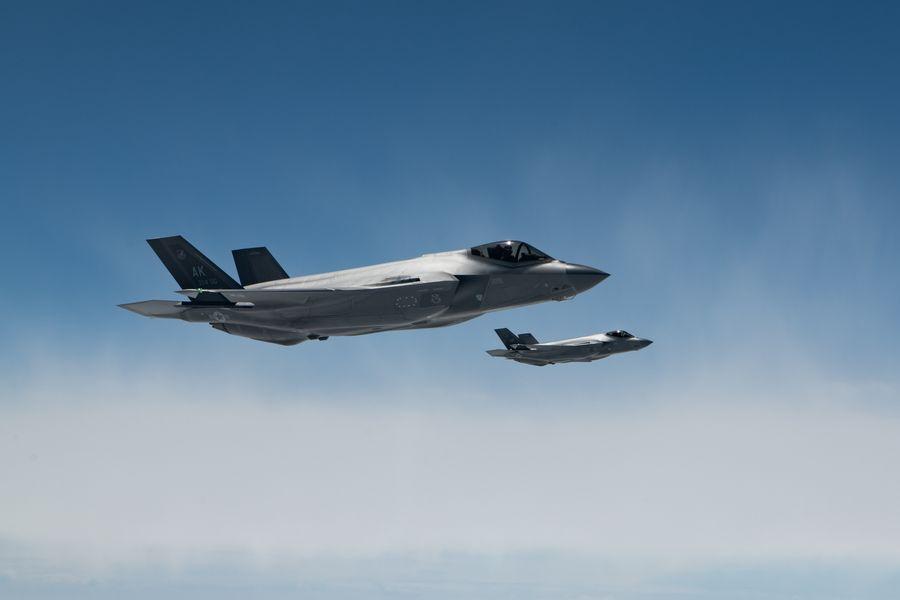
The Right Fighter Mix: The Commander's Perspective
Published May 8, 2023 • Read time: 5m
Fourth-generation aircraft have given the U.S. Air Force a competitive edge against adversaries for decades. As a former Air Force fighter pilot, I spent over 2500 hours in a F-15 cockpit.
Today, older F-15s have reached the end of their useful lives. Meanwhile, a new version of the fighter, the F-15EX, has arrived on the scene.
This raises important considerations for Congress: What is the nature of the modern threat, what mix of aircraft gives us the most capability against that threat, and what will maximize value to the taxpayer?
The Modern Threat
The entire globe is a potential theater for the U.S. Air Force, but two regions in particular occupy most of war planners’ thoughts: the Indo-Pacific, particularly Taiwan and the South China Sea, and NATO’s eastern flank along the border with Russia.
Our adversaries have turned these areas into vast zones bristling with advanced anti-aircraft missile batteries, in particular the S-400. These zones constitute a highly lethal environment for fourth-generation aircraft such as the F-15EX.
The effectiveness of modern anti-aircraft systems against fourth-generation aircraft is why we don’t see the Ukrainians or the Russians (whose air forces are almost entirely fourth-generation) gaining air superiority. Indeed, if one side were to gain air superiority, we might be closer to the war’s conclusion, rather than continuing to slog through attritional combat.
The People’s Republic of China, meanwhile, now has the second-largest military budget in the world, increasing 7.2 percent (but likely more). The PRC also has the largest air force in the Indo-Pacific, and it is accelerating fifth-generation aircraft procurement. Today, the fifth-generation J-20 Mighty Dragon totals over 50 jets in its fleet, with many more to come.
The combination of advanced anti-aircraft systems and fifth generation fighters underscores the importance of survivability for the air force, especially as the PRC accelerates its build-up.
That’s why our allies and partners who face modern peer adversaries are not clamoring to buy legacy F-15EXs, or any other aircraft that is a generation behind. Indeed, there is only one aircraft they are lining up to buy: the F-35.
Finland, Switzerland, Canada, and Germany have all ordered F-35s in the last year or so. Singapore just ordered more. The Czechs and Greeks are lining up, too. This is not a coincidence. It’s because fifth-generation stealth capabilities are simply the price of admission to the fight.
The Capabilities America Needs
What is so great about fifth-generation aircraft? There are hundreds of advantages an aircraft like the F-35 holds over last-generation aircraft, but a few stand out: stealth, sensors, survivability, and connectivity.
First, stealth. Low-observability allows penetration of airspace that would be deadly to fourth-generation fighters. Stealth allows a pilot to deliver its payload and return home safely. In a so-called “permissive environment” where stealth is not needed, an F-35 can convert to non-stealth, or “beast mode” and carry even more weapons.
Second, sensors. The F-35 gives pilots unrivaled situational awareness. “Sensor fusion” is the term used where the aircraft takes all the information that the plane can see with its advanced sensors, and it puts them all together, or fuses them, in a way that presents a picture of the battlespace to the pilot. With that, the F-35 can not only track and target, but also jam, spoof, and disrupt in a way inconceivable before, giving pilots an advantage against any adversary and enabling them to execute their mission and come home safely.
Finally, connectivity. The F-35 not only draws on its own sensors. It draws on other friendly forces in the battlespace, from any domain – land, sea, air, space – and can use that information to provide targeting information for itself or for another friendly weapons platform. Joint all-domain command and control (JADC2) is all about closing the kill chain using connectivity among services and across all domains, and the F-35 is the linchpin. If you can identify and kill your target before your opponent, you win.
I have read some commentary justifying the F-15EX as a “bomb truck.” You know what’s a bomb truck? A bomber. America has bombers with massive payloads and ranges that can operate in permissive and non-permissive environments.
Value to the Taxpayer
The same folks who have been saying the F-15EX has a role as a bomb truck often also play fast and loose with the numbers. Here are the facts: The true fly-away cost of an F-15EX is about $31 million more than the F-35A, according to the Heritage Foundation, and the F-35 is 10 percent cheaper to operate.
But what about sustainment? There is simply no way that a two-engine fighter, the F-15EX, is going to be simpler and cheaper to sustain and keep ready than a single-engine combat aircraft, the F-35.
Bottom line, when it comes to cost, the F-15EX costs materially more per plane to buy - and to fly. And yet, when it comes to capability, there is no real comparison. So, why are we paying more to get less?
The reality is that the right fighter mix is not a mix at all. It’s time to go all-in on fifth-generation capability – as much as we can get, as fast as we can get it.
There’s no time to lose. If you are still not convinced by my rationale, please ask the fighter pilots who will fly into the teeth of these heavily defended areas what would they prefer, 4th or 5th Gen? I know the answer and I bet you do too!
William R. Looney III served 40 years in the United States Air Force and retired as a four-star general. During his career, he commanded an F-15 squadron, 2 F-15 fighter wings, and an Air Expeditionary Force (AEF) in Southwest Asia, in addition to numerous other command tours. He is also currently a consultant for a number of defense companies, including Lockheed Martin.
After the Midterms, the Right Strategy Against Iran
By Lance Gordon • RealClearDefense
The Color Revolution Came Home
By Emzari Gelashvili • RealClearDefense
When Access Becomes the Fight
By Richard Byno • RealClearDefense
What the 2026 Midterm Results Mean for U.S. Strategic Competition with Rivals
By Dean Chen • RealClearDefense
Measurable by Design: Project Meridian
By Alex Willard • RealClearDefense
New USAF Force Design Bets on Technology
By Stephen Losey, Air & Space Forces
DoD Pushes $450M in Loans To Bolster U.S. Space Companies
By Hitchens, BrDefense
The U.S. Navy Needs a New Battlecruiser. Will It Get One?
By Sadler & Ouellette, NatInt
U.S. Army Rehearses Rapid HIMARS Rocket Launcher Deployment
By Global Defense N.
Coding Commander's Intent into Unmanned Systems
By Thomas Baumstark, Proceedings