
America and the Idea of Eurasia
Last updated 01:00 AM EDT • Read time: 19m
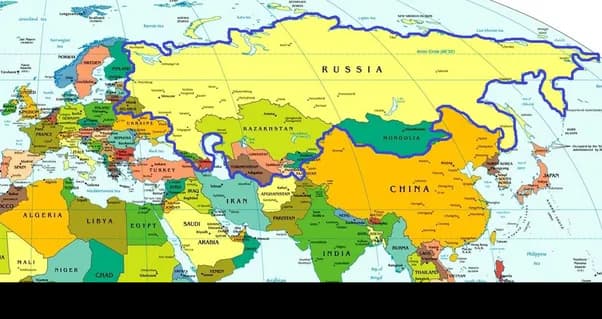
Europe, the Middle East, and Asia are inextricably linked. Any American attempt to separate them strategically will fail. This is because the strategic whole of the current competition is Eurasia taken in toto, not any individual region. This is the culmination of some 200 years of strategic development, and some 500 years of political development.
The reality of Eurasian competition illuminates the stakes of the Ukraine War, makes clear the relevance of an increasingly unstable nuclear balance between the U.S. and its adversaries, and should accelerate American and allied preparation for a long-term strategic competition with the potential to descend into war.
The Eurasian Problem
Ukraine and Taiwan physically bookend the expansion of the Eurasian revisionist coalition. Their fates are linked not precisely because of concrete deterrence linkages between the two, but because the revisionist coalition’s objective is the destruction of the entire American-backed Eurasian security system. Moreover, because the struggle is Eurasian, the U.S. cannot ignore one Eurasian region to concentrate on another, nor can it accept a significant degree of strategic daylight between itself and its partners.
Grasping the evolution of the Eurasian question requires some brief historical reflection. I will use this reflection as our base to understand more precisely where Ukraine and Taiwan fit into the Eurasian problem.
Eurasia emerged as a result of the developing 16th to 19th century trade system that is typically termed “globalization”. The European powers expanded beyond Europe, competing over the Americas to be sure, but the primary markets and populations that they targeted were on the Eurasian landmass. The British Empire would have disintegrated if the Americas, rather than Eurasia, had been the focal point of economic interaction. But it traded the Thirteen Colonies for the Indian Subcontinent and leveraged its control over major Eurasian chokepoints to expand its wealth.
American policy has always held Eurasia in the background. That is, from its independence, the objective of American policy has been to ensure the United States remains strategically autonomous from Eurasia, that the Eurasian powers cannot dominate the United States and determine its political orientation or disrupt its way of life.
As George Washington noted, the United States is difficult, if not impossible, to invade. It is simply too far and too big – Washington could never have known how vast the American Republic would become in just a century – to be conquered in full. But the United States, as a vast and varied power, has interests that necessarily diverge.
This creates an obvious vulnerability, since rather than directly taking over American territory, an adversary can tempt parts of the United States to detach themselves from the broader polity for the sake of self-interest. Inducements to treason are far easier to employ than full-scale assaults, as for example the Russian Federation belatedly realised during its assault on Ukraine.
A Eurasian power can manipulate the American Republic because American prosperity depends on access to Eurasia, whose landmass holds the majority of people and resources. The United States may be wealthy and resource-rich, but the Western hemisphere is not wealthy enough to enable a completely autarkic existence. Hence the danger of Eurasian power-projection.
Until the late 19th century, the U.S. had no need to consider the concrete Eurasian balance of power. European competition was synonymous with Eurasian competition. The European powers were so grossly technologically, organizationally, and bureaucratically advanced compared to their non-European counterparts that they dominated every continent. But as Bismarck put it, Germany’s map of Africa was in Europe.
The broader questions of Eurasian competition were fundamentally questions of European competition, as there were no non-European challengers that could disrupt the European powers’ positions throughout Eurasia. Until 1870, no European power could really crack the broader system and threaten to dominate Europe or Eurasia because Britain controlled the European littorals, and by extension the Eurasian littorals. The U.S.’ strategic task was therefore to deny Eurasian powers opportunities to intervene in American affairs. Hence the American Republic’s expansion westward, its decisive victory over Mexico, and even the prosecution of its Civil War all girded a position sufficiently powerful to deter Eurasian meddling.
The situation began to change in the late 19th century when the Eurasian balance shifted. Three changes occurred near-simultaneously. Within Europe, a united Germany transformed the continental balance, turning a region previously populated by militarily competent but economically limited and politically fractious actors into a coherent strategic actor with immense economic and military structural strength.
Beyond Europe the U.S. and Japan emerged as major industrial and military powers, building productive systems and fleets that could rival those of the Europeans. The British were the main loser of structural shifts in power.
London proved chronically unable to grasp the real trade-offs it faced, between regional prioritization and the erosion of its Eurasian position and thereby its empire, or a bid for primacy and greater domestic strain but a higher chance of sustaining its broader system. In the event, London adjusted belatedly towards Europe, cutting deals explicitly with Japan and tacitly with the U.S..
The major strategic shift from an American perspective was the inability of Eurasian powers to police their own affairs. After the 1890s, the European empires were primed for a confrontation, perhaps not a continental-wide conflict but a conflict, nonetheless. It was entirely unclear what power or coalition was most likely to be dominant, hence the military balance became extremely close and fluid, and each actor planned for an aggressive war. The system was out of kilter because there was no clear hegemon, nor was there a coherent alliance system to tie all the powers together.
The Great War demonstrated the delicate balance in Europe. Absent American intervention, the Central Powers likely would have won. Germany could not land a decisive punch against the British Grand Fleet, but its submarine campaign came close to strangling the UK.
Meanwhile, after knocking Russia out of the fight, Germany successfully concentrated in the West and launched a major offensive, one that would have had a much greater chance of success without American materiel pouring into Europe and American destroyers protecting British sea lines of communication and supply.
Yet the sheer degree of devastation the Great War inflicted on the European continent, along with the time it took Germany to reach near-victory, indicate the marginal character of the European balance.
The combination of the Eurasian-ization of strategic competition and a lack of an automatic European-Eurasian balance necessitated long-term U.S. participation in Eurasian politics. This was and remains an uncomfortable proposition for the American public, political class, and strategic community. It is also eminently necessary to sustain the American Republic’s way of life, which requires a stable Eurasian commercial system. If this is to exist, the U.S. must deny an aspirant to Eurasian hegemony the opportunity to dominate the landmass.
This points to the fundamental linkages between Eurasia’s three regions – Europe, the Middle East, and Asia. All three are relevant because they are part of a unified geostrategic whole, not disaggregated and disconnected with completely compartmentalised strategic dynamics.
The question of credibility is transcendent. America’s position in Eurasia requires the ability to transfer forces and supplies from one littoral area to another, which thereby keeps Eurasian commerce moving. The domination of the Eurasian region by one hostile power would disrupt this transfer of forces, materiel, and commercial goods, thereby undermining the American political-economic system, intensifying the divisions between parts of the U.S. with radically distinct modes of production, and ultimately allowing an aspiring Eurasian hegemon to construct a coherent coalition and dominate the landmass. A balance of power approach will not do: the U.S. will not be affluent enough to sustain a balance without trans-Eurasian economic stability.
This explains the creation of NATO, the U.S.’ security structure in Asia, and the American attempted maintenance of the British security position in the Middle East. All three are interlocking in strategic purpose, even if their shape depends on specific regional political factors.
Why did the U.S. win the Cold War? Because of its ability to leverage Eurasian power against the Soviet Union. The Sino-American entente alongside the U.S. naval and military buildup transformed the USSR’s massive territory into a strategic vulnerability, as it meant the Soviets were vexed from multiple angles and unable to mass forces in Europe.
After 1991 Eurasia did not simply vanish. Rather, the U.S. strategic community and policy class, unable to recognize the enduring character of the Eurasian problem, prematurely drew down American forces and commitments in Eurasia, while maintaining the notional political structures needed for a Eurasian surge without actually developing them.
Ukraine and Taiwan
Ukraine and Taiwan lie at each end of Eurasia’s contested rimland and littorals. Their fates must be considered together. Not, however, because of political linkages per se, but because of the military-strategic need to hold both of Eurasia’s halves with the Middle East as the connective tissue between each half.
Consider, first, the active front-line, Ukraine, and the state of the ground war. The next six months of combat will be critical for the timeline and scale of a future Eurasian conflict. At bottom, Russia is losing, but it makes a profound difference whether it loses slowly or rapidly.
Modern media fixates on the temporary, oblivious to longer-term actions. The contemporary day trader has a time-horizon of minutes, hours, or at best days. The contemporary media consumer has an attention span of a few minutes.
When combat in Ukraine slowed after the Kherson offensive – the fourth major offensive the Ukrainian Armed Forces mounted in 2022, all of which concluded in either major operational reversals or strategically significant defeats for Russia – analogies were drawn at once to the First World War’s static battlefields.
In a war of attrition, said the punditry, the Russian bear may bleed, but his sheer size and ferocity will carry him through. Under these circumstances, Russia could be expected to wait and grind Ukraine down with its punishing bombardment of civilian infrastructure, mild probing attacks along the line, and continued disruption of its grain exports. Ultimately, Ukraine’s offensive would peter out, considering the mixed and limited materiel Kyiv can field. Or so they said.
The reality is different. Russia was unwilling to pursue the above strategy, likely because the Kremlin legitimately feels weak and exposed, struggling with a Ukrainian military that is more competent than its own, and of increasingly high technological quality. Hence Russia launched an offensive over the winter that failed to accomplish a single operational objective. It appears that Ukraine, in just a brief operation in early May, undid three months of hard-fought Russian gains.
Ukraine has bided its time, partly because the West has restrained it through long-term waffling over critical equipment deliveries, but primarily out of prudence. The ground only froze in February, creating a six-week window for an offensive.
But by that point, Russia’s assault along the contact line, particularly against Bakhmut and Vuhledar, was in full swing. There was no need for a counterstrike when Russia was willing to grind up the only advantages it had over Ukraine, its raw manpower and materiel, in unsuccessful offensives against fixed positions that took ground meter by meter at prohibitive cost.
The Russian army is in a precarious position. It has only a limited number of units remaining that can execute a mobile defense. Ukraine will break through the first line of Russian fortifications, and perhaps the second, as Ukrainian heavy brigades drive towards Tokmak.
Containing the breakthrough and preventing Ukraine from driving the 30 kilometres south it needs to cut Russian logistics requires a mobile defense. But Russia’s airborne forces, its remaining competent maneuver units, are exhausted from months of assault operations and fireman activities defending hot sectors along the line. They must also defend a massive amount of territory maneuvering on exterior lines, since Ukraine can threaten Russia’s position in the east just as much as in the south.
Modern combat on a three-dimensional extended battlefield is a contest of systems, what the Pentagon terms battle networks. Combat is psychologically stressful, maneuver warfare particularly so. Russia, with its poorly organized and ill-coordinated forces, will face a crisis of command once the Ukrainian offensive accelerates, inducing friction in the Russian force, possibly leading to its collapse.
The war is unlikely to end even with a massively successful offensive. Crimea will be difficult for Russia to defend, but Ukraine will need anti-ship missiles aplenty to destroy the Russian Black Sea Fleet and break the supply route to the peninsula. Moreover, absent a contest at sea, Russia can simply seal off Kherson, Mykolaiv, and Odesa once again, hitting any ships moving to or from Ukraine’s critical southern ports. The U.S. and its allies must recognize that the only route to peace in Ukraine is through a stable balance of forces, which requires Ukrainian economic viability. Ukraine will be viable economically only if it retakes its southern ports and winnows down the Black Sea Fleet enough to make a blockade unattainable.
The upshot is that the Ukraine War will be “long,” insofar as the U.S. and its allies must maintain European security over the long haul. An inability to do so will embolden China.
China’s decision to assault Taiwan will stem from a careful appraisal of the military balance, even if that appraisal is incorrect. The same was true of Russia’s assault on Ukraine. It is now clear that Russia began planning for the invasion of Ukraine a solid month before Kabul fell, and weeks before the Taliban’s offensives broke the Afghan National Army’s will. American and allied inaction as Afghanistan collapsed surely encouraged the Kremlin, but its decision calculus stemmed from a much broader, more comprehensive assessment of the military balance.
Deterring China requires a firm grasp of the Indo-Pacific military balance.
We may still learn from Russia’s blunders. Three factors were likely critical in the Kremlin’s calculation.
First, years of subversion were meant to have hollowed out the Ukrainian state. Russia sought leverage throughout the Ukrainian security and strategic apparatus that could introduce friction into Ukraine’s decision-making and overload Kyiv’s ability to digest provocations and respond effectively.
Second, NATO’s slow reaction to the March 2021 force buildup created a brief window of military opportunity that Russia could exploit once hostilities commenced.
Third, the 2014 experience convinced the Kremlin that only limited sanctions would follow a successful invasion and annexation.
In the event, Russia’s critical error was its erroneous first assumption: although Russia did overload Ukraine cognitively in the south, there was enough remaining Ukrainian strategic vitality to withstand the invasion’s shock, organize a coherent defense, and prevent Russian forces from entering urban areas to stage a puppet regime.
Beijing’s calculus will be different than Moscow’s for geographic, military, and cultural reasons. But again, at bottom, China’s choice for or against war will stem from its perceived ability to win a war with the U.S. and its allies over Taiwan.
Part of U.S. deterrence equation is immediate denial. China must be convinced that, on the one hand, U.S. forces will be able meaningfully to influence the balance around Taiwan during a conflict’s opening days and, on the other, that Taiwanese forces can resist with U.S. help.
But initial denial is only part of the problem. China may believe that a long war suits its interests if the U.S. cannot sustain such a war. This is an issue partly of industrial capacity, but also of the free flow of forces from other parts of Eurasia to the Western Pacific, and of logistical capabilities to sustain a major war of months or years.
It is this broader set of considerations that points to the Eurasian strategic problem. If the United States does not have a favorable balance in Europe or the Middle East, other states will be incentivized to disrupt American forces or probe American and allied supply and communications lines. This will create a much broader war across the whole of Eurasia.
If America struggles to demonstrate that it can fight and win this war – in historical parlance, if the U.S. military cannot fight and win multiple regional contingencies – China has a strong incentive to test the United States, given that other Eurasian revisionists will exploit perceived American weakness beyond the Western Pacific and produce challenges that overwhelm the U.S. military.
To deter China, then, the U.S. must demonstrate its ability to fight a short and a long war. Winning a long war requires American forces structured for a broader Eurasian conflict, not just for a Western Pacific confrontation. Hence the necessity of a European and Middle Eastern security system that favors the United States and, in turn, the linkage between the fate of Taiwan and Ukraine.
A Eurasian-Wide War
The Middle East will be crucial in a Eurasian-wide war because the Middle East is the link between Western and Eastern Eurasia. The critical Suez-Indian Ocean maritime route lies within the Middle East’s maritime littorals, meaning a stable Middle Eastern balance is central to ensuring the stability of this route.
Iran is the most likely disruptor to a stable Middle Eastern balance. China’s strategy is Eurasian, as most recently demonstrated by its Iran-Saudi normalization agreement. China hopes to free up the Iranian military to challenge the U.S. directly – and likely by extension to attack Israel – without forcing Iran into a conflict with the Gulf States.
The self-styled Islamic Republic also places a unique role at higher ends of escalation. If Iran fulfils its nuclear aspirations, this combined with its strategic location and economic potential can make it a bona fide Eurasian power. A nuclear Iran will not have a massive arsenal. But when combined with a still-potent Russian nuclear deterrent and Chinese investments in nuclear arms – and North Korea’s nuclear weapons – the Eurasian revisionist coalition could gain strategic superiority over the United States, particularly if Chinese and Russian missile defenses are carefully employed.
The issue is extremely technically complex, and we remain several years away at least from missile defense systems fielded at scale enough to blunt a nuclear strike, due to the restrictions missile defense treaties have imposed on all powers’ anti-missile developments. But the reality is nevertheless that the U.S. faces a military competition that can extend to every rung of the escalation ladder, a competition the likes of which it has not faced since the Cold War, and arguably never faced during the Cold War given the specific technical nature of each belligerent’s strategic nuclear forces. A three-body problem has replaced the unitary threat to which we grew accustomed in the Cold War.
The struggle for Eurasian mastery in which China, Russia, and Iran are clearly engaged demands an equal American response that secures each Eurasian region, not just Asia. Winning the Ukraine War is but the first step to securing Europe for American interests. Fundamentally, the U.S. still seeks to dissuade European “strategic autonomy.”
A fully united Europe would have no guarantee of respecting U.S. interests. More likely, a Europe delusional enough to believe in its own independent power, but still divided over how to use that power and the political structures to govern it, will be too headstrong to understand the benefits of American security guarantees but too weak to deter hostile action.
Russia will return as a threat. It is only a question of how long its military reconstitution will take. A total Ukrainian victory, in which Russia is expelled at minimum from the territories it has occupied after 24 February 2022, would set Russia back the farthest by triggering the greatest shock in Moscow and undermining the Russian military. But Russia is now second only to Ukraine in its land combat experience.
Its military has a keen understanding of how unmanned aerial systems, distributed sensing, and rapid communications interface with short and long-range fires to bring victory in a major ground war. Much as it did after 1905 – in another humiliating defeat – Russia will rebuild, with the help of an increasingly fascistic political economy and an alliance with China and Iran.
Securing Europe requires creating a legitimately defensible European security structure, one that includes Ukraine within NATO. But anything less than a resounding Ukrainian victory will create the political space for Russia, with its European and American helpers, to delay Ukraine’s NATO accession and set the conditions for another war. Meanwhile, the longer the Russia threat persists, the harder Western European powers – at this point France foremost among them – will push for strategic autonomy.
In turn, a lasting peace requires an economically viable Ukraine. Its integration into the single market must be accelerated, particularly given the Eastern European states’ desire to exact uncompetitive concessions from Brussels. In the long-term, there must be a variety of financing vehicles to maintain Ukrainian economic sustainability, alongside a major energy reconstruction effort. Ukraine’s greatest advantage, beyond its food production, is its energy surplus. As the most nuclearized nation in Europe, Ukraine had a robust power grid with significant excess capacity. Ukrainian nuclear engineers and power specialists are highly experienced and could set up a more distributed grid, relying on new technologies like Small Modular Nuclear Reactors, better solar and wind plants, and a decentralised, modular grid less susceptible to Russian attack.
In the Middle East, meanwhile, Iran is almost certain to obtain nuclear weapons within the decade. Alongside the task of revitalizing U.S. nuclear forces to maintain long-term escalation control, the U.S. will also need to restrain additional nuclearization. Nuclear weapons are extremely expensive, and it is unlikely that the Gulf States, Turkey, Egypt, and other potential regional nuclear powers will be able to construct secure, effective nuclear command and control systems and second-strike structures. Nuclearization therefore brings with it the serious possibility of unintentional or ineffective nuclear use, which would be disastrous for the U.S.’ regional strategic position.
This necessitates a purposefully engaged United States, one that does far more than “balance” off-shore, and instead plays a constructive, forward-leaning regional role. This has never occurred. The U.S. has always sought to avoid a British-style deep engagement in the Middle East, to its long-term strategic detriment.
The most dangerous decade is the one the U.S. faces today. Deterrence is not impossible. But deterrence is hard. Success requires consistent strategic effort to shape the military and justify resources. It demands the self-understanding of our position as a free island dependent no less on access to the commerce than on the balance of power and idea of what kind of order will prevail in the Eurasian island.
Seth Cropsey is founder and president of Yorktown Institute. He served as a naval officer and as deputy Undersecretary of the Navy and is the author of Mayday and Seablindness.

Putin, Plague, and America’s Biodefense Gap
By Ryan Kane • RealClearDefense
From Hormuz to the South China Sea: Defending Freedom of Navigation in Contested Waters
By David F. Lasseter • RealClearDefense
Checklist for Modern Conflict Readiness
By Sergey E. Ivashchenko • RealClearDefense
AUTOWARCOM Is Heading for a Command-and-Control Collision
By Michael Carvelli • RealClearDefense
The Unfinished Reform
By Mark W. Castillon • RealClearDefense
From Hormuz to the South China Sea: Defending Freedom of Navigation in Contested Waters
By David F. Lasseter • RealClearDefense
National Guard Soldier Shot While Breaking Up Fight in Washington D.C.
By Military.com
‘No Marine Fights Alone’
By Gidget Fuentes, USNI News
Sea Services Weigh How to Embrace Autonomous, Attritable Tech
By Reeves, NatDef
Lockheed Delivers C-130J to Become Navy’s TACAMO Plane
By Stephen Losey, A&SF