
F-16s Will Bolster Ukraine's Fighting Force
Last updated 01:00 AM EDT • Read time: 5m
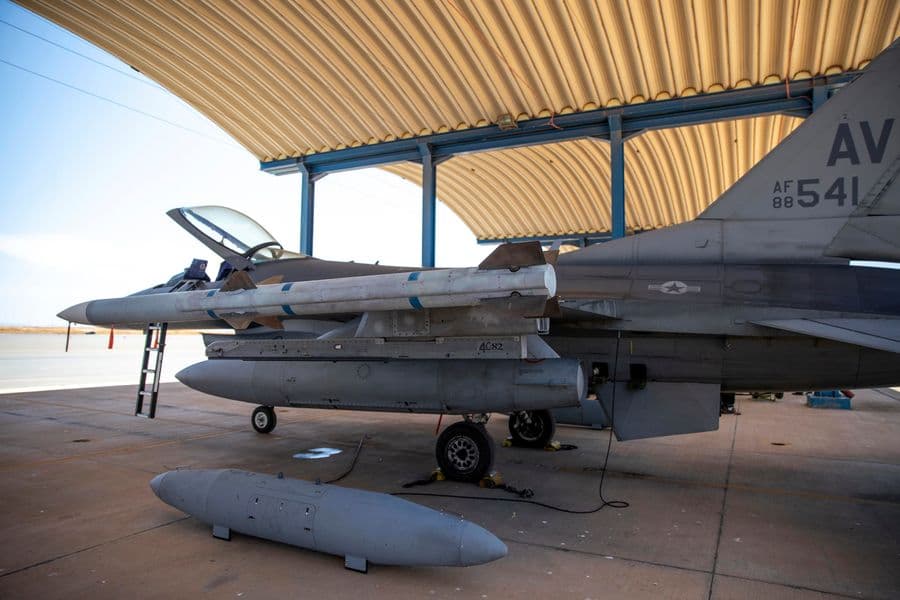
FILE - Weapons are loaded on a U.S. F-16 fighter jet as it prepares to take part in the African Lion military exercise, in Ben Guerir, Morocco, June 14, 2021. President Joe Biden on Friday, May 19, 2023, endorsed plans to train Ukrainian pilots on U.S.-made F-16 fighter jets, according to two people familiar with the matter, as he huddled with allies at the Group of Seven summit on how to bolster support for Kyiv against Russia's invasion. (AP Photo/Mosa'ab Elshamy, File)
F-16’s going to Ukraine could help it defend against Russian aerial assaults. But their greatest value may be to augment future Ukrainian counter-offensives aimed at retaking occupied land. This will require training and exercising, but Ukrainian forces are fully capable of mastering it.
On May 19, President Biden reportedly told the G7 that the U.S. would support a joint effort to train Ukrainian pilots on fourth generation aircraft, including F-16s. In recent weeks, the U.S. has signaled to European allies that it would approve their plans to export F-16s to Ukraine.
As recently as February Biden said Ukraine “doesn’t need F-16’s now.” The Department of Defense said providing F-16’s would be very costly and they were not one of Ukraine’s “top three priorities.” But Members of Congress from both parties have persisted in urging that Biden approve them.
The F-16 is a capable fourth-generation aircraft, but not a panacea. General James Hecker, commander of U.S. Air Forces in Europe, cautions, “It’s going to help a little… I don’t think it’s going to be a game changer. It’s not like a fifth-generation aircraft.” An example of the latter is the stealthy F-35, which some allies in Europe are acquiring to replace F-16’s.
F-16’s could soon be integrated into Ukrainian forces. A recent U.S. Air Force assessment predicted that only four months would be required to transition experienced pilots. But this would give them only initial mission qualification. U.S. instructor pilots favor a 17-week program. This would include three weeks on the use of advanced air-to-air missiles and another four weeks on air-to-ground munitions.
Switching from former Soviet aircraft could be challenging. Two Ukrainian pilots who have been flying F-16 simulators in the U.S. were observed reverting to flying Soviet-style formations. Rushing training could increase the risk that Ukrainian pilots might revert to old or risky habits in stressful situations.
F-16s could play important roles.
They could complement ground-based air defenses to protect Ukrainian cities and ground forces. Because of the earth’s curvature, F-16’s can see flying objects at longer distances than can ground-based radar. F-16 radars have greater capability than those on Ukraine’s Mig-29’s. In some cases, the weapons F-16’s use to down aerial targets may be less expensive than ground-based missiles.
Retired U.S. Air Force General Philip Breedlove, a former NATO Supreme Allied Commander and veteran F-16 pilot, has pointed out that air power is also crucial for combined arms operations. (Ground forces working together with aviation are also called joint operations.)
Combined arms operations function like an orchestra of firepower. Artillery softens enemy defenses at longer ranges. Tanks and infantry fighting vehicles punch through defenses. Infantry engage and destroy ground forces and help protect armor. Aviation provides fire support and mobility in both close and deep operations.
At times, the U.S. has learned the value of combined arms operations the hard way. The 1980 attempt to rescue U.S. diplomatic hostages in Iran failed in part because some military elements had too little prior experience working together. The 1986 Goldwater-Nichols Act nudged the Department of Defense to emphasize combined arms operations. They were a stunning success in the 1990-91 Gulf War.
Last January, Ukrainian troops began learning more about combined arms operations at the Grafenwoehr training area in Germany. While U.S. and NATO ground forces conduct such training along with aviation, Ukraine has lacked suitable fast combat jets. F-16’s may fill this gap better than Mig-29’s, in part because of incompatible electronics.
Combined arms operations require high-grade intelligence to find the enemy, timely coordination to direct forces, and trust that all elements are doing their job. More training of intelligence specialists will be important.
Effective combined arms operations require skilled pilots and ground spotters. Called joint terminal attacks controllers (JTACs), spotters designate targets for aircraft to attack. JTAC training may take five or more months.
However, based on current threats from Russian air defenses and fighter jets F-16s will find it challenging to support troops on the ground.
During this fighting season, Ukraine’s armed forces will likely conduct innovative combined arms operations, mostly involving ground forces. As F-16’s flow into Ukraine and personnel become trained, Ukraine’s combined arms fighting will come to resemble more sophisticated NATO-style operations. Even so, several years may pass before the contribution of F-16’s to combined arms operations becomes fully realized.
John Hoehn is an associate policy researcher at the nonprofit, nonpartisan RAND Corporation and former military analyst with the Congressional Research Service. William Courtney is an adjunct senior fellow at RAND and former U.S. ambassador to Kazakhstan and Georgia.

The Services Do Not Need a Four-Star Autonomous Warfare Command
By Steven Wills • RealClearDefense
Honor Them While There Is Still Time
By Jeffrey Rosales • RealClearDefense
From Siberia to Fairford: How Operation Spider’s Web Has Changed the Rules of Airpower
By Frank A. Rose • RealClearDefense
Faster Simulations, Better Defense Decisions
By Rut Lineswala • RealClearDefense
Will HASC Have an Oversight Subcommittee in the Next Congress?
By Christopher J. Bright • RealClearDefense

Hegseth Barred Trans Troops. Military Boards Are Rejecting Those Orders.
By NYT
Closing the Sea: Lessons from Ancient Mediterranean Blockades
By DeCasien, CIMSECFrom Siberia to Fairford: How Operation Spider’s Web Has Changed the Rules of Airpower
By Frank A. Rose • RealClearDefenseFaster Simulations, Better Defense Decisions
By Rut Lineswala • RealClearDefense
Bombers Could Have a Major Air-to-Air Combat Role
By Joseph Trevithick, The WarZone