
Still Flying to the Little Big Horn
Last updated 05:40 AM EST • Read time: 15m
In 1987, the United States and the Soviet Union signed the INF Treaty which banned all ground-launched ballistic and cruise missiles with ranges from 500-5,500-km. Thanks to the legacy of the INF Treaty (Russian violations and Chinese non-participation), both Russia and China have a large advantage in dual capable (nuclear and conventional warhead options) ground-launched medium- and intermediate-range missile systems. Because of the INF Treaty, the United States has substituted manned aircraft for these types of missiles. Hence, the size and characteristics of the U.S. fighter force is even more important. In addition to theater conventional strike, fighter aircraft carry the B-61 bomb, the only U.S. non-strategic or tactical nuclear weapon. The U.S. strategic bomber force is small and only the 20 B-2 bombers have a significant capability to penetrate advanced air defenses. Unfortunately, the U.S. fighter force is very old, growing smaller and in dire need of modernization.
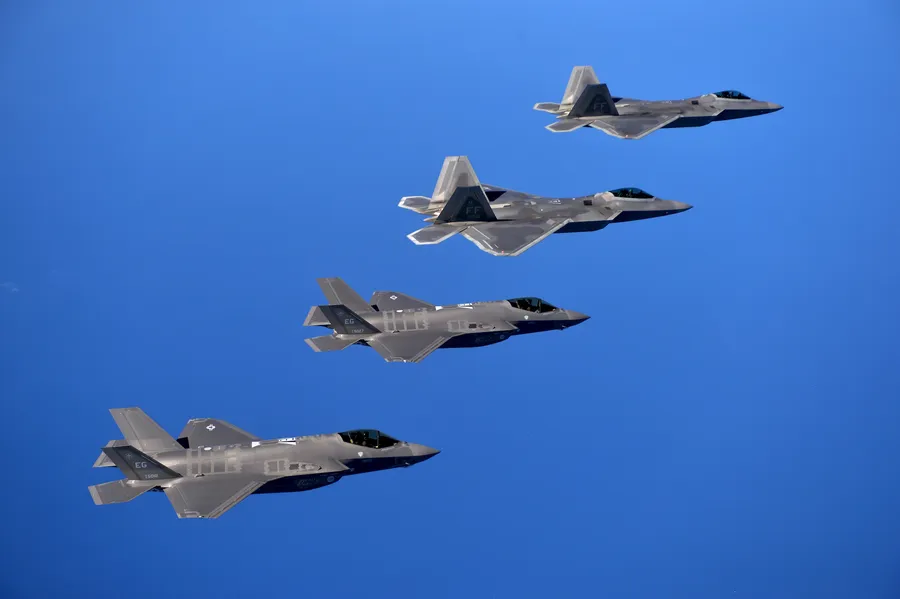
Starting in April 2023, Russia began to violate the agreed protocols on incidents between U.S. and Russian aircraft flying over Syria, which were designed to prevent dangerous confrontations. Russia began to harass American aircraft including the F-16 Block 50 (the United States’ most modern F-16) with dangerous activities including overflights of U.S. airbases by Russian Su-34 strike aircraft and dangerous intercepts involving the Russian Su-35S air dominance fighter aircraft. Except for a few Russian Su-57 “stealth” fighters, the Su-35S is the most advanced Russian fighter in its Air Force. Writing in Airforces Monthly, aviation journalist Barak Taghvaee noted that two days before the appearance of the U.S. 5th generation F-22 fighters, Russia ended its harassment actions. The probable reason is that in its first Red Flag exercise outing, the F-22 achieved a kill ratio against 4th generation aircraft of 241-to-two. After the F-22s were withdrawn and F-16CMs took up the armed patrol duties, Russian aerial harassment resumed.[i] Even though the F-35s were deliberately not operated in a stealth mode, the F-35s “significantly reduced violation of the deconflicting protocols.”[ii] He further noted that when F-35s were present, the Su-35S did not violate the deconfliction protocols.[iii] Russian propaganda aside, this is a clear indication of what the Russians really think about the F-16s, the F-22s and the F-35s.
The 1970s vintage F-16, in its upgraded late Cold War versions, is still a good 4th generation fighter.[iv] Its reported radar cross section is low by fourth generation fighter standards. This is particularly true when it gets Have Glass V stealth treatments. However, it is not remotely in the same class as the F-35, which reportedly has a radar cross section (RCS) 1,000 times smaller than the Russian Su-57. The Su-35S reportedly has a RCS that is two to six times larger than the Su-57.
The F-35 has a great advantage over 4th generation fighters because of its stealth and advanced sensor fusion which allows it to determine the nature of the engagement. Pilot error that could be lethal when flying a 4th generation fighter may have little effect on an engagement when flying a 5th generation fighter. Moreover, even today, the average age of F-16s is 31 years.[v] Even with the planned upgrades which includes an Active Electronically Scanned Array (AESA) radar,[vi] the F-16 aircraft is a very old airframe.
Decades of unrealistic threat assessments concerning the threat from both Russia and China have degraded the capability of the U.S. military to fight high intensity conflict. As a legacy of the now defunct INF Treaty, both Russia and China have an enormous advantage in medium- and intermediate-range missiles. Russia violated the INF Treaty and 90% of the Chinese theater missiles force is composed of missiles with ranges that were prohibited by the INF Treaty. Because of this, the United States uses fighter aircraft to do the same type of targeting. Thus, underfunding of the fighter force has great significance.
In the 1990s, the Air Force planned on an all stealth 5th generation fighter force. In 2020, it reduced its goal from 100% 5th generation fighters to 60%. The difference between the all 5th generation fighter force that was previously planned and what is now going forward in the Biden Administration’s Fighter Road Map appears largely due to its defense budget cuts. In its first budget proposal, the Biden Administration cut F-35 production to only 33 aircraft a year, almost a 50% cut in the Trump Administration’s projected level. The Biden Administration’s 2023 budget plan involved only slow (48 per year) introduction of the 5th generation F-35 fighter and retention of old F-16s in the force until about 2040. The 72 F-35s and F-15EX fighters that the Biden Administration proposes for the Air Force buy in its FY2024 budget proposal is barely enough to prevent further aging of an already very old force. (The Trump program had slightly reduced the average age of U.S. fighters to 29.1 years in 2021.)
To make matters worse, in February 2024, it was reported that the Biden Administration, in the context of planned large scale FY2025 defense budget cuts, had ordered an 18% reduction in planned F-35 production. At this point, the F-16 may face not only adversary 5th generation but 6th generation fighters. Moreover, the size of the U.S. fighter force will continue to fall. Shortly after the reports of reduced F-35 procurement, China was reported to have tested its second stealth fighter the J-35 on its first aircraft carrier. This opens the possibility that the fictional scenario in Top Gun Maverick where the F-18 was outclassed will actually play out in the Far East.
Amazingly, the Biden Administration is proposing the elimination of 33 of the small (185 strong) F-22 force, which for the time being is being blocked by the Congress. As a result, the U.S. fighter force is far more vulnerable than it should be and this will continue to be the case for the foreseeable future. In addition, the Biden Administration has allowed a significant decline in the readiness of the F-35 force.
The limitations of even 4.5 generation fighters are depicted daily in the war in Ukraine.
Russian 4.5 generation fighters have been unsuccessful in defense suppression and have not achieved air superiority against Ukrainian ground-based air defenses.[vii] They have been basically reduced to launching long-range missile systems against air and ground targets.[viii] (Indeed, Ukraine says it shot down two Su-34s and one Su-35S in a single day in February 2024. In October 2023, Russia reportedly accidentally shot down one of its own Su-35S fighters.) As defense analyst Maya Carlin has pointed out, the Su-35S has “garnered attention primarily for negative reasons.” Without stealth, there are substantial limitations on what a fighter aircraft can do in a high threat environment. The supermaneuvrability capability of the Su-35S is much less significant when its lack of stealth prevents it from engaging in deep penetrations and merging with adversary fighters.
While the Su-35S’ avionics and integrated defense system are admittedly inferior to comparable American systems, the lack of stealth is probably the main factor in limiting its use in Russia’s war against Ukraine. Both Russia and China have large numbers of advanced surface-to-air missiles (SAMs) against which 5th generation aircraft are necessary to counter. The capabilities of these systems will significantly increase in the next decade as both Russia and China add even more advanced SAMs. There is no justification for the development and procurement of an F-16 replacement that is less capable than the F-35, which was originally intended to be the F-16 replacement.
The Biden Administration’s Air Force fighter program seeks to have a “four-plus one” fighter program that includes the F-35, F-15EX (a newly built 4.5 generation fighter), the legacy F-16 (and eventually a successor jet less capable than the F-35), the Next Generation Air Dominance (NGAD) fighter and the A-10 close support aircraft. The Air Force plans to procure only 200 NGADs, and the likelihood is that there will not be a significant number of these aircraft until the 2030s. There is no significant information on the characteristics of the NGAD. It is likely to be very good. However, such a small number will probably minimize Air Force upgrades to the NGAD much in the same way it has limited upgrades to the to the similar sized F-22 force.
In the words of Lieutenant General David A. Deptula USAF (Ret.), Major General Lawrence A. Stutzreim USAF (Ret.) and Heather Penney, “…fourth-generation aircraft, even with advanced avionics modifications like those on the F-15EX, are simply not survivable against modern threats.” In 2019, Air Force Magazine reported, “[The] USAF has said that 2028 is probably the latest the jet [F-15EX] could conceivably operate close to contested air space.” This is only a few years after the system becomes operational.
Fourth and fifth generation fighter integration is necessary because large numbers of 4th generation aircraft exist, but it is not a substitute for adequate 5th generation fighter procurement, particularly regarding the China threat. In addition, U.S. 4th generation fighters do not have thrust vectoring. Thrust vectoring is now almost universal in the new Russian fighters and will increasingly be present in new Chinese fighters.
The Air Force now has opted for the least capable engine upgrade for the F-35 Block 4. This limits the improvement in F-35 range and aerodynamic performance and will give Russia and China more time to catch up in the revolutionary adaptive cycle jet engine technology. Indeed, in 2023, the Secretary of the Air Force Frank Kendall said he would like to reconsider the decision not to pursue the adoptive cycle engine for the F-35. Under the Biden Administration’s defense spending, this is not likely to happen.
Indeed, none of the proposed recommendations for 5th generation fighter aircraft by the prestigious Mitchell Institute (the main one being increased F-35 production) have been adopted by the Biden Administration primarily because of its underfunding of defense. In addition to the immediate elimination of 33 F-22s, the Air Force now plans for the early elimination of the entire F-22 force while retaining F-16s with a tiny fraction of its capability. The September 2021 issue of Combat Aircraft Journal quoted a Navy F-18 (roughly comparable to an Air Force F-16) pilot as saying that the F-22 ECM broke his radar lock and that in “hyper maneuverability mode” the F-22 “suddenly performed a black flip” and ended with its gun aimed at the F-18.[ix] While the F-35 is not in the same class as the F-22 regarding maneuverability, it reportedly has “some eye-watering ‘open moves’ – maneuvers that conventional fourth-generation fighter cannot follow.”[x] In a 2017 Red Flag exercise, the F-35 achieved a kill ratio of 20-to-one.
The procurement of F-15EX for the air dominance role is a strange decision. Reportedly, it was originally imposed on the Air Force by the Pentagon bureaucracy. Even with the upgrades, the F-15EX is clearly not as dominant in the air-to-air role against advanced 4.5 generation aircraft as the F-15 was in the 1980s and it is more expensive than the F-35. In 2019, the Air Force said that it saw the F-15EX “…as a possible standoff weapons magazine working in conjunction with the F-22.” Without the F-22, the 4.5 generation F-15EX does not appear to be viable in the air superiority role against adversary 5th generation aircraft. The F-15EX appears better suited as a long-range interceptor and long-range strike fighter carrying cruise missiles and hypersonic missiles because of its longer range and the ability to be protected from Russian and Chinese missile attack by hardened aircraft shelters.
The claim that its advanced Electronic Counter Measures (ECM) capability is a replacement for stealth against advanced air defenses does not appear plausible. Advanced ECM can enhance its performance but it will not be equivalent to an F-22 or an F-35. Without stealth, the aircraft would be too vulnerable to adversary stealth fighters even if they lacked full fifth generation capabilities by U.S. standards. This is a particular concern in light of large scale Chinese procurement of advanced J-20 stealth aircraft. The situation will be even worse when China fields 6th generation systems which it is reportedly developing.
The U.S. Air Force now plans 1,000 collaborative combat aircraft (CCA) which are armed drones. This is long overdue. However, Secretary of the Air Force Kendall has stated that it will make maximum use of existing technology which means while the CCA will be available earlier, it will be at the low end of systems designed for a high intensity conflict. Noted air warfare expert retired Colonel Mark Gunzinger has observed that “lower-cost CCA may lack the mission systems and full functionality of 5th-generation fighters…” However, no matter how good they are, CCAs are unlikely to become available in significant numbers in a timeframe relevant to a war crisis this decade, which the United States likely will face. Former Secretary of Defense and former Director of Central Intelligence Robert Gates recently wrote in Foreign Affairs that, “The United States now confronts graver threats to its security than it has in decades, perhaps ever. Never before has it faced four allied antagonists at the same time-Russia, China, North Korea, and Iran-whose collective nuclear arsenal could within a few years be nearly double the size of its own. Not since the Korean War has the United States had to contend with powerful military rivals in both Europe and Asia. And no one alive can remember a time when an adversary had as much economic, scientific, technological, and military power as China does today.”
The U.S. Navy is even less prepared for high intensity conflict. In the critical next decade, most Navy fighters will be 4.5 generation F-18E/Fs.[xi] While developed and built after the end of the Cold War, they are a poor substitute for 5th generation aircraft. In its proposed FY2024 budget, Navy F-35 procurement is only 15 aircraft. It will take a decade to provide the Navy’s nine operational carriers with a single small squadron of F-35s.[xii]The Biden Administration’s reported cut in F-35 production in the FY2025 budget will further delay this.
A single small F-35C squadron per carrier is probably an insufficient number to provide the necessary offensive and defensive capability to deal with the growing Russian and Chinese threat. The Navy is not introducing CCA anytime soon. It did not participate in the Joint Air To Surface Standoff Missile (JASSM) long-range cruise missile program from 2004 to 2021. In light of its late start in JASSM procurement, the Navy will clearly have inadequate capabilities in the coming crisis decade.
The Marine Corps is committed to an all 5th generation F-35 force, but due to the limited resources the Biden Administration is providing, the Marines will be flying very old Harriers until 2027 and older model F-18s until 2030. In FY 2024, Marine Corps F-35 procurement is only 20 aircraft this year.
Hence, the United States is inadequately prepared for a high intensity conflict. The excellent report of the bipartisan United States Strategic Commission noted that, “The United States [needs to] prioritize funding and accelerate long-range non-nuclear precision strike programs to meet the operational need and in greater quantities than currently planned.” It warned that, “[The United States needs to make] Strategic investments in research, development, test and engineering of advanced sensor architectures, interceptors, cruise and hypersonic missile defenses, and area or point defenses are urgently needed.” Under the Biden Administration’s defense spending, this is very unlikely to happen.
Congressman Mike Gallaher (R.-Wis) has recently pointed out that in a conflict with China the United States would run out of long-range precision missiles and precision bombs in less than a week. The situation is probably a little better with regard to Russia because of its large expenditure of weapons in its war against Ukraine and the poor performance of its long-range strike missiles. In a simultaneous conflict with Russia and China as detailed by the United States Strategic Commission, the situation would be even more dire.
Thanks to decades of denial of any serious threat from Russian and China, the range of the JASSM series of cruise missiles is too low to deal completely with countries as large as Russia and China. Since a high percentage of U.S. fighters and bombers are pre-stealth, the number and range of U.S. long-range precision strike missiles are critically important.
The United States is even short of short-range precision munitions. In the war against ISIS, “…the Air Force was using up Joint Direct Attack Munitions (JDAMs) so quickly that they were being loaded onto combat aircraft in the Middle East a scant 24 hours after being crated up and shipped from Boeing’s St. Louis factory.” Despite this, in the FY2021 budget, U.S. bomb production was about cut in half. Reportedly, by mid-2023, “America’s arsenal is running dangerously low.” The empty arsenal problem also applies to much of NATO. This is the result of decades of inadequate defense spending. The purchasing power of the U.S. defense budget has been negatively affected by the Biden Administration’s inflationary policies. The current inability to supply Ukraine adequately illustrates how badly the U.S. has allowed its military industrial base to decline.
Dr. Mark B. Schneider is a Senior Analyst with the National Institute for Public Policy. Before his retirement from the Department of Defense Senior Executive Service, Dr. Schneider served as Principal Director for Forces Policy, Principal Director for Strategic Defense, Space and Verification Policy, Director for Strategic Arms Control Policy and Representative of the Secretary of Defense to the Nuclear Arms Control Implementation Commission. He also served in the senior Foreign Service as a Member of the State Department Policy Planning Staff.
Notes:
[i] Babak Taghvasee, “Cat and mouse maneuvers,” Airforces Monthly, January 2024, p. 66.
[ii] Ibid., p. 67.
[iii] Ibid.
[iv] Jon Lake, “From Seven to Four,” Combat Aircraft Journal, June 2023, p. 35.
[v] Ibid.
[vi] Ibid.
[vii] Alexander Mladenov, “Russia’s Seas Mission Goes Missing,” Combat Aircraft Journal, October 2022, pp. 28-30.
[viii] Ibid., p. 29.
[ix] “Raptor Revelations,” Combat Aircraft Journal, September 2021, p. 29.
[x] John Lake, “F-35 Friend of Folly?”, Combat Aircraft, May 2021, p. 32
[xi] Ibid.
[xii] David Axe, “Navy Air,” in Guide to the US Navy 2023, Warships International Fleet Review, 2023, p. 46.

Counterterrorism and the Growing Convergence in Homeland Security and Homeland Defense
By Austin Doctor • RealClearDefense
The Future of Space Power Depends on Integration
By Damian DiPippa • RealClearDefense
America Should Unleash Cyber Privateers
By Jacob Schelp • RealClearDefense
America Invented the Battery, but China Controls the Factory
By William Crane • RealClearDefense
A Defense Win for Americans and Israelis in Arkansas
By Bradley Bowman • RealClearDefense

F-16s Build on Iran Combat Lessons to Prepare for China Threat
By Rebecca Grant • Lexington Institute
Key Space Force Satellites Can’t Talk to Each Other
By T. Hitchens, Breaking Defense
Blue Angels Pilot Scott Laux Removed for Failing To Uphold Standards
By Johnson, PNJ
The Future of the Ground Reconnaissance Enterprise
By Joe Albano, The Connecting File
The Future of the ARG/MEU
By William Yale, Proceedings