
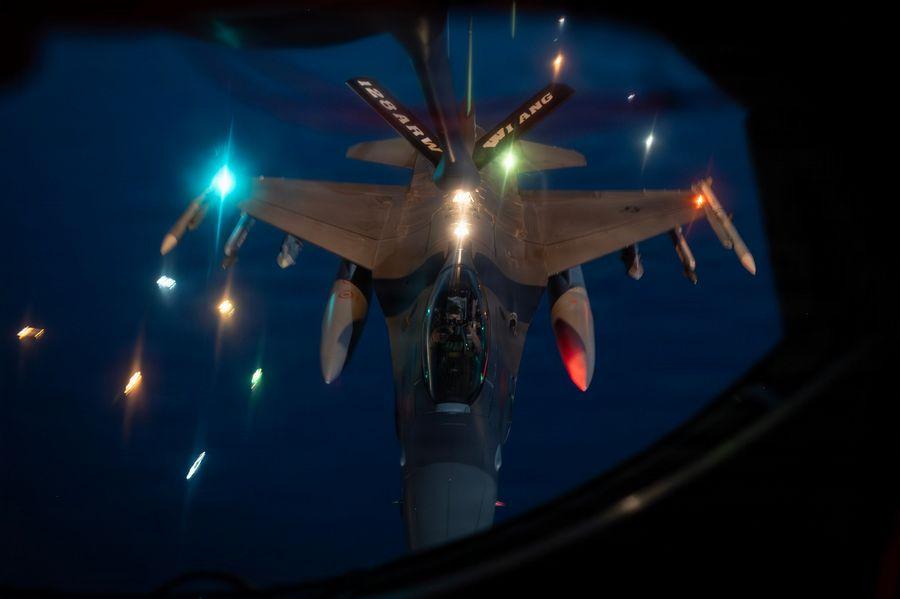
A U.S. Air Force F-16 Fighting Falcon aircraft refuels from a KC-135 Stratotanker aircraft during Operation Epic Fury, April 2, 2026.
F-16s Build on Iran Combat Lessons to Prepare for China Threat
Last updated 02:45 PM EST • Read time: 6m
Join the Conversation
0Iran war combat lessons are driving a faster pace of modernization for the U.S. Air Force’s F-16s.
The F-16s have been in the thick of the action during Operation Epic Fury, and will be again if strikes against Iran resume. Night take-offs, anti-drone missions, aerial refueling, and air dominance patrols are just a few of the missions prominently highlighted on X by U.S. Central Command. Not pictured: the specialized capability to kill any air defenses that go active with the radar-homing High-speed Anti-Radiation Missiles, or HARMs, an F-16 “Wild Weasel” specialty.
Behind the scenes, the U.S. Air Force is racing to incorporate Iran war combat sortie lessons into modernization plans to equip the F-16 fleet to take on China, or any future threats. From killing drones to fighting spectrum warfare, the next decade could place heavy demands on the F-16 fleet.
Priority one was to update the F-16 as a drone killer. CENTCOM showcased the latest anti-drone configuration in an August 25, 2026 photo of the F-16 on a twilight mission laden with extra fuel tanks, wingtip missiles, a targeting pod and two dispensers for small rockets carried on an underwing hardpoint. This was the result of almost two years of intensive work. For example, F-16s have been armed to take on drones with weapons like the AGR-20F Advanced Precision Kill Weapon System (APKWS), a precision-guided rocket specially modified in 2024 to enhance the F-16 anti-drone mission.
F-16s jumped in during a complex attack in November 2024 as the Houthis fired ballistic missiles, suicide drones and land-attack missiles toward the USS Abraham Lincoln and her strike group operating in the Red Sea. F-16s shot down multiple suicide drones heading for the Navy ship and, under the tactical guidance of USS Spruance, also shot down a land-attack missile.
“While the Viper has been equipped to carry up to 42 rockets for decades, the newest Standard Conventional Load (SCL) equips the F-16 to do so while also carrying four heat-seeking AIM-9X missiles,” said U.S. Air Force Maj. James Gregory, 77th Fighter Squadron Viper weapons officer, in September 2025. “These rockets have been used dozens of times to shoot down one-way attack drones in the Red Sea, doing so without using the more costly and longer-range AIM-120 missiles.
Full, detailed lessons from Operation Epic Fury are still close-hold due to ongoing operations. Simply follow the Air Force’s money trail to see how the service is feeding lessons from Iran and its proxies into its bold plans for the F-16 fleet.
Take the example of IVEWS, the Integrated Viper Electronic Warfare Suite. IVEWS is a major upgrade that provides a near fifth-generation quality of detection and targeting capabilities while inside a jamming environment. This is an internal EW system interoperable with the F-16’s AN/APG-83 active electronically scanned array radar, designed to the standard of Open Mission Systems Tier I. The job of IVEWS is to provide constant situational awareness for identification and geolocation of threats. These advanced capabilities enable the F-16 to use its AESA radar to track multiple targets at once, and to jam an active threat while targeting it for destruction. Think of it as a fifth-generation targeting capability aboard a fourth-generation fighter.
First flight of the new system took place on an F-16 at Eglin AFB in September 2024. Since then, Congress has responded to an urgent operational need request by the Air Force to speed up testing and fielding of IVEWS. Initial plans called for about 200 F-16s to receive IVEWS. However, the core of the F-16 fleet consists of about 608 later-block F-16s. The demand signal for F-16s is so strong that the wiser move now under consideration by the Air Force is to equip all the advanced blocks of F-16s with IVEWS.
Two F-16s caught by sudden Houthi air defense missile fire show why upgraded detection is vital. On March 27, 2025, two F-16s were flying alongside a larger strike package hitting Houthi ballistic missile manufacturing facilities in Yemen. As they departed, the Houthis unexpectedly fired six surface-to-air missiles at the pair of “Wild Weasel” F-16s. “You see this bright white light, and you see the rocket with the first missile launch, and it’s essentially directly underneath our position,” one of the pilots, Lieutenant Colonel William “Skate” Parks, told Air & Space Forces Magazine. The job of the Wild Weasels was to draw fire, and they employed high-G maneuvers and chaff to evade the ad hoc Houthi shots. Both pilots were awarded the Silver Star for their actions.
Pacific scenarios will plunge the F-16 into an intense electronic warfare environment. The F-16s will be active in hunting and killing Chinese aircraft and air defenses on land and at sea aboard China’s People’s Liberation Army Navy ships. Every tail needs to be ready to fight in a peer environment.
The F-16 is also a testbed for the Family of Affordable Mass Munitions, or FAMM – a new, affordable standoff cruise missile family first designed as a munition for palletized launch from large aircraft. In March, the test team at Eglin AFB completed a round of tests for a “lugged” munition, including loading, fit and function, high-risk envelope expansion, and live fire from an F-16. Anduril, CoAspire, and Zone 5 are all listed as vendors, and the Air Force plans to buy as many as 27,000 of the missiles over the next five years. “When you have a lot of them,” Air Force Chief Gen. Kenneth Wilsbach said of FAMM while testifying before Congress in June, then adversaries “will end up using their exquisite defenses to shoot those weapons down, and eventually we’re going to get some through.”
The upgraded capabilities of IVEWS, FAMM, and other programs such as inertial navigation and onboard computing build on lessons from the war with Iran to prepare F-16s for all future threats. Then there is combat attrition to consider. A ballistic missile attack by Iran against an airbase in Jordan lightly damaged eight F-15Es and one A-10. Regional commanders count on more F-16s to surge. That is why the Air Force is reportedly considering purchases of new F-16s in 2028 – the first new buys in 20 years. At this point, the nation can’t afford a penny-pinching approach to equipping the F-16 fleet.
Rebecca Grant, Ph.D., is a national security analyst based in Washington, DC specializing in defense and aerospace research and national security consulting. She has over 20 years experience working with the United States Air Force, United States Navy, and top aerospace clients.

Counterterrorism and the Growing Convergence in Homeland Security and Homeland Defense
By Austin Doctor • RealClearDefense
The Future of Space Power Depends on Integration
By Damian DiPippa • RealClearDefense
America Should Unleash Cyber Privateers
By Jacob Schelp • RealClearDefense
America Invented the Battery, but China Controls the Factory
By William Crane • RealClearDefense
A Defense Win for Americans and Israelis in Arkansas
By Bradley Bowman • RealClearDefense
F-16s Build on Iran Combat Lessons to Prepare for China Threat
By Rebecca Grant • Lexington Institute
Key Space Force Satellites Can’t Talk to Each Other
By T. Hitchens, Breaking Defense
Blue Angels Pilot Scott Laux Removed for Failing To Uphold Standards
By Johnson, PNJ
The Future of the Ground Reconnaissance Enterprise
By Joe Albano, The Connecting File
The Future of the ARG/MEU
By William Yale, Proceedings