
Israel's "War of Cruel Rich People"
Last updated 10:58 PM EDT • Read time: 9m
The logic of war is one of necessity – other measures have not worked, and resorting to violence is necessary to achieve one’s ends. The severity of actions in war are also dictated by what is considered necessary, often under perverse logic that is rejected in retrospect. The atomic bombings of Hiroshima and Nagasaki and the firebombing of German cities during World War II, for example, were and are rationalized as necessary to sap the Axis war effort and persuade leadership and populace to give in.
Today, the severity of the destruction of Gaza – 1,000 children amputated without anesthesia by December 2023, 25,000 women and children killed according to the Defense Secretary of the U.S., one million people facing catastrophic hunger – is, as always in war, rationalized in light of necessary and ongoing war goals – “Israel must invade Rafah,” to quote a recent article, “no alternatives exist to a full-scale military assault that would defeat Hamas”.
Of course, there are always different ways a war can be fought. To pick a simple example, the Israeli public – along with probably every other country’s public – was opposed to the land invasion of Gaza, with 49% opposed and only 29% in favor just prior to invasion. The emotional weight of Hamas’ brutal massacre was heavier then – not lighter – but the public preferred another route than occupying Gaza, which we’re all told is essential in light of the horror of Hamas’ crime. At the war’s start, the Israeli priority was freeing hostages and bombing Hamas leaders, which has since – under the conditions of massive mobilization and intense warfare – evolved into narrowly prioritizing military victory.
What would the alternative to land invasion have been? Look to Afghanistan. With the benefit of hindsight, many Americans recognize it would have been better to engage after 9/11 from more of a perspective of policing – partnering with other countries, gathering intelligence, bringing perpetrators to justice, and – yes – undertaking operations like the one that killed Bin Laden. Trying to transform other societies through military force – even with tens of billions of military and development aid – did not work.
An alternative war could have centered on keeping Israelis safe. Obviously the first step was securing its borders, a process in which Israel killed more Hamas and other Gazan fighters – about 1,600 – than the number of Israelis who have been killed in the war so far (as well as killing many partygoers and Kibbutz residents killed by tanks and helicopters in reckless fire). In a way, as the number of dead Palestinians exceeded Israelis within days of the start of the war, Hamas already suffered one defeat: no longer being able to invade Israel or kill many Israelis.
A secure Gaza border should actually have been assumed. Remarkably, only 600 soldiers were present – .4% of the Israeli standing army – on the border with Gaza on October 7 – a region of two million people ruled by Hamas, when Israel had Hamas’ plan of attack more than a year before the attack. Had 2,000 soldiers been on the border – only 1/75th of Israel’s standing army – the October 7th Massacre would have been impossible in the form it took.
In any case, such an attack could not happen again. After October 7th a repeat attack would be impossible because almost 2/3rds of the assailants were dead or captured and the border was secured. Hamas does not need to be destroyed to prevent another October 7th, just as the Taliban and Al Qaeda do not need to be destroyed to prevent another 9/11. And what does it mean to “destroy Hamas” when violently crushing Palestinians by the tens of thousands is increasing Hamas popularity far above prior decades? Why do all Hamas battalions need to be destroyed – even at the cost of tens of thousands of civilian lives and Israelis traumatized for life by war – if they can’t cross the Israeli border? How is the value of depleting Hamas infantry battalions to be weighed against the risk of war with Iran or Hezbollah, disruption to the global economy, and of course the U.S. and other allies? Total victory as presented by ultranationalist politicians is not about security against attacks, it is about other agendas, in this case including ethnic cleansing and mass starvation.
After securing borders, Israel could also have focused on intelligence and bombing and killing Hamas leaders. It is simply not the case that Hamas’ tunnel system makes it possible for Hamas leaders to hide safely, permanently. This is a myth, or lie, depending on the source. The IDF killed the commander of Hamas’ anti-tank forces in the first weeks of the war and killed high-level Hamas commanders in Syria and Lebanon, and killed another top-level Hamas commander recently in an attack that is assessed to demonstrate co-optation of high-level Hamas insiders, all with bombs. These men travel in their roles and show their faces above ground, and Israeli intelligence is very capable when not completely neglected and misused. Israel has killed many other Hamas commanders and fighters in relatively targeted attacks.
Another example to consider is Lebanon, where typical estimates are that civilians comprise about 1/6th-1/9th of the dead, and not the overwhelming majority as in Gaza. Obviously, this is partly due to geographic differences, but it’s also due to the more focused nature of the campaign. Israel’s own officers called the Gaza War a “war of cruel rich people” and “unusually wasteful” this month.
Biden is culpable. While it is not easy to find numbers, it seems perhaps more than 2/3rds (possibly 22,000/29,000 bombs dropped by December) of the bombs in this war are U.S. American. The war could have been far more targeted, and the U.S. had the leverage to insist on it. At any time, Biden could in one phone call have required far more care for civilians.
Another vital next step for Israeli security could have been replacing Netanyahu and revisiting the catastrophic intelligence, military, and geopolitical failures that led up to this attack. Despite the protests and alarmed concerns of a key IDF officer, the Nova Music Festival was not cancelled and authorities withheld warnings from festivalgoers. Half the civilians Hamas killed on October 7th were there. Where was the army? Partly in the West Bank implementing a settlement agenda. For much of 2023, Israel maintained twice as many battalions in the West Bank as normal, as Netanyahu’s ultra-right nationalist allies worked toward steeply increased tensions and violence. Itamar Ben-Gvir is perhaps the world’s only security minister to have kept on the wall of his office a picture of a mass murderer and shooter who shot 154 people during worship. He is also presumably one of few security ministers to have advocated for the murder of a prior prime minister of his country, the peace-oriented Yitzhak Rabin, against whom Netanyahu also agitated fratricidally. Rabin’s blood still cries up from the ground.
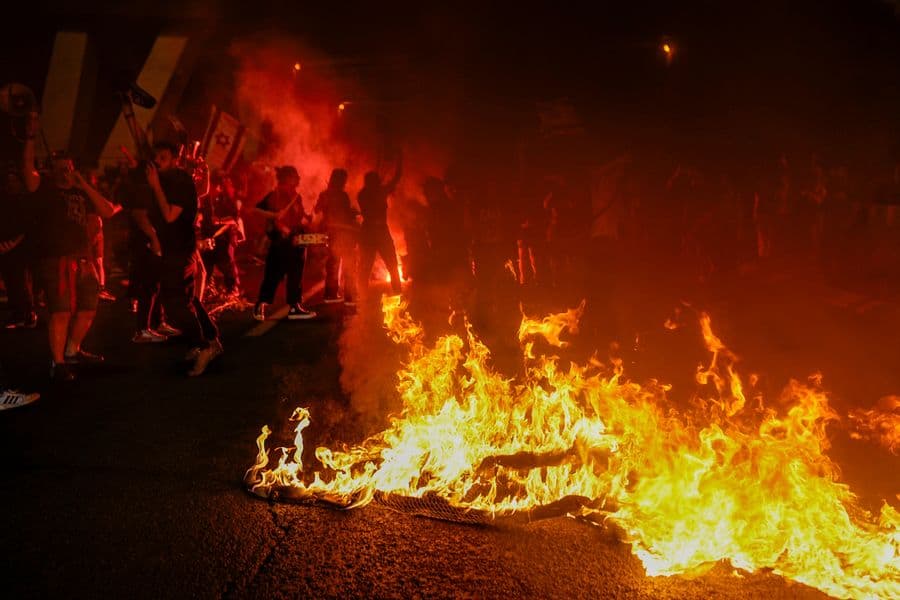
As Senator Chuck Schumer recently expressed, it would be good if Israelis had the chance to select new leaders. Israelis themselves rate Netanyahu’s war performance as very poor, only 15% wish for him to stay in office after the war, and a few months ago only 4% thought he was trustworthy in information about the war. As long as Israel is under intense war footing, elections will be possible. Netanyahu is a danger to his country and the world. Israel’s economy shrank by an annualized 20% in the last quarter. Instead of sympathy and massive solidarity rallies like after October 7, Israel’s reputation is deeply tarnished. The effects on migration/emigration are opaque but possibly significant. Netanyahu wishes to remain in power at any cost, but is wildly unpopular – continued war is the only space in which he is guaranteed safety. During a recent visit, an Israeli said to me “he will throw away the treasury, the hostages, and the army, because he knows, once he’s out of government, he could go to jail.” Netanyahu could lead his country to even more wars to keep his office.
Really re-thinking of human security in Israel-Palestine goes beyond war. Israel has fought wars with over a dozen countries – with almost all of them it has made peace. In 2018, Gazans not connected to Hamas organized a non-violent protest movement in which tens or hundreds of thousands of Gazans participated, protesting Trump’s moving of the embassy, the blockade of Gaza (an act of war under international law), and achieving a right of return. In the same year, Hamas removed the destruction of Israel from its charter. As 10,000+ Gazans were injured at the protests – many maimed for life as their kneecaps and eyes were shot out -- and 223 killed as the Great March of Return was put down. It is not difficult to see how Hamas exploited Gazans’ disillusionment and despair to generate terrible violence.
Obviously, Hamas is a horrifying terrorist organization and these protest demands would never immediately be met in the immediate term. And any advocate for Israel can also name instances in which Israelis took steps toward peace that Arabs did not reciprocate. But the absence of any gains from peaceful protest or engagement and erosion of Palestinian life, land, and rights manifested in continuous land theft in the West Bank has created space for cynicism and violence. At this time, Jewish people are 47% of the population of Israel-Palestine and directly control about 90% of the land, as well as Palestinians’ ability to travel, live with their spouses, reach their land, and work. Most of the world intuitively understands this is wrong.
As pro-democracy protests and continuous elections and collapsing coalitions in Israel show, the fanaticism and ethnic cleansing mentality of West Bank settlers is also driving Israel into a right-wing abyss that is a threat to Israeli society and security from within. Degrading Hamas’ capacity to commit terrorism and maintaining the precedent of death for people who plan or conduct terrorism against Israel are understandable war goals. But the current war does not center those goals at all. This is an entirely different vision of violence and power. The war should be brought to an end.
David S. Fehr is a tour leader who works in Israel-Palestine, working for a peace organization.

ICE Is Not a Four-Letter Word
By Meda Parameswara Reddy • RealClearDefense
The U.S. Can Draw Down in the Middle East Without Going Blind
By Cudi Zerey • RealClearDefense
America Needs a Joseph Directive
By Jeff Ballabon • RealClearDefense
Partnering Decides Whether Flexible Military Construction Can Work
By Matt Russell • RealClearDefense
Eight Months of Epic Fury and Still No Internal Alternative
By Stephen D. Cook • RealClearDefense

GE Aerospace to Supply Engines for Two US Navy Flight III Destroyers
By Defense Post
U.S. Air Force Asks Industry for New Cruise Missile for Ukraine
By Michael Peck, DNews
First Flight II San Antonio-class Amphib Completes Builder’s Trials
By Mongilio, USNI N.
LGM-35 Sentinel ICBM on Track for 2030
By Kris Osborn, Warrior Maven
On American Destroyers, Avoid a Self-Inflicted Wound in Spain
By Defense News