
Congress Is Right To Focus on America's Maritime Strategy
Published June 7, 2024 • Read time: 4m
The United States has more than 20,000 miles of navigable waterways that from the earliest days of our country have played a major role in making America prosperous, secure, and powerful. Even today these waterways continue to promote our national economic resiliency and strength, but there are several challenges facing American maritime power today.
A newly released Congressional report, entitled “Congressional Guidance for a National Maritime Strategy: Reversing the Decline of America’s Maritime Power,” confirms this unfortunate trend and finds that it must be reversed. This critically important document deserves our attention.
The fact remains that no world power can maintain its economic strength or its national security without a strong maritime presence, but over the years the U.S.-flagged shipping fleet that supports this critical capability and helps supply our U.S. military has fallen into steep decline.
Meanwhile, the People’s Republic of China now not only has a navy that is larger than our own, but they have become the world’s largest shipbuilding and shipping player on the planet. The communist Chinese regime has 230 times more shipbuilding capacity than the U.S. according to the Office of Naval Intelligence.
This is a trend that must not be allowed to persist. If the totalitarian Chinese regime has a stranglehold on international shipping, they will use it to disadvantage their adversaries. And if their navy continues to grow beyond that of the U.S., we should not be surprised to see more provocations. The spy balloons floating over America and gathering intelligence were just a small warning that we cannot allow China to become more powerful than the U.S.
Fortunately, there are a number of important things that can be done as outlined in the report to reverse America’s maritime decline and achieve maritime economic and security strength.
For example, it is a great deal more expensive to build ships in the U.S. and a big part of those costs are regulatory and tax related. Rather than continuing down this failed pathway we must find innovative ways to grow our shipbuilding capacity and develop advanced technologies to make our maritime industry the envy of the world so that it attracts the attention and interest of our economic allies.
In support of these efforts, Congress should establish tax incentives for the government and American companies to ship their goods on U.S. flagged ships and to grow the U.S. flagged international fleet’s size and shipping capacity. It is also important to create a National Maritime Council that would monitor and report on laws, regulations, and other issues that hamstring our maritime industry so that we can be more competitive.
Ensuring the integrity of our domestic waterways and international shipping lanes is similarly important. Preserving the Jones Act, an important tool to protect America’s heartland that keeps unvetted international ships and crews at our border ports by requiring ships operating in America’s inland waterways to be American crewed and built is an important start.
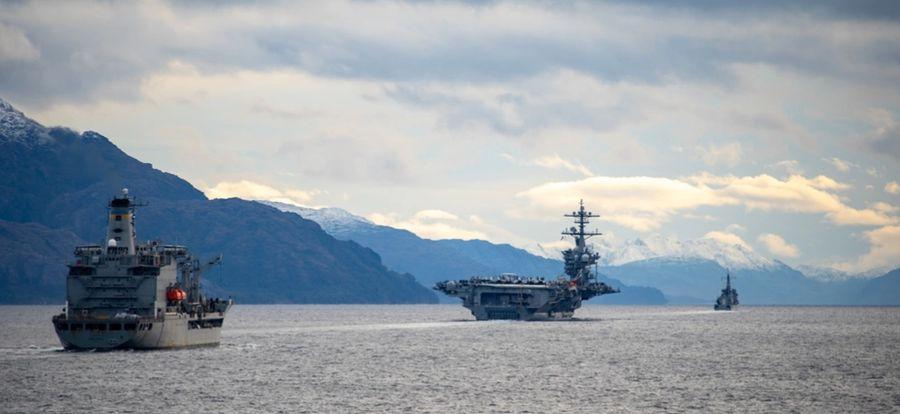
We must also ensure that the U.S. Coast Guard and Navy are properly funded. Having the ships – and planes in the case of aircraft carriers – that are required to defend America and maintain its strength are important. Conflict with the U.S. must not look like an easy victory to its adversaries. Projecting strength reduces the chances of war, so investing in a robust defense makes war less likely and increases the prospect of peace and security.
We have spent $7.5 Billion to build seven electrical vehicle charging stations. That does nothing to benefit American prosperity or security. But if we were to invest in our maritime transportation system and our inland waterways, we could do a great deal to promote American prosperity and security.
All of this is critically important because we cannot allow ourselves to become the next Great Britain. The country was once the world’s greatest maritime power and now it cannot even build the ships that it needs. If that happens to the U.S. — and without changes, we will be on our way to that — we will cease to be economically independent and safe from a security perspective.
The bottom line is that private industry and innovation will be key to a resurgence of our maritime industry. But our elected officials ought to be willing to make sure that our regulatory and tax policies unleash American investment and innovation. Ultimately, we also need to make sure that we don’t ignore our military and defense needs and as we work to promote our security, we will receive a side benefit of economic strength.
George Landrith is the President and CEO of Frontiers of Freedom, a public policy think tank devoted to promoting a strong national defense, free markets, individual liberty and constitutionally limited government. To learn more about Frontiers of Freedom, visit www.ff.org.

Iran’s Nuclear and Chemical Weapons Threat
By Ben Ollerenshaw • RealClearDefense
Europe’s Rearmament Paradox
By Daniel Darling • RealClearDefense
Pentagon’s Pursuit of Faster Acquisition
By Ben Harris • RealClearDefense
The Army’s AI Cyber Defenders Need a Proven Stand-Down Order
By Gleb Tsipursky • RealClearDefense
After the Silence
By Chase Skylar DeMayo • RealClearDefense

The First Surface Drone-v-Drone Fight
By CDR Salamander, CDR Salamander
Air Force Strengthens F-22 Raptor Combat Readiness in the Pacific
By Global DefenseAfter the Silence
By Chase Skylar DeMayo • RealClearDefense
Underwater Arms Race Puts U.S. Naval Supremacy at Risk
By Tom O'Connor, Newsweek
New Facilities To Pump Out Upgraded F/A-18E/F Super Hornets
By Trevithick, WarZone