
Secretary Hegseth and the Gathering Storm
Last updated 11:02 AM EST • Read time: 7m
In his “iron curtain” speech delivered in early 1946, Winston Churchill reflected on the Second World War, which had ended just six months earlier.
“There never was a war in all history easier to prevent by timely action than the one which has just desolated such great areas of the globe,” Churchill said. “Last time I saw it all coming and cried aloud to my own fellow countrymen and to the world, but no one paid any attention.”
Churchill was referring to the time period he was out of office in the political “wilderness”—1932 to 1939—when he repeatedly sounded the alarm about Hitler’s expansionist ambitions and Germany’s growing military capability. Churchill recounted all of this in the first volume of his World War Two memoirs, The Gathering Storm.
The events of the 1930s that led to the outbreak of war have too often been used to justify wars of choice. Churchillian rhetoric and exaggerated historical analogies helped fuel the tragedy of the Vietnam War and the futile, endless wars of the George W. Bush-Obama years. The neoconservative remnant both here and in Europe has attempted to portray the war in Ukraine as a repeat of the 1930s.
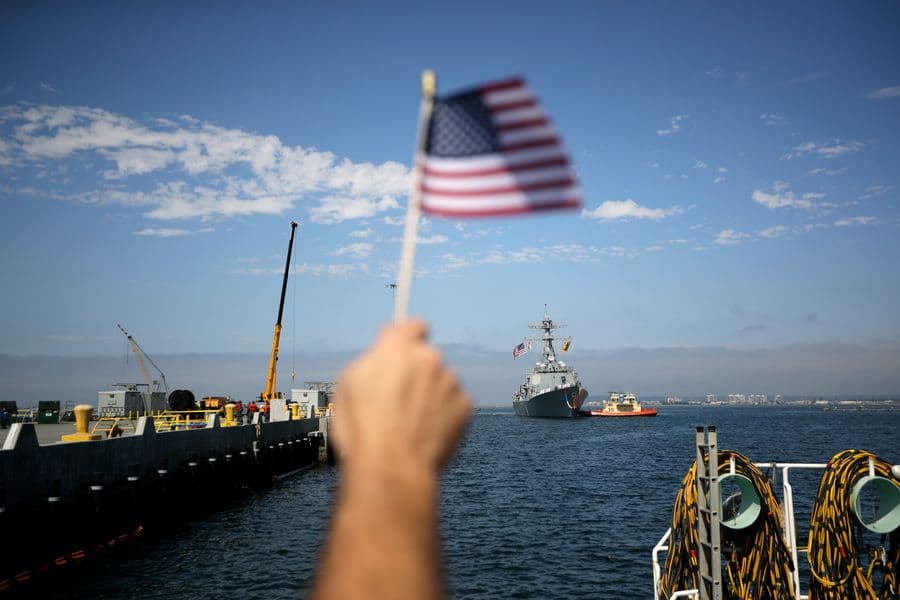
But there is another “gathering storm” on the horizon—the western Pacific Ocean.
U.S. Admiral Sam Paparo, who heads the Indo-Pacific Command, has played the role of Churchill in the 1930s, warning his countrymen and the world about China’s growing threat in the western Pacific and urging political leaders to increase military preparedness to deter China. Those warnings have been affirmed by key Trump administration officials like Vice President J.D. Vance and Defense Secretary Pete Hegseth.
In February 2024, Admiral Paparo warned that China’s military buildup was designed to dominate the South China Sea, and that America’s force posture in the region is “sized for efficiency” but not for “effectiveness under fire.” He said that China’s “militarization in the region and aggressive activities” were destabilizing and called for a “whole of government” approach, including “strategically employing all elements of national power” against China.
In November 2024, Admiral Paparo told a packed Brookings Institution audience that China’s moves in the South China Sea were a rehearsal for an invasion or blockade of Taiwan. Paparo said that, in the summer of 2024, he witnessed “the most joint exercises from the People’s Republic of China that I have ever seen—with the widest geography, the most joint operations for air, missile, maritime power that I had seen over an entire career of being an observer.”
Paparo also repeated sentiments expressed by (hopefully) incoming Under Secretary of Defense for Policy Elbridge Colby, who has noted that U.S. aid to Ukraine and Israel is affecting our readiness to counter China’s Pacific Ocean ambitions. The United States, Paparo warned, is unprepared for sustained conflict with China in the western Pacific in part because the transfer of weapons to Ukraine and Israel is depleting U.S. stockpiles. The Indo-Pacific theater, Paparo said, is “the most stressing theater . . . because [China] is the most capable potential adversary in the world.”
Paparo’s suggestion of a turn from Europe and the Middle East to the Indo-Pacific was echoed by both Defense Secretary Pete Hegseth and Vice President J.D. Vance, who recently conveyed some uncomfortable truths to our European allies.
Defense Secretary Hegseth, speaking recently at a NATO meeting, emphasized the need for European members of NATO to take “primary responsibility” for the defense of Europe by increasing their investments in “hard power.” Hegseth promoted what he called “strategic realism.” “You can’t shoot values, you can’t shoot flags, and you can’t shoot strong speeches,” he said. “There is no replacement for hard power.”
Hegseth echoed President Trump’s insistence that our NATO allies spend more for their own defense. If NATO is to endure, Hegseth said, its European and Canadian members must shoulder more of NATO’s defense burden. Hegseth invoked President Eisenhower to warn our NATO allies that the United States will no longer serve as NATO’s “Uncle Sucker.” At the NATO Ukraine defense meeting, Hegseth made it clear that the U.S. goal was not a Ukrainian victory in its war with Russia, but a negotiated peace that will not include a return to Ukraine’s pre-2014 borders or Ukraine’s membership in NATO.
Hegseth also emphasized that any security guarantees to Ukraine should be non-NATO guarantees not subject to Article 5 of the Treaty (an attack upon one is an attack upon all), and will not involve the deployment of American troops to Ukraine. Europe, not the United States, must supply the “overwhelming share of lethal and non-lethal aid” to Ukraine. The United States, he said, will use its limited resources to prioritize the threat from China.
Hegseth’s remarks were echoed, in part, by Vice President J.D. Vance at the Munich Security Conference. Vice President Vance told his audience that the U.S. expects Europe to “step up” to provide for its own defense, leaving the United States to focus on greater threats to its own security in the Indo-Pacific. But Vance’s speech, unlike Hegseth’s, emphasized “values” such as free speech, democracy, and civilizational culture—the things, he said, that are worth defending but that are under attack in Europe and in the United States by elites who wish to censor opinions they don’t like and deny power to political leaders who don’t share their views.
Washington Times reporter Bill Gertz notes that China has “nearly tripled the number of precision strike ballistic missiles” and “nearly doubled” the number of missile launchers capable of striking “all targets in the western Pacific, including the key U.S. military hub on Guam in a single mass attack.” Meanwhile, according to Paparo, the U.S. Indo-Pacific Command is operating on “increasingly thin margins of error,” with depleted munitions, maintenance backlogs, and the growing obsolescence of air, missile, maritime and space platforms.
In the 1930s, Churchill warned about deficiencies in Britian’s air defenses in the face of Germany’s military buildup and aggressive intentions. Hitler had spelled-out his aggressive plans in Mein Kampf, but the world looked away in the hope that avoiding difficult choices would preserve peace.
China’s President Xi Jinping has repeatedly told the U.S. and the world that he aims to unify Taiwan with the mainland, either peaceably or by force. He has claimed the entire South China Sea as Chinese territory. His stated goal is to end the “century of humiliation” by establishing a China-centric world order. The Biden administration, like the appeasers of the 1930s, approached China as a “competitor” instead of an adversary.
Biden, like Bush 41, Clinton, Bush 43, and Obama sought to engage China with the goal of changing it into a responsible stakeholder in the “rules-based international order.” That was always a strategic mirage. China is a global adversary intent on replacing the United States as the leading global power and determined to shape the international order for its priorities. Biden and his national security team presided over what Churchill in 1934 and 1935 called the “Locust Years.” Like the Baldwin government then, Biden’s government was, in Churchill’s memorable description: “Decided to be undecided, resolved to be irresolute, adamant for drift, solid for fluidity, all-powerful to be impotent.”
That has now changed with the Trump administration and his national security team of China hawks. Paparo’s warnings about China have not gone unheeded, and the Europeans would be wise to prepare for a vastly reduced American role in NATO. Time is of the essence. The “Locust Years” of engagement have taken their toll on U.S. preparedness for war in the western Pacific. The distractions of Ukraine and the Middle East must be ended. The gathering storm is almost upon us.
Francis P. Sempa writes on foreign policy and geopolitics. His Best Defense columns appear at the beginning of each month.
The Dual Threat: Why Beijing’s Collapse Is Just As Dangerous as Its Rise
By Efraín Vázquez-Vera • RealClearDefense
Optimizing Trump’s Strategy to ‘Rot Iran’s Economy’
By Brian G. Chow • RealClearDefense
The AI Scare Is the New Y2K: A Veteran’s Perspective on Hype, Risk, and the Discipline Needed to Modernize Safely
By Kenneth Smith • RealClearDefense
The Pentagon’s AI Rush Needs Adult Supervision
By Michael Aaron Cody • RealClearDefense
ICE Is Not a Four-Letter Word
By Meda Parameswara Reddy • RealClearDefense

Marine Died of Injuries Suffered During Fast-Rope Training on Okinawa
By Brian McElhiney, Stars and Stripes
Drones Built To Look Like Birds Evaded Detection at Air Force Tech Exercise
By T&P
Navy Unfairly Evaluated Saildrone Musv Proposal, Court Finds
By D. Stancy, BrDefense
HII and Thales Demonstrate UUV with End-to-End Autonomous MCM
By Naval News
General Atomics Joins Army-Navy Hypersonic Glide Body Production
By Defence Blog