
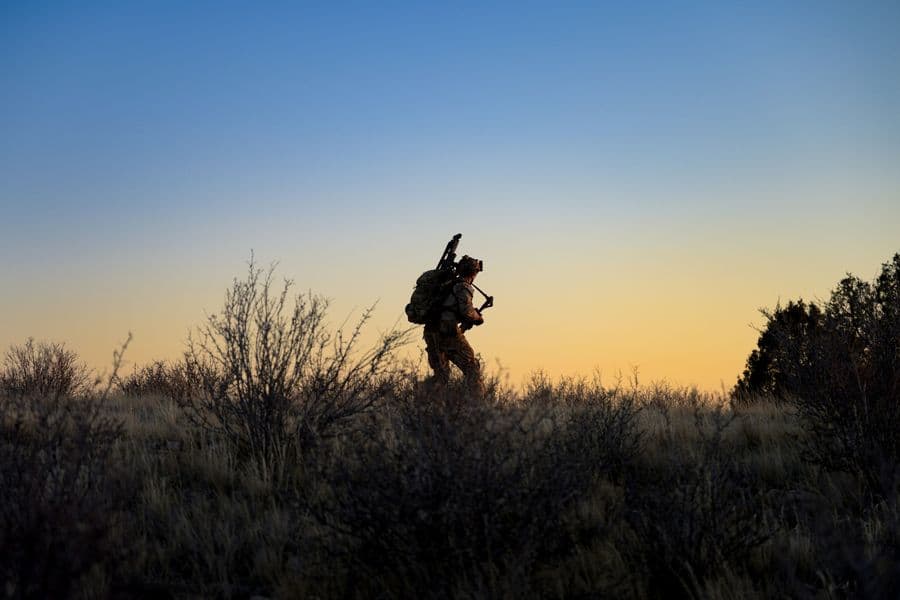
Reimagining Our Warfighter
Last updated 11:21 AM EDT • Read time: 4m
Narrative Operators for Nuanced Terrain
“We have a vision of what our warrior looks like… a guy who’s six-foot-five, who can lift mountains. I’m not sure that’s exactly who we always need.”
— Rep. Chrissy Houlahan, 2025 National Security Innovation Base Summit, Ronald Reagan Institute
This wasn’t an offhand remark, it was a strategic provocation to rethink what national security demands in the 21st century. Chrissy Houlahan—an Air Force veteran and House Armed Services Committee member—was addressing the deeply ingrained mental image still shaping how we recruit, train, and evaluate military talent.
That image—the tall, muscled, physically dominant archetype—isn’t wrong, but it is incomplete. Especially now. Because the most consequential fights ahead may not require lifting mountains, but rather, lifting meaning.
Story as Strategy
Warfare has always had a cognitive dimension—how we think, how we interpret uncertainty, and the stories we tell ourselves about enemies and purpose. Today, that cognitive terrain isn’t just part of war—it is the battlefield.
Understanding this shift requires more than new tech—it demands new cognition. Major Christopher Mesnard, in his thesis at the U.S. Army Command and General Staff College, lays the groundwork for what he calls narrative-based decision-making. He defines narrative not as a communications tool, but as a cognitive function. As he writes…
“The mind thematically aligns stories and their elements into narratives, demonstrating a cognitive process that assists in an individual’s understanding of reality and the possible decisions which logically fit into that reality.”
This means that every warfighter—regardless of their domain or mission set—is, in some way, a narrative actor. Warfighters don’t just carry weapons, they carry worldviews. They don’t just execute orders, they embody stories about who matters, what matters, and what it means to win.
And in a global environment saturated with misinformation, disinformation, and adversarial influence, narrative fluency may be as important as marksmanship. Narrative fluency—the ability to read, decode, and deploy meaning across psychological, informational, and cultural domains—is now mission critical.
The Intelligence Age
OpenAI CEO Sam Altman describes the era we’re entering as The Intelligence Age—a time when human capability will be amplified not by physical force, but by access to abundant intelligence and scalable reasoning.
“We are more capable not because of genetic change, but because we benefit from the infrastructure of society being way smarter… AI will give people tools to solve hard problems and help us add new struts to that scaffolding that we couldn’t have figured out on our own.”
Altman envisions a future where individuals command personal AI teams, access instant knowledge, and wield cognitive leverage unimaginable to past generations. But that future demands a new kind of readiness—one built for complexity. It requires narrative operators, who are warfighters that can synthesize information, question assumptions, and navigate cultural ambiguity with fluency and intent.
Those who thrive in this age won’t be those who carry the most weight, but those who carry the heaviest cognitive load—with agility, not just endurance.
Force to Fluency
We are witnessing a quiet revolution. But it won’t stay quiet for long. Representative Houlahan is right—we're stuck in a weird place. On one hand, we understand that today’s battlefields include cyberspace, social media, and AI-enabled operations. On the other, our recruitment models and leadership pipelines still privilege physical optics over cognitive depth.
It’s time to evolve.
The warfighter of the Intelligence Age is not just a kinetic asset. They’re cognitive sentinels, cultural diplomats, and moral innovators. They understand the power of narrative—not just to influence others, but to orient themselves in the face of volatility.
They may not look the part. They may not “lift mountains.” But they lift morale. They lift understanding. And they reduce ambiguity where others freeze in it. Because that is what future fights will require.
The Path Forward
If we want to remain the most capable military in the world, we must reimagine what capability truly means. It’s no longer just about strength under fire—it’s about clarity under complexity. We must start recognizing narrative fluency, strategic empathy, and cognitive self-awareness as core components of readiness—not soft skills, but survival skills.
We need a new mental model—one that favors narrative over reaction, and interpretation over instinct. A modern decision loop for today’s warfighter. And it begins with how we recruit, how we train—and how we tell our own story.
Chad Williamson is a military veteran and is currently pursuing his graduate degree in national security policy. He lives on Capitol Hill with his wife, Dr. Heather Williamson, and their two chocolate labs, Demmi and Ferg.
From Siberia to Fairford: How Operation Spider’s Web Has Changed the Rules of Airpower
By Frank A. Rose • RealClearDefense
Faster Simulations, Better Defense Decisions
By Rut Lineswala • RealClearDefense
Will HASC Have an Oversight Subcommittee in the Next Congress?
By Christopher J. Bright • RealClearDefense
The U.S. is Overpaying for Missiles
By Alex Lee • RealClearDefense
The U.S. Nuclear Deterrent Umbrella
By Peter Huessy • RealClearDefense
From Siberia to Fairford: How Operation Spider’s Web Has Changed the Rules of Airpower
By Frank A. Rose • RealClearDefenseFaster Simulations, Better Defense Decisions
By Rut Lineswala • RealClearDefense
Bombers Could Have a Major Air-to-Air Combat Role
By Joseph Trevithick, The WarZone
Pentagon, Lockheed Agree to 10-Year Deal for 850 F-35 Jets
By M. Scanlon, Military T.
The Marine Corps Has a Boot Problem
By Travis Pike, Sandboxx News