
The U.S.-China Dilemma Over USFK Realignment
Last updated 07:03 AM EDT • Read time: 5m
Strategic Tug-of-War: The U.S.-China Dilemma over USFK Realignment under the Second Trump Administration
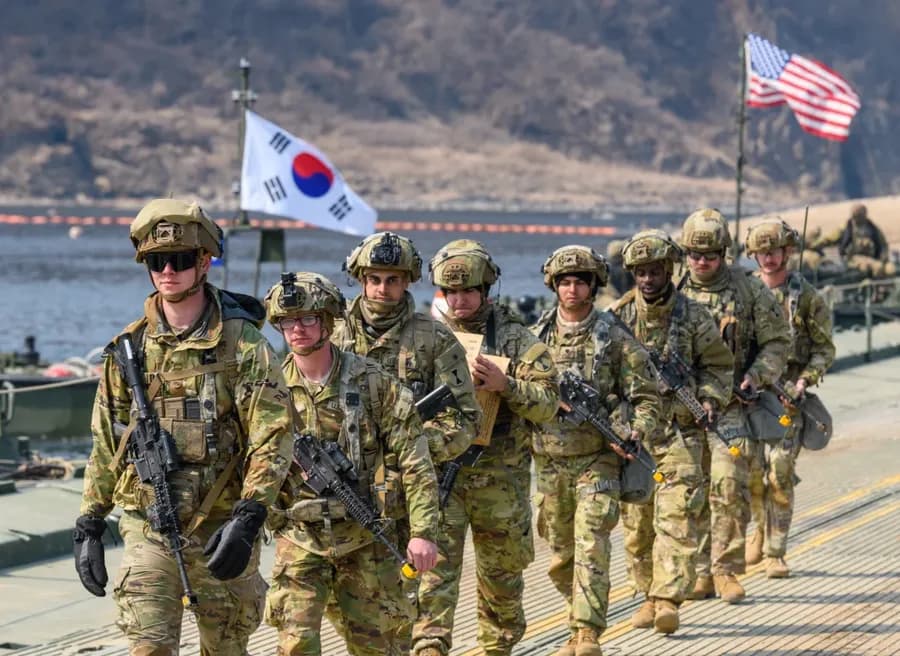
The inauguration of the second Trump administration has reignited debates over the future of U.S. alliances, particularly in East Asia. One of the most pressing and sensitive issues is the potential realignment of United States Forces Korea (USFK) amid intensifying U.S.-China strategic rivalry. While the Trump administration continues to take a transactional approach to alliances—emphasizing burden-sharing and economic efficiency—it is simultaneously pushing for a reconfiguration of U.S. military posture to better counter China’s assertiveness in the Indo-Pacific. This dual policy direction places USFK in the middle of a complex strategic dilemma: how to balance its enduring role in deterring North Korean aggression with growing expectations that it contribute to broader regional contingencies. The answer to this question could fundamentally reshape the alliance structure and regional security architecture.
The Trump administration frames overseas deployments less as strategic commitments and more as services that must be justified in terms of economic or geopolitical return. In this view, realigning USFK to serve multiple regional objectives may be seen as a way to increase “efficiency” within a constrained budgetary and political framework.
From a military planning perspective, there is growing interest in using USFK assets for broader Indo-Pacific operations. As the Taiwan Strait and South China Sea emerge as flashpoints, Korea’s strategic geography and U.S. facilities on the peninsula offer potential value for crisis response or force projection. The Trump administration’s Indo-Pacific strategy increasingly favors flexible, distributed deployments, and some within the defense establishment view USFK as a potential node in that wider architecture.
However, while regional utility is an emerging factor, it must not come at the cost of eroding USFK’s central and enduring mission: deterring North Korean aggression. The presence of nearly 30,000 U.S. troops on the peninsula remains one of the most credible indicators of American commitment to South Korea’s security. This deterrent function is not a legacy concept but a present necessity, given Pyongyang’s continued development of nuclear and missile capabilities, its pursuit of tactical nuclear weapons, and its willingness to escalate tensions. Any operational shift in USFK must begin with the recognition that deterring North Korea remains a core pillar of regional stability and alliance cohesion.
South Korea, meanwhile, faces mounting pressure on multiple fronts. It remains deeply reliant on the U.S. security umbrella, yet its economic dependence on China complicates alignment with U.S. strategies that Beijing views as containment. The memory of China's retaliatory measures following the THAAD deployment in 2016 still resonates in policy circles. Any overt transformation of USFK into a force explicitly aimed at China could trigger renewed economic and diplomatic coercion. South Korea’s national interest lies in preserving alliance credibility while avoiding unnecessary entanglement in a great-power rivalry.
The second Trump administration’s unilateral and top-down approach to alliance management only intensifies Seoul’s dilemma. Concerns are growing that decisions about USFK’s future role may be made without adequate consultation with South Korea, undermining the principle of joint strategic planning that has historically underpinned the alliance. Such a shift would not only harm mutual trust but also limit Seoul’s ability to manage domestic political consensus on the alliance.
One particularly sensitive issue is the growing speculation about USFK’s possible role in a future Taiwan contingency. While South Korea has not been directly involved in Taiwan-related security planning, it cannot afford to be unprepared. Rather than resisting the topic, Seoul should undertake a deliberate and preemptive strategic review—examining the full range of possible scenarios, the extent and form of potential participation, and how any involvement would align with national interests. This kind of forward planning would allow South Korea to retain agency in decision-making, avoid reactive crisis behavior, and ensure that any contribution is based on careful judgment, not pressure.
From Beijing’s perspective, any movement toward integrating USFK into a U.S.-led Indo-Pacific network—especially one linked to Taiwan—will be interpreted as direct strategic encirclement. In response, China could apply military, economic, or diplomatic pressure on South Korea, or exploit alliance frictions to isolate Seoul. These risks are real and must be factored into any decision regarding USFK’s posture.
In this complex environment, South Korea must pursue a balanced approach. It should clearly articulate that while USFK’s mission may evolve with changing regional dynamics, its foundational role in deterring North Korea remains indispensable. Simultaneously, Seoul should remain open to exploring regional cooperation in domains that do not provoke strategic backlash—such as humanitarian assistance, cyber defense, or supply chain resilience. Above all, it must ensure that its voice is included in all discussions regarding alliance adaptation and regional planning.
For the Trump administration, a key lesson from its first term remains relevant: imposing unilateral decisions on allies weakens long-term strategic cohesion. If USFK is to serve both Peninsula and regional functions, this must be accomplished through transparent dialogue, shared assessments, and mutual agreement—not transactional pressure or top-down directives.
Ultimately, the debate over USFK realignment under the second Trump administration reflects broader tensions in the U.S.-ROK alliance. It is a test of whether both nations can reconcile diverging pressures—fiscal, strategic, and geopolitical—without sacrificing trust or capability. The outcome will determine whether the alliance evolves into a more resilient and strategically adaptive partnership or becomes another casualty of great-power rivalry and domestic uncertainty.
Jihoon Yu is a research fellow and the director of external cooperation at the Korea Institute for Defense Analyses. Jihoon was the member of Task Force for South Korea’s light aircraft carrier project and Jangbogo-III submarine project. He is the main author of the ROK Navy’s Navy Vision 2045. His area of expertise includes the ROK-US alliance, the ROK-Europe security cooperation, inter-Korean relations, national security, maritime security, and maritime strategy. He earned his MA in National Security Affairs from the US Naval Postgraduate School and PhD in Political Science from Syracuse University.

Iranian Cyber Operations
By Michael Groen • RealClearDefense
Reflecting on an Epic Horse Campaign in the Mountains of Afghanistan
By Brian Glyn Williams • RealClearDefense
The Godfather of American Foreign Policy Realism Speaks to Today’s World
By Francis P. Sempa • RealClearDefense
In Pursuit of Nuclear Abolition
By Peter Huessy • RealClearDefense
Innovation Alone Won’t Prepare the U.S. for the Future Battlefield
By Joshua Segal • RealClearDefense

Navy Civilianizes Six Former Flag Billets, Reduces Six to Captains
By Mongilio, USNI N.
Raytheon's $8B Contract for Strategic Comms Terminal Modernization
By M+A El
America’s Maritime Moment Will Not Wait
By CDR Salamander
Armor Up?
By Marine Corps Compass Points
Who Shoots Down the Drone Over the Shipyard?
By John Ferrari & Dillon Prochnicki • RealClearDefense