
Assessing North Korea's Claimed Nuclear-Powered Submarine
Last updated 07:29 AM EST • Read time: 6m
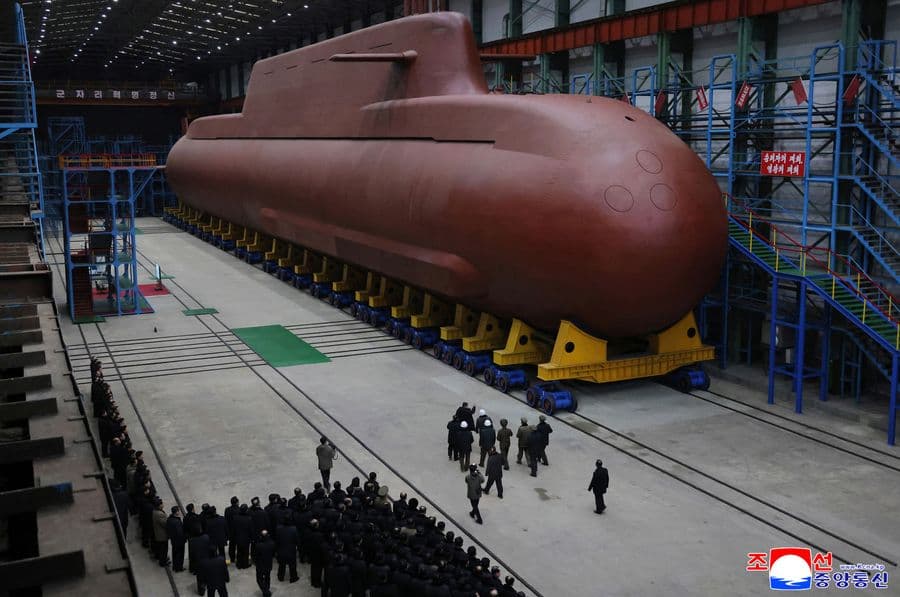
North Korea’s late-December exposure of what it called an “8,700-ton-class nuclear-powered strategic guided-missile submarine” should be read less as a technical unveiling than as a strategic forcing move. The images of Kim Jong Un inspecting a largely assembled hull were choreographed to generate political and psychological effects: projecting momentum in naval “nuclear weaponization,” implying a more survivable sea-based nuclear posture, and compelling Seoul, Washington, and Tokyo to plan against a higher ceiling of risk before the capability is proven. The episode matters because perceptions change behavior; it also invites skepticism because photographs and slogans do not equal operational capability.
The most concrete element is the displacement claim—8,700 tons—paired with the visual impression of a hull well advanced in construction. Reporting noted that outside analysts considered it plausible that major systems could already be installed, while North Korean messaging framed the platform as near-operational and missile-capable. Yet these datapoints do not answer the questions that determine whether a sea-based nuclear capability truly alters the strategic balance. A hull is the visible part of the iceberg. The decisive thresholds are unglamorous: safe propulsion, quieting, crew proficiency, sustainment, and reliable command-and-control.
This is why the key distinction is between what North Korea asserts and what it demonstrates. “Nuclear-powered” cannot be validated by shipyard imagery. Naval nuclear propulsion demands far more than a reactor concept; it requires shielding design, high-end quality control, disciplined procedures, radiological safety infrastructure, specialized maintenance capacity, and—hardest to build quickly—a professional culture of nuclear operations that minimizes catastrophic error. Even advanced navies treat nuclear propulsion as an ecosystem, not a component. The reveal may show progress in shipbuilding and message discipline, but it does not establish that North Korea possesses the industrial and organizational foundations needed for sustained nuclear-powered deployments.
The same logic applies to readiness. A strategic submarine becomes strategically meaningful not when it is photographed, but when it completes prolonged and credible sea trials, when crews are trained and certified, when the platform can operate repeatedly without serious incidents, and when a predictable maintenance cycle allows it to return to sea. Those steps are where complex programs often stumble. If North Korea is attempting a leap to nuclear propulsion, the first years of operation—if they arrive—would likely be the most training-intensive and accident-prone, and therefore politically risky.
Second-strike credibility is an even higher bar. A sea-based deterrent reshapes calculations only if it is survivable under pressure: able to hide, receive secure orders, and execute them reliably. That requirement is demanding in any environment, but especially around the Korean Peninsula, where geography is constraining and allied ISR and anti-submarine warfare capabilities are substantial. In crisis terms, the core issue is not whether a submarine exists, but whether it can evade persistent tracking long enough to preserve coercive leverage or retaliatory options.
North Korea’s messaging thrives on blurring categories, and ambiguity is the mechanism. Pyongyang benefits when external audiences merge “nuclear-powered” and “nuclear-armed” into a single, maximally threatening concept. If “nuclear submarine” is heard as the most escalatory interpretation, deterrent effect is created immediately, regardless of whether the propulsion claim is mature. A plausible near-term pathway is therefore a platform optimized to carry nuclear-capable missiles and marketed at maximum threat value, because that leverages capabilities North Korea already possesses—warheads and missile technology—while leaving the most demanding leap, sustained nuclear propulsion at sea, partly obscured. Even a conventionally powered missile submarine can impose strategic costs if it forces defenders into persistent surveillance and tracking.
The timing and bundling of the reveal reinforces the view that this is a campaign rather than an isolated announcement. Kim paired the submarine narrative with broader modernization rhetoric and other weapons activity, and he criticized South Korea’s pursuit of nuclear-powered submarine technology with U.S. support—signaling that Pyongyang views undersea competition as interactive and politically exploitable. This is deterrence by uncertainty: it pushes the alliance to plan against the upper bound because the consequences of underestimating a sea-based nuclear option are severe.
Speculation about external assistance, including commentary linked to Russia, adds a risk factor without resolving the core uncertainty. If such help exists, it could compress timelines for difficult subsystems. But it is not a proven shortcut to operational credibility. Even meaningful outside support cannot instantly produce the hard-to-fake outputs that matter most: safe reactor operations, quieting discipline, repeatable deployments, and resilient command-and-control. The prudent stance is to treat external assistance as a potential accelerator that strengthens the case for monitoring and enforcement, while refusing to grant Pyongyang automatic credit for success.
Strategically, the reveal can have consequences even if the submarine is not yet operational. It can worsen crisis stability by shortening decision times and intensifying worst-case planning. It can drive deeper allied investment in persistent ASW and ISR integration—strengthening deterrence but also increasing peacetime friction through more shadowing and close encounters. It can amplify regional political feedback loops, as North Korea frames South Korea’s own submarine ambitions as hostile, pushing the issue deeper into domestic debate. To judge whether this is moving from show to shift, the relevant indicators are patterns rather than proclamations: sustained sea trials; signs of a real reactor-operations ecosystem; milestones that demonstrate credible missile integration; and evidence of systematic deployment behavior rather than staged appearances.
In that context, the South Korean debate over nuclear-powered attack submarines (SSNs) need not dominate the analysis to be relevant: North Korea’s move reinforces the narrower operational point that undersea competition increasingly turns on persistent tracking and denial, where endurance can matter. Any Korean SSN discussion, however, remains constrained by alliance politics, nonproliferation considerations, industrial readiness, cost, and opportunity costs—meaning it should be treated as one option within a broader ASW/ISR strategy rather than a symbolic mirror-response. Ultimately, North Korea’s “nuclear submarine” exposure is best understood as an attempt to harvest strategic effects before capability is proven, and the appropriate response is to avoid validating propaganda claims rhetorically while hedging operationally through stronger undersea awareness, tighter allied integration, careful monitoring of enabling transfers, and crisis-management measures suited to a more ambiguous maritime nuclear environment.
Jihoon Yu is a research fellow and the director of external cooperation at the Korea Institute for Defense Analyses. Jihoon was the member of Task Force for South Korea’s light aircraft carrier project and Jangbogo-III submarine project. He is the main author of the ROK Navy’s Navy Vision 2045. His area of expertise includes the ROK-US alliance, the ROK-Europe security cooperation, inter-Korean relations, national security, maritime security, and maritime strategy. He earned his MA in National Security Affairs from the US Naval Postgraduate School and PhD in Political Science from Syracuse University.

Trump's Disrupt First, Negotiate Second: Greenland in Focus
By Meda Parameswara Reddy • RealClearDefense
In Seeking Peace With Beijing, Taipei Is an Asset, Not a Burden
By Alexandru Filip • RealClearDefense
Strike First: Israel's Inevitable Doctrine for the Iranian Axis
By Lance Gordon • RealClearDefense
It’s Not President Trump but Thomas Friedman Who Should Be Ashamed
By Francis P. Sempa • RealClearDefense
Putin, Plague, and America’s Biodefense Gap
By Ryan Kane • RealClearDefense
U.S. and Japan Begin Naval Exercises Near Taiwan
By Mari Yamaguchi • Associated PressU.S. and Japan Begin Naval Exercises Near Taiwan
By Mari Yamaguchi, AP
U.S. Navy, Gecko Robotics Surge AI Maintenance Contract
By Ceder, Simkins, Navy T.
Ghost Shark XL-AUV Payload Bay Seen For First Time
By Thomas Newdick, The WarZone
Dakota Meyer Tapped As Barracks Task Force Senior Advisor
By C. Stassis, MC Times