
Retired Admiral Urges India's Turn to Mahan—So Should We
Last updated 06:34 AM EST • Read time: 6m
There was a time in the late 19th-early 20th centuries that the navies of all the great powers paid homage to the writings of American naval historian and strategist Alfred Thayer Mahan, who had dutifully served aboard Union ships during the American Civil War but whose fame and lasting influence derived from his books and articles written between 1880 and 1914. Much of what Mahan wrote about is, of course, dated and not relevant to 21st century naval warfare. But Mahan was more than a historian of naval warfare. He was also a geopolitical theorist whose global worldview remains relevant to 21st century world politics.
The key to Mahan’s worldview was geography. He understood that geography provided nations with opportunities and constraints and, therefore, greatly impacted a nation’s national security interests. Mahan understood that the United States, like Great Britain, is effectively an insular power with lengthy seaboards along the Atlantic and Pacific Oceans and the Caribbean Sea, and no continental rivals. He also understood that sea power in its broadest sense is essential to U.S. security and prosperity because of our geographic location.
Mahan described the oceans as a “wide common” that linked the world’s continents. “Communications dominate war,” Mahan wrote, and “broadly considered, they are the most important single element in strategy, political or military.” “In its control over [communications],” Mahan continued, “has lain the pre-eminence of sea power.” The sea is also “the great medium of communications—of commerce,” and therefore essential to an insular power’s wealth.
In his most important geopolitical works—The Problem of Asia (1901) and The Interest of America in International Conditions (1910)—Mahan foresaw the geopolitical trends of the 20th century: the struggle for power between Eurasian-based land powers and insular sea powers. The First and Second World Wars and the Cold War were manifestations of Mahan’s geopolitical insight, and in each instance the insular powers won, but all of these contests were, to borrow the Duke of Wellington’s description of the Battle of Waterloo, “close run things.”
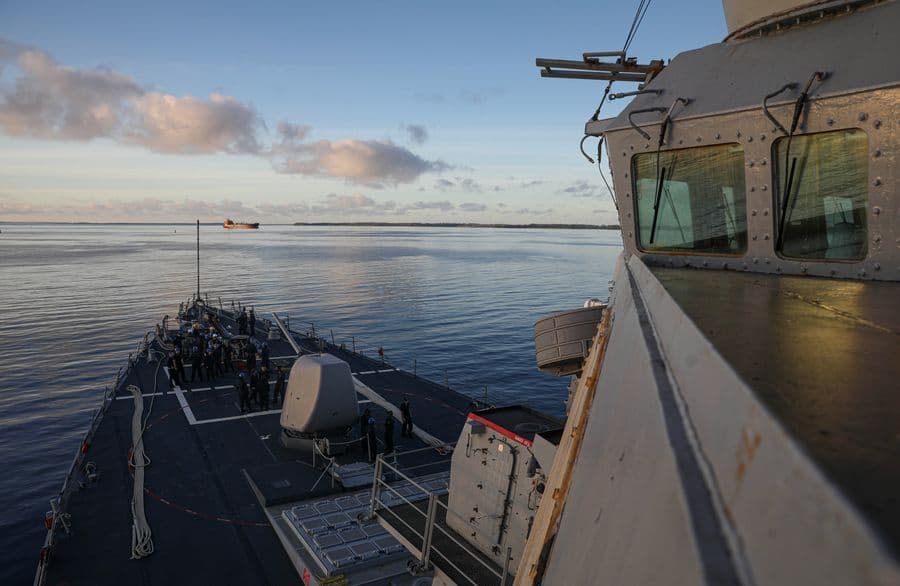
More than a hundred years later, Mahan’s concepts still resonate with naval strategists and geopolitical thinkers of many nations. Writing in the U.S. Naval War College Review, Raja Menon, a retired Indian Navy admiral and respected strategist, urges India’s leaders to turn to the strategic concepts of Mahan to promote economic prosperity and to prevent China’s attempt to dominate the Indo-Pacific region. India, he writes, will not be able to block China’s maritime ambitions unless it adopts a “Mahanian vision” for the Indian Ocean.
Menon sees the Indian Ocean as pivotal to China’s plans to supplant the United States as the world’s leading power. He notes that China already possesses the world’s largest navy, and its shipbuilding capacity dwarfs that of the United States. There is within the People’s Liberation Army Navy (PLAN) a “strong, pro-Mahanian lobby,” first identified by James Holmes and Toshi Yoshihara in their important book Chinese Naval Strategy in the 21st Century: The Turn to Mahan. Menon mentions Hu Bo’s book Chinese Maritime Power in the 21st Century: Strategic Planning, Policy, and Predictions as evidence of Mahan’s influence on China’s strategic thinking. Menon believes, however, that China’s immediate naval force structure is designed primarily to give it predominance in the South China Sea and parts of the western Pacific, but not as yet to dominate the world’s oceans.
Menon is not the first Indian strategist to invoke Mahan. In 1945, K.M. Panikkar wrote India and the Indian Ocean: An Essay on the Influence of Sea Power on Indian History, which Menon describes as an extensive elaboration of Mahan’s ideas to India’s geopolitical situation. Those ideas, Menon writes, are still relevant to India in the 21st century. “[S]ea power, Menon writes, “will be one of the cardinal factors in the rise of India on the global stage in the twenty-first century.”
Contemporary America’s best geopolitical thinker Robert Kaplan a few years back wrote a book titled Monsoon: The Indian Ocean and the Future of American Power, in which he suggested that the Indian Ocean region was now the geographical pivot of world politics. The Indian Ocean rimland, Kaplan notes, contain “the principal oil shipping lanes, as well as the main navigational choke points of world commerce—the Straits of Bab el Mandeb, Hormuz, and Malacca.” And he noted further that the “Indian Ocean is where the rivalry between the United States and China in the Pacific interlocks with the rivalry between China and India, and also with America’s fight against Islamic terrorism in the Middle East, which includes America’s attempt to contain Iran.”
Admiral Menon believes there is much India can learn from Mahan’s classic The Influence of Sea Power upon History, especially the connection between sea power in its broadest form and economic prosperity. A key element of India’s sea power strategy is Project Sargamala, initiated by Indian Prime Minister Narendra Modi in 2015, which seeks to “develop India’s ports to take advantage most fully of its key position in the Indian Ocean.” It has both economic and strategic aspects. Economically, Project Sargamala is designed to grow India’s exports and protect its imports (especially oil and gas) by protecting trade routes. Strategically, it is designed to “counter Chinese attempts to influence smaller countries of the Indian Ocean with the [Belt and Road Initiative].”
Menon explains that,
The project also aims to sponsor an integrated coastal surveillance system of the exclusive economic zones of smaller Indian Ocean countries, as well as act as the first responder to environmental disasters and large oil spills. India’s hope is that these initiatives will give substance to the stand taken by the Indian Ministry of External Affairs that the Indian Ocean countries will accept India as a net security provider in the region, as well as cooperate in trade and economic integration.
Menon includes in his article a map of India showing the numerous major and minor ports that dot the vast Indian coastline and that are grouped into commercial economic zones. Project Sargamala is a strategic approach that brings Mahanian concepts into 21st century geopolitics.
It is in the broader Indian Ocean rimland where U.S. and Indian strategic interests coalesce. In international relations, the enemy of my enemy is my friend, and China is the geopolitical enemy of both the United States and India. Geopolitically, India is the western edge of an arc of containment that stretches through Southeast Asia, Australia, the Philippines, Taiwan, South Korea, and Japan—all supported by U.S. Sea power. America, like India, needs to turn to Mahan.
Francis P. Sempa writes on geopolitics.
Beyond Hormuz: What Washington Should Expect from a Frontline Ally
By Daewon Cho • RealClearDefense
Putin, Plague, and the America’s Biodefense Gap
By Ryan Kane • RealClearDefense
Patriot Delays Force a New Air Defense Doctrine on NATO’s Eastern Flank
By Jan K. Varga • RealClearDefense
How the Army Can Turn Plans into Combat Power
By Matt Russell • RealClearDefense
Is It Déjà vu All Over Again: The 2012 Report on Global Zero
By Peter Huessy • RealClearDefense
U.S. Marine Corps Attack Helicopters Set for Major Upgrade
By C. Jones, Defence Blog
How the Iran War Compounded the U.S. Navy’s Maintenance Crisis
By Hartung, NatInt
Fielding Forces for Full Mobilization
By Jon Hoffman, Proceedings
BAE’s New Launcher Lets Warships Deploy and Replenish Missiles at Sea
By NextGenD
Why Is the Navy Spending $19 Billion on ‘Flying Gas Stations’?
By Mark Thompson, RS