
The Transparent Battlefield
Last updated 06:11 AM EDT • Read time: 8m
Why Modern War Is Driving the Rise of the Micro-Unit
Recent reporting from Ukraine points to a silent but consequential change in how ground combat is being fought. Russian forces have moved toward small assault elements, in some cases as few as four, or even just two, men, advancing under the cover of drones and indirect fire, while Ukrainian accounts describe dispersed teams probing, infiltrating and fixing positions while remaining difficult to detect. The pattern is consistent across multiple sources: large formations draw attention, attention brings precision fire and survival increasingly depends on remaining small, dispersed and connected to a wider system.
This is more than a battlefield adjustment as it signals a potential structural change in the basic unit of maneuver. For decades, Western doctrine has treated the section or squad as the foundation of infantry combat. That idea is now being challenged as constant and unrelenting surveillance from unmanned systems has altered the relationship between movement and exposure. Thermal imaging, loitering munitions, and real-time aerial reconnaissance compress the time between detection and strike. Under these conditions, the physical size of a unit can become a liability.
For the purposes of this paper, a micro-unit refers to a highly dispersed tactical element, typically consisting of two to four personnel, operating semi-independently while remaining tightly integrated into a broader sensor-to-shooter network.
In Ukraine, the response has been to reduce liability by reducing size and exposure. Small teams move in short, irregular leaps, often guided by overhead drones. These micro-units serve multiple roles:
Sensors: Identifying weak points or confirming enemy positions.
Fixers: Forcing the enemy to react and reveal themselves.
Finishers: Exploiting vulnerabilities when the opportunity allows.
Their effectiveness depends less on organic firepower and more on integration into a wider network that includes artillery, first-person-view (FPV) drones, and electronic warfare support.
The result is a battlefield where decisive action unfolds through a sequence rather than a single massed maneuver. A drone identifies a position; a micro-unit advances to confirm or pressure it; fires are adjusted in real time and follow-on systems maintain pressure. The tempo is set increasingly by information flow rather than by the mass of troops on the ground. The infantry element remains essential, though its function has transformed: it anchors the system, providing presence, judgment, and the ability to exploit fleeting opportunities.
This evolution broadly aligns with developments observed in Israel. The Israel Defense Forces created the multidimensional unit - often referred to as the Ghost or Refaim unit - designed to integrate ground forces with drones, precision fire, and intelligence assets at a much lower level than traditional formations. The concept aimed to shorten the distance between detection and engagement, allowing small teams to operate with disproportionate effect. Reports from recent operations suggest that this approach has matured into a coherent method of fighting, where units operate as part of a tightly linked sensor-to-shooter network.
A similar pattern - albeit under very different conditions - has emerged in highly asymmetric environments, most notably the civil war in Myanmar. There, anti-junta resistance forces, operating without the resources of a conventional military, have paired commercially available quadcopters with light infantry elements. Facing a state military with advantages in heavy artillery and armor, these forces have moved away from traditional platoon structures by necessity, relying instead on dispersed micro-teams to map positions, execute low-cost strikes and exploit vulnerabilities.
While these cases differ significantly in scale, capability and doctrine, their partial convergence is notable. Across Ukraine, Israel and Myanmar, the same underlying pressure is visible: the increasing transparency of the modern battlespace. Whether driven by industrial-scale attrition, institutional experimentation or insurgent necessity, the direction of travel is broadly similar. As the battlefield becomes more transparent, survival tends to favor dispersion, while effectiveness increasingly depends on connectivity.
This combination is contributing to the rise of the micro-unit.
This trajectory carries a further implication that deserves attention: exposure. As exposure becomes increasingly lethal, the number of humans required at the point of contact is likely to fall. This move is driven by necessity rather than preference, as high-risk tasks are already moving toward machines. Drones conduct reconnaissance and strike, while unmanned ground systems (UGSs) move supplies and deliver payloads. Each iteration reduces the need to place soldiers in exposed positions. The logical extension is a layered assault system in which machines absorb initial risk, while human elements act as decision-makers and integrators - directing effects rather than delivering them through mass.
This does not remove the need for human presence as ground must still be held, complex environments require judgment and civilian interaction demands strict ethical control. The change lies in how often and under what conditions, soldiers are exposed. Presence becomes more deliberate than constant, applied where human judgment carries the greatest value.
The micro-unit model also introduces a significant paradox. While dispersion enhances survivability, high-intensity conflict remains inherently attritional. When a four-man micro-unit suffers casualties, it can rapidly become combat ineffective, placing strain on Western armies already facing recruitment and personnel pressures.
For the United States and the United Kingdom, these realities raise immediate questions. Both maintain infantry structures built around sections and platoons designed for combined arms maneuver at scale. The challenge lies in aligning these capabilities with emerging battlefield conditions across four critical areas:
1. Force Design and Sustainment
Infantry units must be able to operate as distributed elements that function independently while remaining connected. This requires organic access to unmanned aerial systems at multiple levels, alongside a rethinking of combat logistics. Supplying dispersed micro-units - while conducting casualty evacuation without exposing the network - will likely depend increasingly on automated and autonomous resupply systems.
2. Decentralized Command and Control
Traditional hierarchies assume centralized oversight that becomes difficult to sustain under constant threat and dispersion. Commanders must set intent clearly and allow execution to unfold through decentralized action, with small teams operating beyond immediate supervision.
3. Signature-Centric Survivability
Small teams reduce physical visibility but remain vulnerable once detected. Protection shifts toward concealment, deception, and speed. Electronic warfare becomes critical both for protection and for degrading enemy observation, while signature management and disciplined movement regain prominence.
4. Integration of Fires
Micro-units depend on the ability to access and direct fires with precision. Training must ensure that even the smallest teams can integrate artillery, loitering munitions, and drone-delivered effects, compressing the sensor-to-shooter timeline.
There is also a profound human dimension as operating in small teams under constant surveillance places significant cognitive and physical demands on individuals. Fatigue, isolation and sustained psychological pressure may affect decision-making, raising important questions for selection, training, and resilience.
For commanders and defense planners, the direction of change is increasingly evident. Evidence from Ukraine, Israel and Myanmar suggests that the traditional foundations of infantry combat are evolving. The section remains a useful administrative and training construct, but its role in combat is changing. The micro-unit, integrated into a broader network of sensors and shooters, is emerging as a dominant tactical form in contemporary operations.
There is, however, an important operational caveat that dispersion alone does not produce decisive maneuver. While micro-units enhance survivability and flexibility, fragmented forces may struggle to generate breakthrough momentum or exploit collapsing defenses without larger formations capable of concentrating combat power. History consistently demonstrates that adaptation does not eliminate the enduring requirement for mass at critical moments.
The challenge for modern militaries, therefore, is not to replace larger formations entirely but to determine how dispersed micro-units can identify, shape, and create opportunities for heavier forces to exploit.
Western armies retain significant advantages in technology, resources, and professional training. Capitalizing on these strengths, however, will require institutional adaptation and a willingness to reassess established models. The trajectory of modern warfare points toward greater dispersion, faster decision cycles, and deeper integration of manned and unmanned systems. The infantry soldier remains central - but the form in which that soldier operates is evolving.
Modern warfare continues to evolve at pace, driven by technological change and battlefield adaptation. Armies not currently engaged in existential war must prepare not only to modernize but to continuously adapt - recognizing that any structure adopted today may require revision tomorrow. What appears increasingly clear, however, is that the traditional reliance on concentrated mass as the dominant expression of combat power is being steadily challenged under the conditions of the modern, transparent battlefield.
Casey Christie is a British defence strategist specializing in international security. He is the Managing Director of Christie and Associates, a London-based private military and intelligence firm. His work has appeared in the Times of London, The South African Sunday Times, Ukraine’s Kyiv Post and Small Wars Journal, among others.
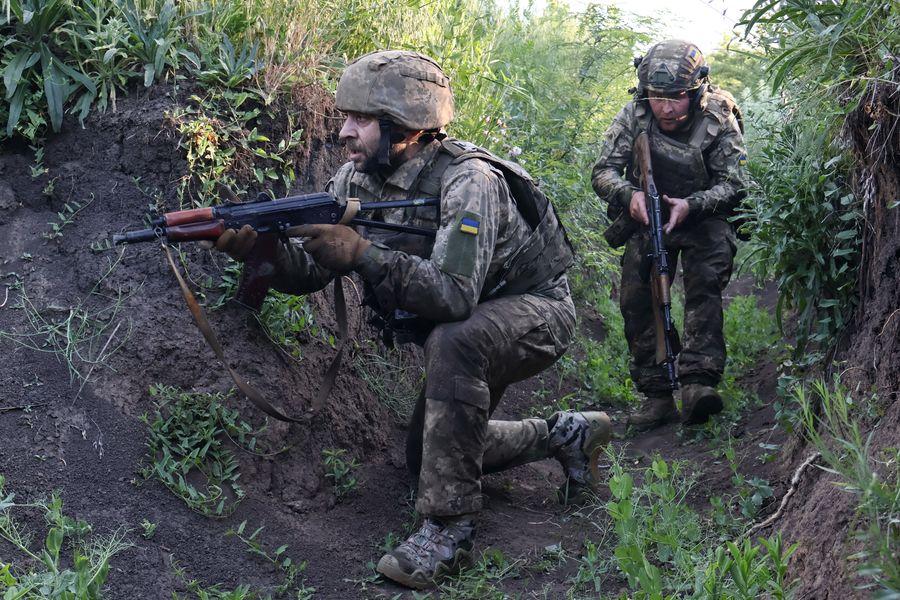
image: In this photo provided by Ukraine's 65th Mechanized Brigade press service, soldiers practice military skills at a training ground near the frontline in the Zaporizhzhia region, Ukraine, Thursday, June 11, 2026. (Andriy Andriyenko/Ukraine's 65th Mechanized Brigade via AP)

Don’t Be Swayed by Tactical Nukes
By Benjamin Giltner • RealClearDefense
How Seoul’s Break With Kyiv Serves Trump’s Russia Turn
By Sang Won Pyo • RealClearDefense
When the Grid Goes Down, the Mission Must Go On. Solar and Storage Can Help.
By John Szoka • RealClearDefense
Data and Communications Technology are the Hidden Keys to Success for Golden Dome
By Eric Velte • RealClearDefense
The Dual Threat: Why Beijing’s Collapse Is Just As Dangerous as Its Rise
By Efraín Vázquez-Vera • RealClearDefense

USS Stout Loses Power During Port Visit Due to ‘Engineering Casualty’
By USNI News
Air Force Lessons Learned From Operation Epic Fury
By Tabitha Reeves, National Defense
Marines Need Nine More Amphibious Warships To Carry Out Its Missions
By TWZ
AFRL, ACC Fly XQ-67A Drone To Test Autonomous Teaming
By Airforce Technology
F-35B Releases Meteor BVRAAM for the First Time
By Parth Satam, The Aviationist