
Congress Needs Clearer Insight into Defense Innovation
Published Aug. 14, 2026 • Read time: 5m
Congress can track the purchase of an aircraft carrier to the dollar. Yet it struggles to answer a simple question: How much is America investing in military autonomy? As defense technology evolves, the question grows more urgent.
As lawmakers debate autonomous systems, artificial intelligence, and other mission-driven technologies, discussions cite multibillion-dollar investment totals. Yet those totals combine annual appropriations, multi-year investments, and enabling technologies into a single number. While useful, they can obscure what Congress must oversee: the programs, platforms, and capabilities that taxpayer dollars deliver.
The Department of War is investing in unmanned aircraft, ships, ground vehicles, artificial intelligence, software, communications, cloud infrastructure, sensors, cyber capabilities, and manufacturing capacity.
Those investments are essential—but distinct. An AI-enabled command-and-control network is not an autonomous aircraft, just as cloud infrastructure is not an unmanned surface vessel. Congress needs to distinguish operational systems from enabling technologies.
Defense innovation financing has changed. For decades, military innovation followed a predictable path: Congress appropriated funding, the Department of War defined requirements, industry developed solutions, and the military purchased products. That model no longer describes how defense innovation reaches the battlefield.
Innovation begins long before a procurement contract is awarded. Private capital—from venture firms and private equity to commercial lenders and strategic investors—finances research, engineering, manufacturing, and production years before companies receive government contracts.
Buy Smarter, Fly More
The Defense Department's Reorganization Problem Comes to Fightertown
America Needs To Spend More on Defense and Build More With It
The Factory Floor and the Balance Sheet
Last year's reconciliation law directed $150 billion in multi-year defense funding for uncrewed systems and drones. Unlike annual appropriations, multi-year funding provides certainty for production and industrial expansion.
America relies on four sources of innovation financing: annual congressional appropriations, multi-year strategic investments, private capital, and corporate reinvestment in manufacturing and industrial capacity.
Replicator was designed to accelerate adoption of commercially developed technologies rather than create them from scratch. Yet Replicator has lagged its ambitions, underscoring the oversight problem.
Federal investment is accelerating a private innovation ecosystem. In 2025, defense technology startups attracted a record $49.9 billion in venture investment, according to PitchBook—nearly double the amount raised in 2024.
Michael Cadenazzi, the DoW's industrial policy director, observed that investors are bringing capital, companies, and talent into defense. This strengthens national security but creates an oversight challenge.
Private investment is not something Congress appropriates, but it shapes how federal dollars translate into military capability. Without visibility into the ecosystem, Congress cannot evaluate the effectiveness of public investment.
Congress does not oversee ecosystems—it oversees budgets. Without a common accounting framework, lawmakers cannot distinguish between investments in operational autonomous platforms, enabling technologies, industrial capacity, and privately financed innovation. That makes it harder to evaluate priorities, measure progress, and exercise oversight.
America's defense spending advantage does not translate directly into modernization capacity.
The United States spent roughly $954 billion on defense in 2025—about one-third of global military spending, and several times more than China's estimated $336 billion or Russia's estimated $190 billion.
But much of that budget supports a globally deployed military neither rival maintains. The Pentagon maintains at least 128 bases in 51 countries, sustaining forces across the Indo-Pacific, Europe, and the Middle East, while China's and Russia's reach barely extends past their own regions.
Personnel costs reinforce the point. Military compensation consumes roughly 28 percent of the Pentagon's budget, reflecting the cost of an all-volunteer force. Neither China nor Russia carries that burden the same way.
None of this erases America's advantage. But because overseas posture and personnel costs consume a substantial share of the budget, the dollars available for autonomous systems modernization are more constrained than the topline figures suggest. Congress cannot afford to lose visibility into where those scarce dollars go.
Misaligned accounting creates problems. Hidden bottlenecks in industrial capacity go undetected. Resources are misallocated. Lawmakers overestimate capabilities when they cannot distinguish between what has been developed and what has merely been funded. Strategic competitors move faster because they see gaps America cannot see.
Congress should modernize its approach. The Department of War and the Office of Management and Budget should develop a classified annual Autonomous Systems Budget Crosscut that identifies investments in operational platforms, research and development, enabling technologies, industrial capacity, and multi-year funding.
Congress should also account for how private capital complements federal investment across the defense innovation ecosystem.
Congress needs the strategic oversight that guided America's greatest defense mobilization. In the years going into World War II, as Arthur Herman describes in Freedom's Forge, America developed a wartime production system that was "the most powerful and flexible system of wartime production ever devised, because in the end no one devised it."
Roosevelt paired strategic direction with private-sector execution, empowering industry leaders to drive production. Today's defense innovation ecosystem requires the same approach: Congress must understand how private capital, multi-year funding, appropriations, and corporate reinvestment advance autonomous systems—not to direct innovation, but to guide it strategically.
Military superiority will not be determined solely by the size of defense budgets. It will depend on how effectively the United States combines public investment with private ingenuity to move technologies from prototype to operational capability.
The Constitution gives Congress the power of the purse, and that authority requires lawmakers to understand how America's military capabilities are financed. Defense innovation has changed. Congress's oversight tools must evolve with it.
James Carter is a Principal with Navigators Global. He previously served as Chief Economist and Senior Tax Advisor to the U.S. Senate Budget Committee, Deputy Assistant Secretary for Economic Policy at the U.S. Treasury, and as a Senior Fellow at the America First Policy Institute. Timothy Maney is a board member of Zenith Intelligence Group and directed the Federal Budget and Appropriations portfolios for the U.S. Chamber of Commerce from 2000 to 2024.
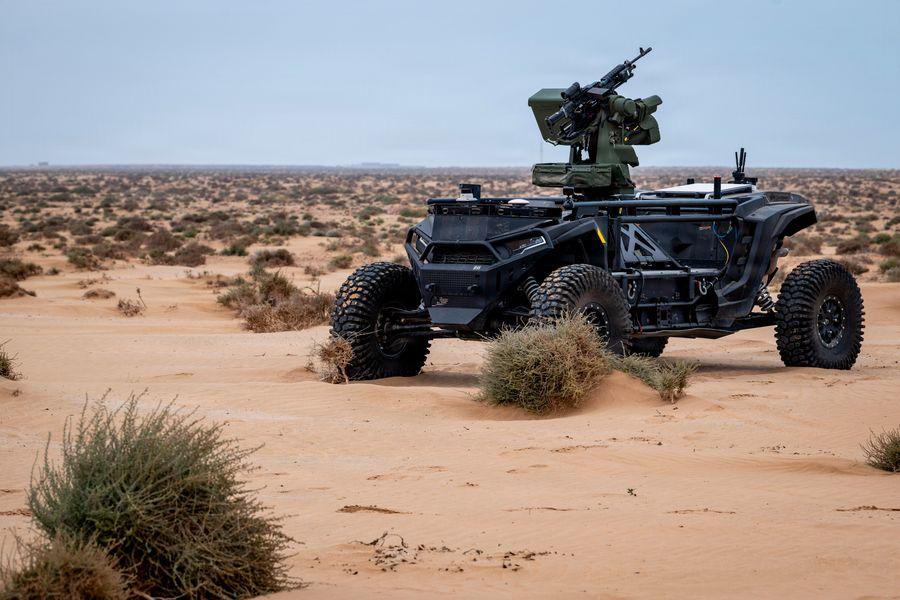
image: An autonomous tactical vehicle is parked after navigating on a plotted course during African Lion 26 at Cap Draa, Tan-Tan, Morocco, April 26, 2026. The exercise served as a multidomain training and experimentation center - Morocco, where service members tested artificial intelligence-powered and autonomous platforms, remote systems, and emerging technologies across attack, defense and mission command operations. The experimentation accelerated target detection, shortened decision timelines and delivered cost-effective warfighting solutions aligned with African partner priorities. (U.S. Navy photo by Mass Communication Specialist 2nd Class Samuel Wagner)

Ending the Conflict with Iran
By Anthony Cowden • RealClearDefense
Going After the Cyprus Money Laundering Hub
By Lise Korson • RealClearDefense
Don’t Bet Against CMMC
By Thomas Graham • RealClearDefense
When Losing Control of AI Becomes a Weapon
By Yunus Emre Tumen • RealClearDefense
International Allied Reliability of States: Criteria and Evolution
By Sergey E. Ivashchenko • RealClearDefense

Coast Guard’s Updated Force Design Plan Includes Maven Smart System
By DS
F-22 Raptor Commands MQ-20 Avenger From the Cockpit
By K. Osborn, Warrior M.
ULA’s Vulcan Rocket Is Grounded for Third Time
By I. Klotz, V. Machi, Aviation Week
Tragedy That Convinced the Coast Guard It Needed Rescue Swimmers
By WATM
USAF Contracts Final KC-46 Lot of Original Production Deal
By Satam, The Aviationist