
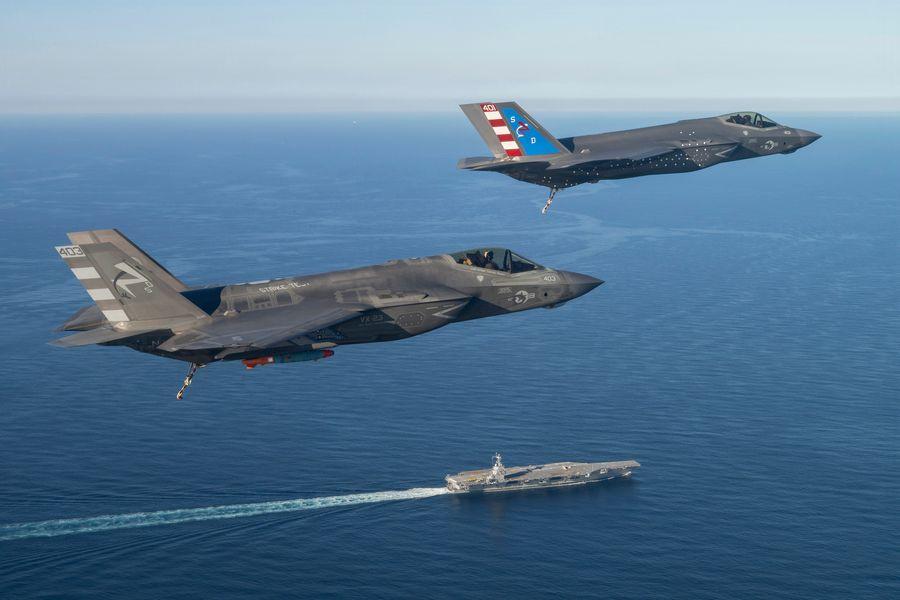
Two F-35 test pilots from Air Test and Evaluation Squadron Two Three (VX-23), Naval Air Warfare Center Aircraft Division (NAWCAD), fly F-35C Lightning II fighter aircraft to the PCU John F. Kennedy (CVN 79) in the Western Atlantic Oct. 13, 2026. This is the first time an F-35C has landed on a Ford-class aircraft carrier. A Patuxent River F-35 Integrated Test Force (ITF) team detached to the ship is conducting Aircraft Compatibility Testing (ACT) with the specially instrumented carrier variant of the stealth jet. ACT assesses the operational capabilities of the ship's aircraft launch and recovery equipment with U.S. Navy aircraft.
Buy Smarter, Fly More
Create Certainty amid Uncertainty to Strengthen America’s Defense
Published Nov. 16, 2026 • Read time: 6m
The FY27 National Defense Authorization Act and FY27 Defense Appropriations remain to be finalized in the 119th Congress’s last few weeks. Enactment of one particular provision under consideration is a means for Congress to decisively fulfill its members’ repeated calls to increase the speed and volume of the firepower that industry delivers to the joint force.
The War Department and Lockheed Martin announced a landmark framework agreement on 22 October that guarantees the minimum production of 850 F-35 Lightning IIs over the next decade and commits Lockheed Martin to invest at least $7 billion of its own capital in the program. The deal, however, remains subject to congressional authorization and appropriations. Congress should now provide the funding necessary to turn this ten-year framework into a durable production agreement.
How We Got Here
After the Last Supper at the close of the Cold War, the United States took much of its defense industrial base for granted, treating it like a resource that could be quickly regenerated when needed. The return of great-power competition has exposed the folly of that assumption. Washington now demands a generational leap in military modernization while retaining antiquated procurement practices that make it difficult for American industry to deliver.
And while Congress and the Trump administration deserve credit for increasing defense spending, rebuilding American industry requires more than larger appropriations. The industrial base is not a switch that the Pentagon can flip on when war becomes imminent. To function in wartime, predictable demand must be maintained in peacetime to support machinists, engineers, technicians, industrial knowledge, and thousands of small businesses.
Air Force Lt. Gen. David Tabor, deputy chief of staff for plans and programs, recently acknowledged this problem while discussing ongoing multi-year-fighter procurement negotiations. Long-term agreements, he argued, would give industry the confidence to invest. "I personally think that yes, that is a good incentive for them to actually see the money into the future and not be beholden to this kind of erratic appropriation process," Tabor said. "It would be great if we can get on that path."
Incremental procurement plans may temporarily allay political fears, but they do nothing to support the long service lives of contemporary weapons.
This new framework for fighters is an encouraging answer to Tabor's concerns.
The Proven Long Term Procurement Model
There is nothing particularly novel about multi-year procurement. Rather than negotiating successive year-to-year purchases, the government commits to a predictable requirement over several years. A manufacturer with ten years of orders can then make investments that would be nearly impossible to justify on a one-year contract. Multi-year procurement is also not confined to comparatively simple weapons such as ammunition. The Pentagon has previously employed multiyear procurement for aircraft including the F-16 Fighting Falcon, F/A-18E/F Super Hornet, C-130 Hercules, and C-17 Globemaster.
The benefits are particularly important farther down the supply chain. A large prime contractor can generally withstand fluctuations in government purchasing - while a small company producing specialized aircraft components may not. Creating predictable demand gives suppliers a reason to expand rather than retrench and survive.
The proposed ten-year arrangement covers production and sustainment, which could stabilize the market, allow for expanded repair capacity, increase spare parts, and preserve the skilled workforce supporting the fleet.
Increased Readiness
The F-35 fleet will remain a central element of allied airpower potentially through the 2080s and we must keep it flying. A fighter waiting for a replacement part is even more of a drain than one that has never been delivered. Non-mission-capable aircraft consume hangar space and money while contributing nothing to readiness.
The Navy's H-60 Seahawk provides a useful example of what sustained investment in spare-parts availability can accomplish. Through a long-term performance-based logistics partnership, the Navy increased material availability from 69 percent to more than 95 percent. More recently, the Navy recognized a seven-year H-60 sustainment initiative that improved material availability from 68 percent to 92 percent, and eliminated backorders for components supporting the helicopter's sonar system.
These examples are particularly relevant to the new F-35 framework, which includes spare parts, modification kits, and sustainment alongside aircraft production. More available spare parts mean more operational aircraft. Congress should consider those readiness benefits alongside the cost of new aircraft when evaluating the merits of the agreement.
No Blank Check
Critics will have legitimate concerns about cost savings before endorsing a decade-long commitment. But the alternative, relying on year-to-year contracts, does little to resolve the uncertainty that contributes to parts shortages and constrained readiness. It is much more fiscally prudent to sustain decisive systems through a disciplined, long-term arrangement rather than a fragmented approach.
None of this means handing contractors a blank check. On the contrary, this is a call for even more demanding government oversight. GAO has warned that poorly executed multiyear contracts can produce cost overruns and restrict future budgetary flexibility. This new framework takes an important step by securing at least $7 billion in private investment from Lockheed Martin, showing that the company is ready to share responsibility and put its own capital at risk to facilitate the program’s success. Congress should ensure that the agreement's implementation includes enforceable delivery schedules, spare-parts packages, annual readiness benchmarks, demonstrated savings, and penalties should contractors fail to deliver. It should also preserve the flexibility for major changes in technology or operational requirements.
Congress and the administration have begun moving in the right direction. The F-35 framework demonstrates that the Pentagon and its industry partners are willing to make the long-term commitments necessary to rebuild American industrial capacity. The question now is whether Congress will authorize the corresponding financial commitment. A ten-year framework doesn’t give industry the certainty it needs if funding remains hostage to the same annual uncertainties the agreement was designed to overcome.
The proposed F-35 agreement is backed by substantial private investment and offers the national security community a generational opportunity to build that capacity and produce measurable improvements in readiness. It is unwise to plan on using a fighter for another sixty years but hesitate to fund the industrial capacity needed to maintain it for ten.
Jeff Kojac was a Marine Corps officer for 30 years and is now Director of Studies at the Baroni Center for Government Contracting, Costello College of Business, George Mason University.

End the Jones Act Waiver
By Mark H. Buzby • RealClearDefense
Prediction Markets Are Becoming a New Frontline for Military Operational Security
By Yang Yunke • RealClearDefense
Can Robots Bring Maneuver Warfare Back?
By Ayeza Areej • RealClearDefense
Buy Smarter, Fly More
By Jeff Kojac • RealClearDefense
Stop Gutting the Conventional Army
By R.D. Hooker, Jr. • RealClearDefense
Hung Cao Facing Contentious Confirmation To Become Navy Secretary
By Konstantin Toropin • Associated Press
U.S. Marines Expand M27 Rifle Contract
By Inder Singh Bisht
Kadena AFB Gets First F-15EX Eagle IIs
By Emily Ryan Miller, Defence BlogHung Cao Facing Contentious Confirmation To Become Navy Secretary
By AP
Fair Winds, Peacoat and Desert Camo: Navy Makes Big Changes to Seabag
By MTimes