
Not Only Robots: Warfare Will Still Need Humans
Last updated 03:09 PM EDT • Read time: 4m
Future warfare won’t be entirely robotic. Yes, people will gradually disappear from battlefield environments where speed, endurance, distance, precision or physical danger overwhelmingly favour use of machines. But people will remain essential where warfare demands contextual judgment, intuition, interaction with civilians and accountability for life-and-death decisions.
The rapid penetration of AI and autonomous systems into warfare is already visible on the battlefields of Ukraine and the Middle East. Two powerful forces are accelerating this trend.
First, advances in AI, sensors, robotics, communications and computing power are enabling autonomous systems to perform missions that only a decade ago required highly trained human operators. Thousands of drones now conduct reconnaissance and strike missions. Autonomous boats patrol coastlines and attack enemy boats and port facilities. Ground robots deliver supplies and clear minefields. AI analyses intelligence at speeds no human staff can match.
Second, across much of the developed world, democratic societies have become increasingly reluctant to accept military casualties. Political leaders face growing public pressure to conduct operations with no boots on the ground. Autonomous systems allow governments to sustain military operations without paying the political price of mounting casualties.
Observing these trends, it is tempting to conclude that the era of the human soldier is approaching its end.
That conclusion, however, is premature.
Space warfare has already become predominantly autonomous. Satellites continuously detect threats, coordinate with one another and process vast quantities of data with limited human intervention. Future space warfare will demand decisions far faster than human reaction times allow. Yet humans will still need to control space operations, intervene at critical junctures to prevent catastrophic outcomes and decide whether to launch attacks or counterattacks.
Air warfare follows close behind. Rather than replacing crewed fighters altogether, AI is more likely to redefine the pilot’s role, at least for the next few decades. As drone swarms become faster, cheaper and more capable, tomorrow’s fighter pilots may spend less time personally engaging enemy aircraft. Instead, they may spend more time orchestrating formations of autonomous aircraft that conduct reconnaissance, electromagnetic warfare, suppression of enemy air defences, decoy operations and precision strikes. The pilot increasingly becomes a battlefield manager rather than a lone aerial warrior. Drones will also replace some helicopter missions, but human pilots will remain essential for complex tasks such as low-altitude aerial fire support in urban environments, where a single error can kill friendly forces or civilians.
Naval warfare is likely to follow a similar path. The oceans naturally favour autonomous systems: surface and underwater vessels can remain on station for months without exposing sailors to danger. They already perform surveillance, mine clearance, anti-submarine and intelligence missions with growing sophistication. As sensors, communications and AI improve, fleets of autonomous maritime craft may eventually replace much larger and more expensive crewed warships. Still, human-operated vessels will be needed for complex missions such as conducting searches on commercial boats sailing in international waters or carrying out amphibious landings and establishing beachheads.
Ground warfare presents a very different challenge. Open terrain favours machines. Autonomous vehicles can transport supplies, evacuate casualties, detect mines and engage armoured formations with increasing effectiveness.
But modern battlefields rarely resemble open deserts or empty plains.
Modern wars are increasingly fought in dense urban environments, forests, mountains and sprawling underground tunnel networks – environments profoundly hostile to autonomous systems. Satellite-navigation signals may be unavailable, communications unreliable, visibility severely limited and maps quickly obsolete. Every doorway, staircase, tunnel junction or collapsed building may conceal a new tactical surprise.
More importantly, modern wars increasingly blur the distinction between combatants and civilians. Distinguishing a civilian carrying groceries from a terrorist who’s concealing explosives requires more than advanced sensors or pattern-recognition algorithms. It demands contextual understanding, cultural awareness, ethical judgment and legal accountability for decisions that may determine whether innocent people live or die.
People will have to do this.
AI will undoubtedly improve, and autonomous ground systems will assume a growing share of military missions. But the environments in which modern armies increasingly operate continue to reward qualities that machines struggle to replicate: adaptability, intuition, moral judgment and the ability to interpret ambiguous human behaviour.
For the foreseeable future, therefore, the question is unlikely to be whether robots will replace soldiers. It is how soldiers and intelligent machines will fight together, and how militaries should redesign their forces to make the most of each.
Boaz Golany is a senior research fellow at the Neaman Institute and an emeritus professor at the Technion – Israel Institute of Technology where he has also served in various leadership positions. He also serves as a board member and strategic consultant to some companies and organisations.
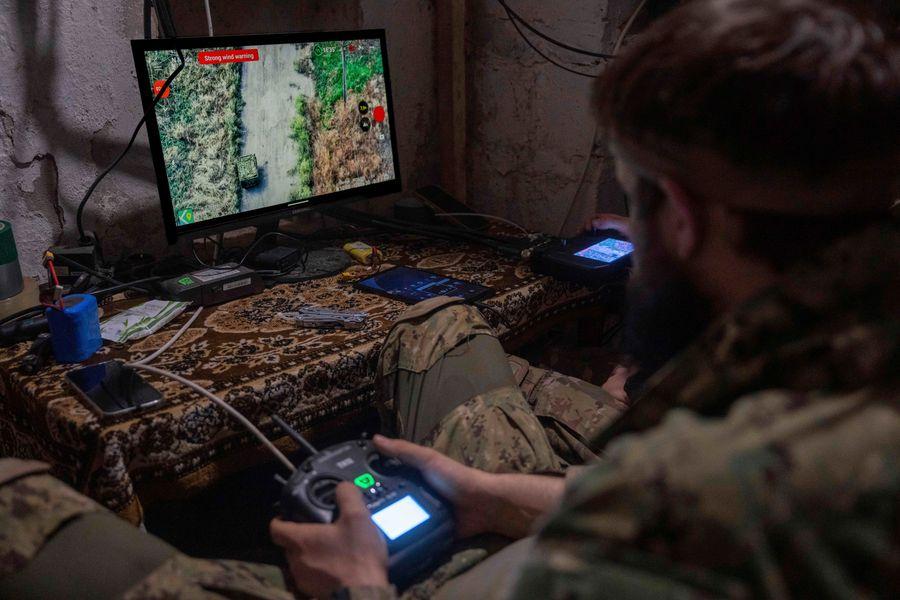
image: Ukrainian servicemen navigate land and aerial drones near Kostiantynivka, Ukraine, on Wednesday, Sept. 10, 2025. (AP Photo/Alex Babenko)
AI contributed no ideas to this article – Boaz Golany.
This article appeared originally at The Strategist (ASPI).

Don’t Be Swayed by Tactical Nukes
By Benjamin Giltner • RealClearDefense
How Seoul’s Break With Kyiv Serves Trump’s Russia Turn
By Sang Won Pyo • RealClearDefense
When the Grid Goes Down, the Mission Must Go On. Solar and Storage Can Help.
By John Szoka • RealClearDefense
Data and Communications Technology are the Hidden Keys to Success for Golden Dome
By Eric Velte • RealClearDefense
The Dual Threat: Why Beijing’s Collapse Is Just As Dangerous as Its Rise
By Efraín Vázquez-Vera • RealClearDefense
USS Stout Loses Power During Port Visit Due to ‘Engineering Casualty’
By USNI News
Air Force Lessons Learned From Operation Epic Fury
By Tabitha Reeves, National Defense
Marines Need Nine More Amphibious Warships To Carry Out Its Missions
By TWZ
AFRL, ACC Fly XQ-67A Drone To Test Autonomous Teaming
By Airforce Technology
F-35B Releases Meteor BVRAAM for the First Time
By Parth Satam, The Aviationist