
China and 'The Suicidal Mania of American Business'
Last updated 04:49 PM EDT • Read time: 6m
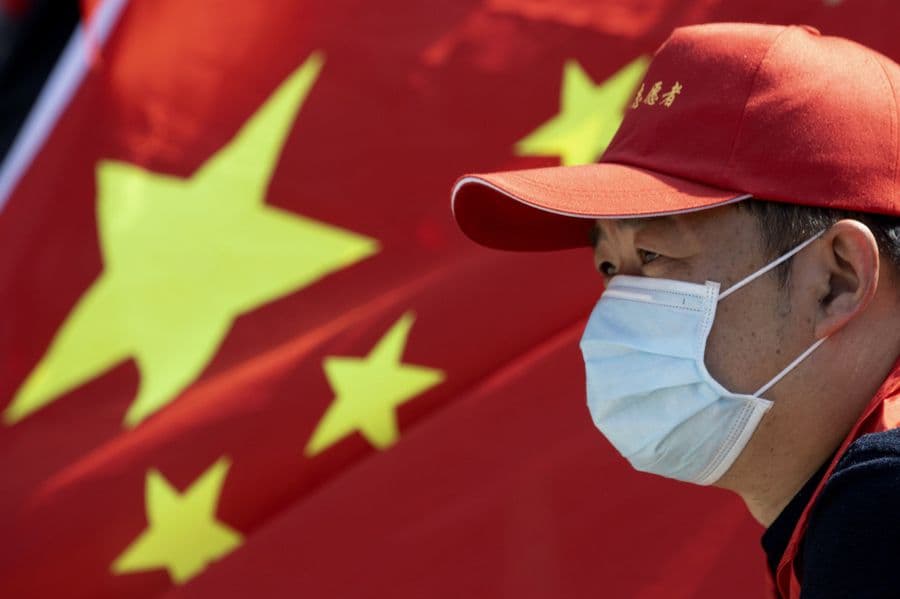
As the U.S. economy reels from the government-imposed shutdown of businesses large and small, and as the COVID-19 virus, unleashed on the world by the perfidy of the Chinese Communist Party (CCP), wreaks havoc on the American people (more than 60,000 deaths thus far), there are important voices warning America about our own capitalists’ role in aiding the rise and expansionist goals of our principal adversary, the People’s Republic of China.
In 2002, in the Introduction to my book Geopolitics: From the Cold War to the 21st Century, at a time when U.S. policy was understandably focused on the terrorist threats from the Middle East/Southwest Asia, I wrote that “the international system created by the end of the Cold War is being challenged by the rise of China in the East Asia-Pacific rim region.” I recommended that to meet this new challenge, we needed to “familiarize ourselves with the timeless methods of geopolitical analysis employed by the great geopolitical theorists,” including Mackinder, Mahan, Spykman, and James Burnham.
Over the next 18 years, and especially since the coming to power of Chinese President Xi Jinping, the CCP has embarked on a geopolitical offensive that encompasses the “Heartland” of Central Asia, the European and Asian “Rimland,” Africa, and the South China Sea-Indian Ocean waterway through which travels so much of the world’s energy supplies and goods. This is China’s so-called Belt and Road Initiative (BRI), the goal of which, as Robert Kaplan has pointed out, is to give China preeminent power on the Eurasian-African “World-Island.”
The United States faced a similar challenge during the 45-year struggle known to history as the Cold War when Soviet communist power based in the Eurasian Heartland and Eastern Europe threatened the peripheral areas of Western Europe, the Middle East, and East Asia. America and its allies (including for a time Communist China) contained then undermined Soviet power, resulting in its largely peaceful collapse in 1989-1991.
The tipping point in the West's victory over Soviet communism came in the 1980s when President Ronald Reagan confronted the Soviets across the geopolitical spectrum. He rebuilt America's military power and confidence that had suffered decline in the wake of our defeat in Vietnam. He provided assistance to anti-communist forces that were struggling against Soviet client states. He built-up U.S. strategic nuclear forces and launched the Strategic Defense Initiative (SDI) to offset a growing Soviet first-strike capability. And, he waged economic warfare against the Soviets—restraining key exports and devaluing commodities, especially oil, that the Soviets relied on for funding their military and geopolitical ambitions.
In the late 1970s when the Soviets were on the geopolitical offensive, and Soviet leaders believed that the "correlation of forces" had shifted in their favor, a bipartisan group of Americans formed the Committee on the Present Danger to promote a shift in U.S. policy from détente to geopolitical confrontation, what President Reagan later called “peace through strength.” Ronald Reagan was a member of the Committee, and when he became President, he staffed important positions in the national security bureaucracy with Committee members.
Today, that committee has been revived as the Committee on the Present Danger China, and some of its members have taken to the airwaves, social media, the internet, and print media to promote policies to meet the challenge of the CCP.
One key area of the Committee’s focus is economic warfare, and one of the Committee’s spokespersons is Roger Robinson, who played an important role in crafting the economic warfare policies that helped lead to the fall of the Soviet Union.
Robinson and others have pointed out that American businesses and Wall Street, narrowly focused on profits, have effectively invested in and helped fund the BRI and China’s growing military. And as we are learning during the COVID-19 crisis, we have ceded control of our strategic and medical supply chain to Chinese companies controlled by the CCP. This is not a new phenomenon.
In the second volume of his Cold War trilogy, The Coming Defeat of Communism (1950), James Burnham included a chapter entitled “The Suicidal Mania of American Business.” It makes interesting reading today. Burnham, a former Marxist, praised American business generally for opening and building our continental nation “on the perspective and scale of Alexander Hamilton’s unprecedented vision.” For that and the widespread economic prosperity they helped produce, he wrote, American businesses are to be honored. But, he wrote, “in relation to the struggle against communism, the American businessman is too ignorant, too greedy, too reactionary and, in a certain sense, too cowardly.”
Most ominous about American businesses in general, Burnham noted, is their pressure for “trade with the enemy.” Businesses, he wrote, “are irked by . . . restrictions on exports to the communist empire.” Most relevant to today’s situation, Burnham wrote: “As the communists swept south in China [on their way to victory in the Chinese civil war in 1949], the businessmen in the China trade bowed to the ground before them, and asked only for the privilege of supplying them with what they need to consolidate their conquest.” Here, Burnham continued, greed was manifest, but ignorance was "even more devastating" because "to trade on a big and unrestricted scale [with the communists] is to prepare suicide—or, rather, to build the guillotine for one's own executioner."
Burnham in 1950 foresaw what the Committee on the Present Danger and President Reagan saw in the 1980s, and what the Committee on the Present Danger China sees today: "The inability of the communists to solve their economic problem is probably their greatest weakness and our greatest protection." But, Burnham noted, American business, in general, is "ignorant, abysmally ignorant, about what communism is, what communists are."
That ignorance of communists and their goals, he noted, extended to the media enterprises, Hollywood and Broadway. And in some cases, it was not ignorance but rather sympathy that fostered benign views of our enemies. Again relevant to our own time, Burnham pointed to the plethora of books and articles in the mid-to-late 1940s that portrayed the Chinese communists as liberal agrarian reformers, rather than the ruthless, murderous gangsters they were.
As Wall Street continues to invest the money of Main Street in China and CCP-controlled businesses, Burnham's final warning resonates: "Communists . . . do not make deals; they make traps: an oath to an infidel does not bind." We ignore this warning at our peril.
Francis P. Sempa is the author of Geopolitics: From the Cold War to the 21stCentury, America’s Global Role: Essays and Reviews on National Security, Geopolitics and War, and Somewhere in France, Somewhere in Germany: A Combat Soldier’s Journey through the Second World War. He has written lengthy introductions to two of Mahan’s books, and has written on historical and foreign policy topics for The Diplomat, the University Bookman, Joint Force Quarterly, the Asian Review of Books, the New York Journal of Books, the Claremont Review of Books, American Diplomacy, the Washington Times, and other publications. He is an attorney, an adjunct professor of political science at Wilkes University, and a contributing editor to American Diplomacy.

Trump's Disrupt First, Negotiate Second: Greenland in Focus
By Meda Parameswara Reddy • RealClearDefense
In Seeking Peace With Beijing, Taipei Is an Asset, Not a Burden
By Alexandru Filip • RealClearDefense
Strike First: Israel's Inevitable Doctrine for the Iranian Axis
By Lance Gordon • RealClearDefense
It’s Not President Trump but Thomas Friedman Who Should Be Ashamed
By Francis P. Sempa • RealClearDefense
Putin, Plague, and America’s Biodefense Gap
By Ryan Kane • RealClearDefense
U.S. and Japan Begin Naval Exercises Near Taiwan
By Mari Yamaguchi • Associated PressU.S. and Japan Begin Naval Exercises Near Taiwan
By Mari Yamaguchi, AP
U.S. Navy, Gecko Robotics Surge AI Maintenance Contract
By Ceder, Simkins, Navy T.
Ghost Shark XL-AUV Payload Bay Seen For First Time
By Thomas Newdick, The WarZone
Dakota Meyer Tapped As Barracks Task Force Senior Advisor
By C. Stassis, MC Times