
Defense Industry Can Help Local Governments Struggling With Natural Disasters
Last updated 07:12 AM EST • Read time: 5m
Defense capabilities like those I flew in combat in the Middle East can save lives from natural disasters on the home-front – from my new home in northern California to the Gulf Coast and beyond.
When you think of drones or aircraft with advanced sensors, long endurance, and data fusion capabilities, you probably think of military command structures and war zones – not local governments and natural disasters. But assets developed by the defense industry have powerful applications at home – against wildfires, tsunamis, and earthquakes – and against the “human security challenges” confronting communities across America, like search and rescue, counter-narcotics, and illegal immigration.
As a Kiowa Warrior helicopter pilot, I saw some of these platforms in action firsthand while flying combat missions in Iraq and Afghanistan. Now, as a newly relocated Northern California resident, I see enormous opportunity for these same capabilities – and a host of others –to better protect regions plagued by wildfires and other natural disasters.
With 2021 ranking as the third costliest year on record for extreme weather disasters, the defense industry and local governments should work together to exploit these capabilities to the fullest.
Rising temperatures and drought have made for arid terrain and worsened fire conditions leading to a sharp rise in the frequency of wildfires. California is a prime example. The California Department of Water Resources reports 2021 was the second-driest year in the state’s history. This past summer and fall, the Dixie fire in Northern California burned almost 1 million acres, wreaking three months’ of havoc along the West Coast. It was California’s second-largest fire on record, just after last year’s August Complex fire – the biggest ever recorded.
Stanford Law Professor Buzz Thompson, one of the nation’s leading water law experts, recently described it like this: "We have in the western United States, gone from the situation where droughts occurred once every 10 or 20 years, to a situation where we never seem to leave a drought for very long before we enter into it again. We used to talk about fire seasons. Nowadays, we talk about fire years because they last all year long” (emphasis added).
These challenges claim lives, cripple local economies, destroy natural habitats, and consume billions of dollars of economic productivity. But defense technology can help solve them – while providing a safer solution for responders. For over 20 years, the US government has encouraged defense contractors to innovate and develop technologies to find and track terrorists in difficult terrains. With slight modifications, that technology should be made more broadly available throughout the nation.
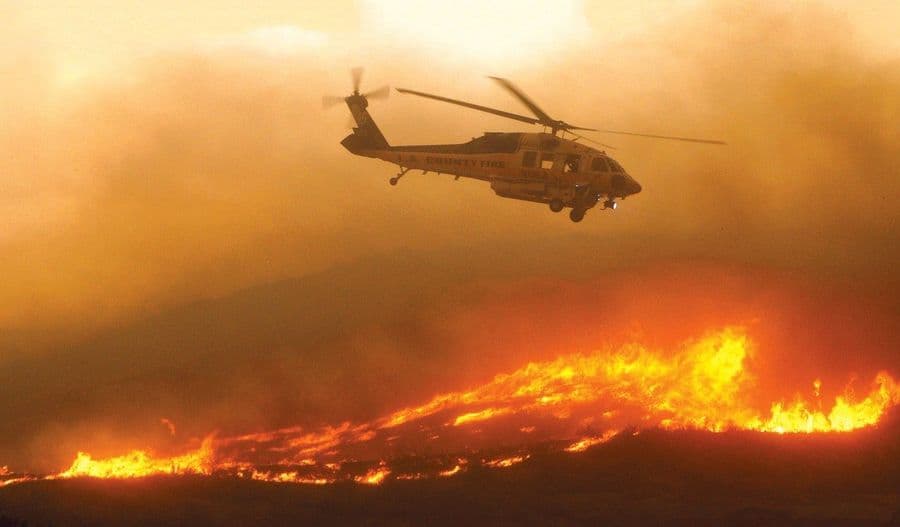
For example, the Firehawk S-70i is a battlefield-proven aircraft that’s been transformed from an original Black Hawk helicopter into an aerial firefighting and utility mission aircraft with enormous value to air and ground wildfire fighting units. Beyond its 1,000-gallon external water tank, this multi-mission aircraft provides an increased power margin while inserting firefighters to a fire line and can be quickly reconfigured for search and rescue, hoist rescue, and medical transport.
But one of the most valuable things the Firehawk provides is time when it matters most, delivering people and resources where and when they’re needed.
Time is your most valuable asset when the heat is on. Flying a Kiowa Warrior in some of the most unforgiving, dangerous terrain in the world, there were times we had to leave the fight to refuel and rearm. But the battle didn’t stop because we needed 30 minutes to get gas; things just got a whole lot worse while we were away.
The same goes for fighting a wildfire or search and rescue. Military assets can provide those extra minutes by reducing time away from firefighting operations while en-route, refueling, or finding water resources, and those extra minutes can be the difference between life and death.
Unmanned aerial systems are another extremely valuable capability because they can sustain operations under poor atmospheric conditions that might be too risky for manned aircraft. These systems can be utilized at home for search and rescue, regardless of poor weather conditions that might otherwise ground pilots. Piloted aircraft are at the mercy of approved or good weather conditions. When I was on active duty, important combat missions were canceled due to bad weather; all too often, the enemy learned our limitations and used them to their advantage.
It’s a given that we want our military to have the best technology and equipment on the battlefield. We should also want that technology for our first responders at home. Properly modified, this tech and equipment can save lives. Industry has plenty of teams dedicated to working with the federal government, it should amplify its work with state and local governments to get these capabilities into regions where they’re critically needed – and do so as soon as possible.
Amber Smith is the former deputy assistant to the secretary of defense (outreach). She is a former Kiowa Warrior helicopter pilot and combat veteran of Iraq and Afghanistan. Follow her on Twitter at @AmberSmithUSA.

A Passage to the Middle East: India as a Mediator and Security Partner
By Irina Tsukerman • RealClearDefense
South China Sea is Key to Invigorate Positive U.S.–Malaysia Relations
By Brent D. Sadler • RealClearDefense
The Necropolitics of the Wasteland
By Yunus Emre Tumen • RealClearDefense
AI, Robotics, and Marines
By Gary Anderson • RealClearDefense
The Emerging SQUAD
By Muhammad Shoaib • RealClearDefense
AI, Robotics, and Marines
By Gary Anderson • RealClearDefense
AUKUS Partners Test Autonomous Maritime Systems
By Jangoulun Singsit, Naval Tech
AUKUS: USS Colorado Announced as First Submarine for SRF – West
By USNI News
Navy, Marine Corps Simulate Ship Strikes From Air and Land
By Alex Wilson, S&S
Air National Guard To Stand Up a New Special Tactics Squadron
By Patty Nieberg, T&P