
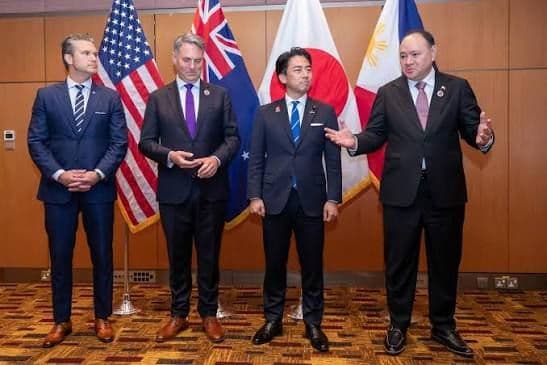
Australian Deputy Prime Minister and Minister for Defence Richard Marles, Japanese Minister of Defense Koizumi Shinjiro, Philippine Secretary of National Defense Gilberto Teodoro, Jr., and United States Secretary of War Pete Hegseth met together on November 1, 2025 in Kuala Lumpur, Malaysia. (NextGen PHDefense via Facebook)
The Emerging SQUAD
From Defense Coordination to Operational Cooperation
Last updated 06:52 AM EDT • Read time: 7m
Join the Conversation
0The Indo-Pacific is saturated with strategic acronyms. AUKUS, announced in September 2021, is reshaping Australia’s long-term defense capabilities. The QUAD, particularly since its revival in 2017, serves as a forum for regional cooperation among four partners. The ANZUS Treaty, signed in 1951, remains the foundation of Australia’s alliance with the United States (U.S.). These are only a few examples of the many overlapping security arrangements shaping the region, from ASEAN-led forums such as the ASEAN Defence Ministers’ Meeting-Plus (ADMM-Plus) and the ASEAN Regional Forum (ARF) to longstanding defense arrangements such as the Five Power Defense Arrangements (FPDA).
Among the region’s many developments is the emergence of a lesser-known Indo-Pacific minilateral grouping comprising Australia, Japan, the Philippines, and the U.S., informally known as the SQUAD. The defense ministers of Australia, Japan, the Philippines, and the U.S. first met during the Shangri-La Dialogue in Singapore in June 2023. In May 2024, U.S. Secretary of Defense Lloyd Austin held talks in Hawaii with his counterparts from Australia, Japan, and the Philippines, further advancing their defense cooperation. By June 2024, the SQUAD label was appearing in policy commentary.
The SQUAD is defined less by its name than by its intended role. The Australia-Japan-Philippines-U.S. grouping focuses more directly on defense and operational activities, while the QUAD addresses a wider agenda spanning maritime security, economic resilience, technology, and humanitarian assistance. In late May 2026, senior military leaders from Australia, Japan, the Philippines, and U.S. Indo-Pacific Command (USINDOPACOM) signed the terms of reference establishing a new Defense Cooperation Council (DCC) on the sidelines of the Shangri-La Dialogue. According to Japan’s Joint Staff, the arrangement covers defense activities, training, and logistics. Australia has since described the council as a mechanism for improving information sharing and accelerating operational activities.
The council could help the four countries build on existing exercises and bilateral defense arrangements, improving coordination between their forces without adding another layer of military activity. Indo-Pacific security has long relied on U.S. bilateral alliances alongside regional institutions. The SQUAD adds a smaller forum for practical military planning among key partners in strategically important locations, complementing rather than replacing these existing arrangements.
Building Operational Cooperation Across the Western Pacific
The Philippines offers immediate strategic relevance. Located between the South China Sea (SCS) and the Western Pacific, the archipelago occupies a key position along maritime approaches linking the two. It also forms part of the First Island Chain strategic concept, with its proximity to the Luzon Strait and other maritime chokepoints giving it an important role in monitoring Chinese military movements and shaping access between the Western Pacific and the seas to its west. In 2026, Australia, the Philippines, and the U.S. conducted three Maritime Cooperative Activities (MCAs) within the Philippine exclusive economic zone (EEZ) on February 15-16, April 9-12, and August 19-25. The exercises involved Australian naval assets and maritime patrol aircraft. Japan, Australia, Canada, the Philippines, and the U.S. also participated in the maritime portion of Exercise Balikatan 2026. These engagements help participating forces develop their capabilities in communications, maneuvering, maritime surveillance, and logistics while familiarizing themselves with each other’s operational procedures.
Japan also supports the emerging minilateral. Its geography gives it a strategic role in both the First and Second Island Chains. Japan has also been undergoing what some observers, including Chinese Foreign Ministry spokesperson Mao Ning, describe as “remilitarization,” citing changes in its defense posture and expanding security partnerships both within and beyond the region. Joint training, cyber cooperation, and defense-industrial collaboration have strengthened ties with Australia, while the Japan-Philippines Reciprocal Access Agreement (RAA) offers a framework for their forces to conduct activities on each other’s territory. Australia and Japan have also moved toward closer defense cooperation and greater integration across multiple domains. These partnerships create further opportunities for the Japan Self-Defense Forces (JSDF) to cooperate with regional partners beyond the traditional U.S.-Japan alliance.
Australia brings distinct strategic advantages to the grouping. Canberra has an interest in preserving a regional balance of power that prevents any single state from exercising coercive control over key maritime routes or dominating regional security arrangements. Its position between the Indian and Pacific oceans gives Australia and its allies strategic reach across both theaters, while its northern approaches offer access to Southeast Asia and its distance from mainland Asia gives Australia and its allies strategic depth. These geographic advantages support regional deployments, maritime surveillance, and allied operations across the Indo-Pacific. Although Australia is not a claimant in the South China Sea (SCS), it maintains a sustained regional presence through deployments and joint exercises. The Royal Australian Navy (RAN) and Royal Australian Air Force (RAAF) contribute maritime surveillance capabilities, including through the RAAF’s P-8A Poseidon aircraft, two of which deployed to the Philippines from January 31 to February 21, 2026, to monitor activity in the SCS.
The SQUAD and the Regional Security Architecture
The SQUAD places hard power and operational security at the forefront, with a sharper focus on military coordination than the QUAD’s broader diplomatic, economic, and technological agenda. Its priorities include joint exercises, operational activities, logistics, and information sharing.
China looms large in these regional security arrangements. However, the parties’ differing perspectives need to be distinguished. Australia and the Philippines have raised concerns over Chinese Coast Guard (CCG) vessels ramming Philippine ships and using water cannons, describing these tactics as dangerous and destabilizing. Beijing sees things differently. China maintains that its maritime activities are lawful and refuses to recognize the July 12, 2016, arbitral award, which ruled in the Philippines’ favor on several key submissions under the UN Convention on the Law of the Sea (UNCLOS). Beijing argues that the presence of foreign militaries in the region will exacerbate existing tensions.
The divide runs deeper than competing interpretations of international law. These differences are also evident in military deployments, patrols, and surveillance, participation in joint exercises, and competing interpretations of the limits of lawful activity. The SQUAD’s practical role lies in translating these strategic differences into more effective operational cooperation. In the Western Pacific, military strength depends not only on missiles, ships, and aircraft, but also on whether forces can communicate, conduct joint surveillance, follow common procedures, resupply one another, and operate together with less need for ad hoc coordination.
The four-country defense council gives existing cooperation a more formal basis, although the SQUAD is not a treaty alliance. ANZUS links Australia and the U.S., while Washington maintains separate treaty alliances with Japan and the Philippines; the four countries have no mutual defense treaty binding them together. The council’s effectiveness will depend on whether regular consultation translates into closer coordination in exercises, operations, logistics, and information sharing. By connecting existing security relationships and making joint activities more routine, it could bring the four countries into closer operational alignment.
Several governments in Southeast Asia favor ASEAN-centered institutions and seek to preserve regional autonomy in their security relationships. Australia and the Philippines continue to support ASEAN centrality while deepening smaller defense partnerships. The SQUAD is developing alongside these established institutions and bilateral arrangements, contributing to a regional security landscape in which smaller, more flexible partnerships play a growing role. AUKUS focuses on advanced defense capabilities, while the QUAD addresses economic, technological, and maritime priorities. The SQUAD adds a more operational dimension, bringing four partners together to deepen practical defense cooperation in one of the region’s most contested maritime environments.
The SQUAD’s value will depend on whether it turns existing partnerships into more routine operational cooperation. For Australia, it adds another layer of defense coordination to its alliances and partnerships in the Western Pacific. In a region where maritime incidents can escalate quickly, established practices of collaboration may matter more than the label attached to the grouping.
Dr. Muhammad Shoaib is a lecturer at the University of Okara, Pakistan; Research Fellow, School of Politics and Public Administration, Shandong University, Qingdao, China.
Muhammad Ali Baig is Deputy Director, Centre for Countering Terrorism and Violent Extremism Studies (CCTVES), Institute of Regional Studies, Islamabad, Pakistan.
Dr. Scott N. Romaniuk is a Senior Research Fellow, Centre for Contemporary Asia Studies, Corvinus Institute for Advanced Studies (CIAS); Department of International Relations, Institute of Global Studies, Corvinus University of Budapest, Hungary.
The Emerging SQUAD
By Muhammad Shoaib • RealClearDefense
Somebody Has to Hold the Ground
By Jay Rogers • RealClearDefense
U.S. Navy Shipbuilding: The Good, the Bad and the Ugly
By Brent Ramsey • RealClearDefense
The Services Do Not Need a Four-Star Autonomous Warfare Command
By Steven Wills • RealClearDefense
Honor Them While There Is Still Time
By Jeffrey Rosales • RealClearDefense

U.S. Military Gives Elon Musk’s SpaceX Access to Sensitive Tracking Data
By Guardian
USS McFaul Returns to Norfolk After 332 Day Deployment
By Sam LaGrone
The U.S. Shipbuilding Revival Is Taking Lessons Halfway Around the World
By WSJ
Hypersonic -Firing B-1B Lancer To Fly Into the 2040s
By Kris Osborn, Warrior MavenU.S. Navy Shipbuilding: The Good, the Bad and the Ugly
By Brent Ramsey, RCDefense