
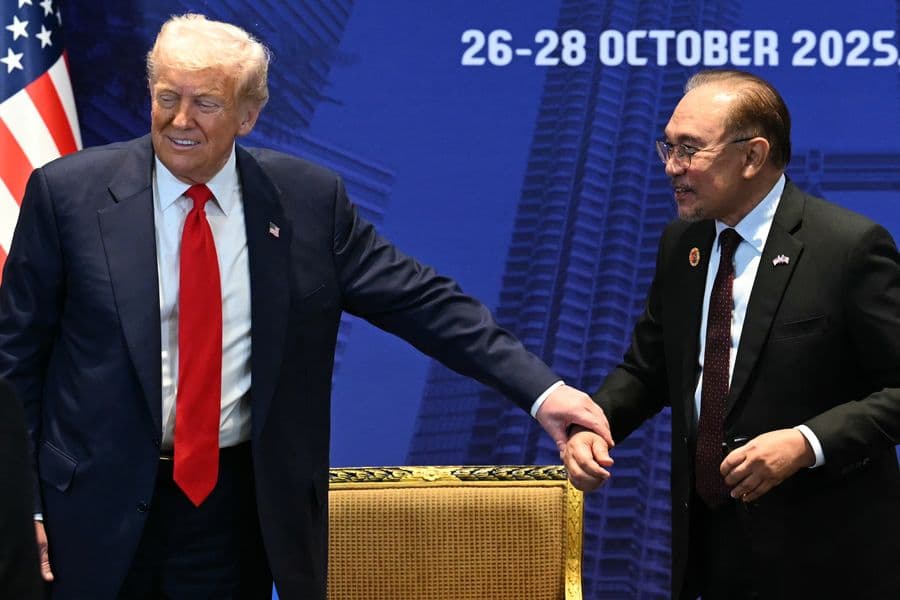
U.S. President Donald Trump gestures to Malaysia's Prime Minister Anwar Ibrahim during a bilateral meeting on the sidelines of the 47th Association of Southeast Asian Nations (ASEAN) summit in Kuala Lumpur, Malaysia, Sunday, Oct. 26, 2025. (Mohd Rasfan/Pool Photo via AP)
South China Sea is Key to Invigorate Positive U.S.–Malaysia Relations
Last updated 04:57 AM EDT • Read time: 4m
Reality is coming home to roost for many in southeast Asia regarding the implications of China’s emboldened claims in the South China Sea, which would place all of the seabed resources and fish stocks within its Ten-Dash-Line. Acquiescence to this would cost Malaysia dearly. Fortunately, it’s awakening to the fact that a new approach is needed.
At the 9th South China Sea Conference hosted by Maritime Institute of Malaysia in Kuala Lumpur, the desire for quiet resolution of disputes played out against reality. That reality is China’s insistence and that its neighbors acquiesce to its claims. For the past few years, the Philippines has been at the forefront of a more vigorous pushback on those claims – even lethally like last year’s fratricide of several Chinese Coast Guard sailors killed in a collision with their own Navy destroyer while harassing Philippine vessels.
If Malaysia fails to strike a balance in relations with Beijing and secure its economic rights in the South China Sea, the political implications would be significant. For one, China has consistently ranked as Malaysia’s top trade partner since 2009, making a crisis with Beijing quickly an economic dilemma. But at the same time, Malaysia’s national oil and gas company Petronas is having to seek new petroleum reserves deeper in contested the South China Sea.
Reduced output is driving Petronas to search for new wells to restore lost output; production dropped by 2.1 percent Q1 2026, continuing a yearlong trend. On the table now are exploration of at least five deep water blocks in Malaysia exclusive economic zone that will surely agitate Beijing. The result could be a replay of when Petronas chartered the drill/survey vessel West Capella to explores these waters in 2020, resulting in a month’s long crisis with China.
The ghosts of the 2018 election loom on some minds. That’s when the long dominate political party, UMNO, was ousted and its Prime Minister eventually jailed for corruption – some of it emanating from the 1MDB scandal. During that election, Beijing actively supported UMNO setting back its local interests for a time. Importantly, UMNO lost its hold of the kingmaker eastern Malaysia states of Sabah and Sarawak critical to carry for whoever wants to be prime minister. And both states are beneficiaries of the offshore petroleum industry in the South China Sea.
The inevitability of crisis with Beijing over Malaysia’s resource rights in its waters looms, with hotly contested Malaysian elections coming before the end of 2027. Despite this, the current prime minister, Anwar Ibrahim, has taken an overly conciliatory posture with Beijing. He stated in July that he rejects “inevitable conflict” over its claims in the area, and in August accepted China’s use of force to settle its dispute with Taiwan, but then walked these comments back days later.
Prior to these less than helpful statements by Ibrahim, President Trump visited Kuala Lumpur in October 2025 for a very positive trip. Given the stakes today, the need for more petroleum production and management of South China Sea crises, renewed American senior level engagement is warranted – the sooner the better given looming elections.
Between now and the Malaysia elections, the goal for the U.S. should be to telegraph its regional presence as a benefit to upholding norms of behavior at-sea beneficial to Malaysia – while deterring China from a wider confrontation. This would marry America First with Malaysia First in a very tangible way over maritime rights.
However, better relations with Kuala Lumpur will require addressing at least one sticking point: managing differences over Israel that the current Anwar administration has taken. All this likely becomes moot if Saudi Arabia signs onto the Abraham Accords, likely drawing Malaysia along.
Malaysia is a strategically located nation with a moderate population. The potential for forging even closer ties based on shared interests in the South China Sea are high – and can be done without forcing unnecessary friction with China.
Brent D. Sadler is a senior research fellow specializing in naval warfare and advanced technology at The Heritage Foundation’s Allison Center for National Defense.

A Passage to the Middle East: India as a Mediator and Security Partner
By Irina Tsukerman • RealClearDefense
South China Sea is Key to Invigorate Positive U.S.–Malaysia Relations
By Brent D. Sadler • RealClearDefense
The Necropolitics of the Wasteland
By Yunus Emre Tumen • RealClearDefense
AI, Robotics, and Marines
By Gary Anderson • RealClearDefense
The Emerging SQUAD
By Muhammad Shoaib • RealClearDefense
AI, Robotics, and Marines
By Gary Anderson • RealClearDefense
AUKUS Partners Test Autonomous Maritime Systems
By Jangoulun Singsit, Naval Tech
AUKUS: USS Colorado Announced as First Submarine for SRF – West
By USNI News
Navy, Marine Corps Simulate Ship Strikes From Air and Land
By Alex Wilson, S&S
Air National Guard To Stand Up a New Special Tactics Squadron
By Patty Nieberg, T&P