
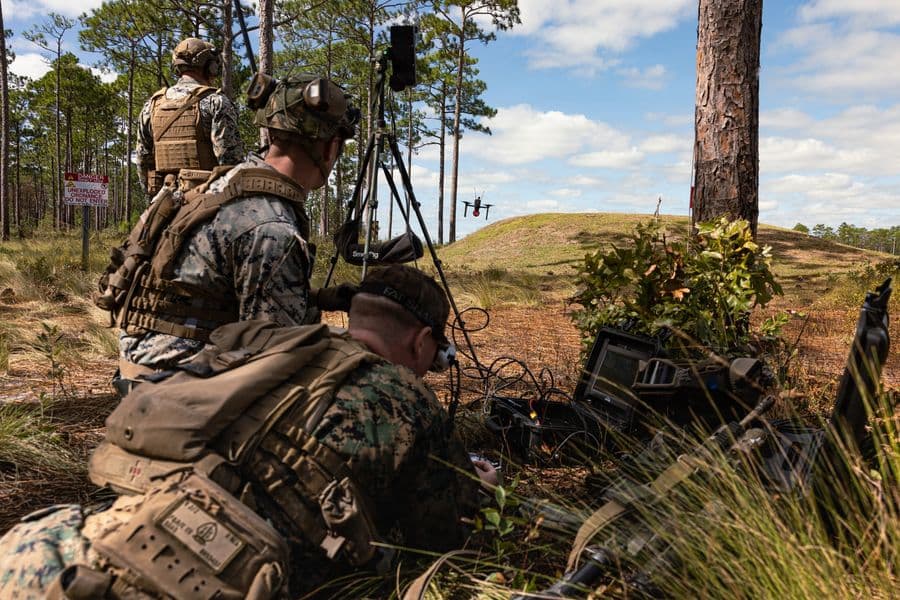
U.S. Marines with 2nd Battalion, 2nd Marine Regiment, 2nd Marine Division, fly a Neros Archer first-person view drone during a Marine Corps Combat Evaluation on Marine Corps Base Camp Lejeune, North Carolina, Oct. 20, 2026. A MCCRE involves a range of scenarios and challenges that test the unit's ability to plan, coordinate, and execute complex missions, including offensive and defensive operations, logistics, and communications. (U.S. Marine Corps photo by Cpl. Judith Ann Lazaro)
AI, Robotics, and Marines
Last updated 04:56 AM EDT • Read time: 5m
From 1998 to 2000, I was the Chief of Staff of the Marine Corps Warfighting Lab. Our primary mission was to look at technologies and tactics that would chart the future of the Corps. One of my primary visions for the future was to partner robots and infantry marines in a combined arms team. At the time, AI was nascent and I was a tad suspicious of giving the bots autonomous kill decisions, but it was obvious that day was coming. We were experimenting with existing Unmanned Aerial Vehicles (UAVs) and Unmanned Ground Vehicles (UGVs). The vision was to create a swarm of robotic skirmishers around a platoon or squad that could scout, and protect flanks and rear. We also envisioned the possibility of very small and micro-robots infiltrating enemy fortifications and buildings. We also explored the possibility of using directed energy non-lethal weapons to clear buildings where non-combatants were present. I believed our vision was ahead of the other services at the time.
In 1999, we partnered with Andy Marshall's legendary Office of Net Assessment (ONA) organization to fight a 2030 based simulation pitting a high-tech U.S. force against an equally high-tech Chinese force attempting to take Taiwan. Our Blue Force included autonomous surface and subsurface vessels, swarms of small Kamikaze drones and highly mobile autonomous smart mines. Marine Corps amphibious landing forces also had autonomous armored vehicles and swarms of micro-robotic scouts and infiltrators. The technology for such systems was nascent, but we believed we opened a window into the future of warfare.
Our planning for future warfare was unfortunately sidelined by the terrorist attacks of 9/11. Instead of complimenting combined arms formations, autonomous systems were used predominantly for counter-IED operations and ISR (Intelligence, Surveillance, and Reconnaissance). The Marine Corps simply adapted to the current battlefield of counterinsurgency operations (COIN) in the Global War on Terrorism (GWOT).
As GWOT drew down, the Marine Corps claimed to have followed the 2018 National Defense Strategy (NDS), by reinventing the Marines’ force structure to inhabit China’s first island chain as part of a strategy of Anti-Access/Area Denial (A2/AD).
The 2018 NDS, however, did not direct the Marine Corps to divest itself from federal statute by dismantling the combined arms capabilities organic to the Marine Expeditionary Unit (MEU) and Amphibious Ready Group (ARG).
The Marine Corps divested much of its combined arms capability and invested in short range NEMSIS (Navy Marine Expeditionary Ship Interdiction System) with a range of just over 100 nautical miles. The missiles would inhabit China’s first island chain and become of the basis of what was known as Force Design 2030, now simply Force Design after realizing that a 2030 milestone could not be reached. As the Marine Corps acquires NEMSIS, the missiles are already becoming obsolete as other services, such as the Army are testing and fielding better systems, such as long-range hypersonic missiles.
The Navy is developing autonomous surface and subsurface combatants, microwave air, and laser air defense systems.
All the services, including the Marine Corps, are now testing and preparing to implement collaborative combat aircraft (also known as drone wingmen) along with fifth and sixth generation fighter aircraft.
In contrast, Marine Corps infantry units remain largely unchanged aside from the use of small drones, loitering munitions, counter-IED robots, and counter-drone systems, but little in the way of increasing the lethality of ground combat units.
Making matters worse, to absorb the costs of Force Design, the Corps got rid of many of its legacy systems to include all tanks and heavy engineer bridging and breaching assets.
The Ukrainians, in contrast, have adapted AI and robotics to ground combat quite successfully. In some cases units totally made up of robots have actually recaptured ground from the Russians. I am not advocating that the Marine Corps go that far. Every technology eventually has a counter and when a robotic system goes down to a microwave burst or some other counter-technology, there is no substitute for having platoons of infantry to take and hold territory.
Even if the Marine Corps started to replace its lost tanks and bridging capability tomorrow, it would take at least a decade to build back to 2018 levels. If the Marine Corps would, however, build hybrid units of humans and robots, the number of Marines needed in tank, engineer, and artillery units could be reduced. Done thoughtfully, this hybrid combat capability could be realized by 2030, thus negating most of the crippling impacts of Force Design.
Hybrid infantry units would create enhanced small unit combined arms teams, but current Marine Corps leadership shows no inclination of resigning from Force Design.
Hopefully, the next commandant will have the moral courage to put the Corps back on the right path and leverage emerging technology to make the Marine Corps a much more capable and resilient organization than it is today.
Gary Anderson retired as Chief of Staff of the Marine Corps Warfighting Lab. He served as a Special Advisor to the Deputy Secretary of Defense and is the author of Beyond Mahan, a Naval Strategy for the 21st Century.

A Passage to the Middle East: India as a Mediator and Security Partner
By Irina Tsukerman • RealClearDefense
South China Sea is Key to Invigorate Positive U.S.–Malaysia Relations
By Brent D. Sadler • RealClearDefense
The Necropolitics of the Wasteland
By Yunus Emre Tumen • RealClearDefense
AI, Robotics, and Marines
By Gary Anderson • RealClearDefense
The Emerging SQUAD
By Muhammad Shoaib • RealClearDefense
AI, Robotics, and Marines
By Gary Anderson • RealClearDefense
AUKUS Partners Test Autonomous Maritime Systems
By Jangoulun Singsit, Naval Tech
AUKUS: USS Colorado Announced as First Submarine for SRF – West
By USNI News
Navy, Marine Corps Simulate Ship Strikes From Air and Land
By Alex Wilson, S&S
Air National Guard To Stand Up a New Special Tactics Squadron
By Patty Nieberg, T&P