
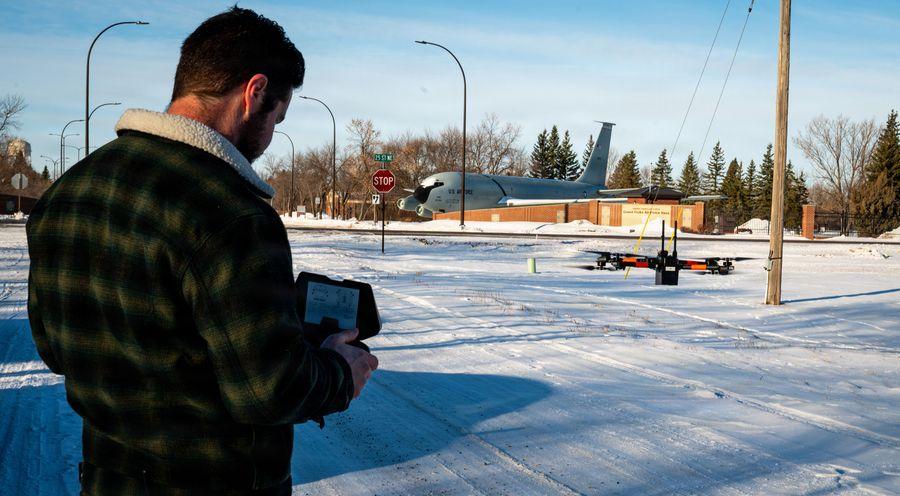
Aaron Sykes, GrandSky flight operations project manager, flies a small-unmanned aircraft system outside Grand Forks Air Force Base, North Dakota, Jan. 12, 2026. The sUAS was used to represent an aerial threat during the multi-agency critical incident response training.
When a Factory Buys Air Defense, What Has It Bought?
Published Nov. 24, 2026 • Read time: 4m

Suppose two factories buy access to the same air-defense crew. On an ordinary night, sharing the expense makes protection affordable for both. On the night both are threatened, the value of each agreement depends on which promise can be kept.
That is no longer a hypothetical. On November 4, Ukraine's Ministry of Defence announced an expansion of its experimental private air-defense program: participating companies may now contract to protect other firms' facilities, and authorized companies may transfer air-defense assets to one another by joint decision with the Air Force Command. The program remains under military control, inside Ukraine's unified air defense. By mid-October, the ministry reported, nearly 100 companies had joined, and private groups had destroyed more than 60 aerial targets.
Read those numbers carefully. They describe participation and interceptions. They do not describe how many sites can be served at the same time.
A second customer can finance a second crew — or buy a second claim on the first. Either transaction looks like expanded protection in the purchasing records of both firms. But nearby facilities tend to need protection simultaneously, because a raid does not schedule its targets in sequence. The commercial value of a protection contract therefore depends on capacity available at the moment when every other customer is also calling for it. A market in readiness can quietly become a market in claims on readiness, and the two are indistinguishable in a spreadsheet.
We Exported Our Arsenal Manufacturing, Now We Must Rebuild It.
Batteries Can Power a Win for America in Super Intelligence
The World Cup Is Over. The Drone Threat Isn’t.
ICE Is Not a Four-Letter Word
There is a second divergence, between the buyer and the command. A factory has every reason to protect its production line. The substation that powers several factories may matter more to the region than any single line — yet its benefit is dispersed among firms that can each hope someone else pays for it. A market directs money toward assets with identifiable buyers. The commander responsible for the whole area sees a different order of importance. Ukraine's structure acknowledges this by keeping private capacity under unified military control; the allocation question is answered by command, not by contract, when it matters most.
None of this argues against private participation. It argues for measuring the right thing. Even a lower cost per interception can improve the economics of an engagement while leaving the economics of availability — crews, coverage, endurance across several sites at once — entirely unresolved. A tally of engagements cannot answer the only question a protected facility ultimately cares about: which operations continued, and for how long.
The American comparison begins from a different allocation of authority. The SAFER SKIES framework extends specified counter-drone powers to eligible state, local, Tribal, and territorial law-enforcement and correctional agencies under federal conditions. A U.S. infrastructure owner cannot simply buy what a Ukrainian firm can now contract for; continuity planning here must account for the availability and lawful scope of a public response it does not control.
Which makes a place like Grand Forks, North Dakota, a useful laboratory. The University of North Dakota and the Northern Plains UAS Test Site are working with JIATF-401 to identify technologies for further evaluation, and Project ULTRA has funding for a counter-drone testbed at GrandSKY. An honest evaluation would start exactly where the Ukrainian experiment will be tested: several facilities needing the same limited response, all depending on the same critical service. Success would be scored in operations continued, not targets engaged.
For a manufacturer weighing a regional investment, the diligence question comes before the choice of hardware, and it is the same question in Kyiv and in Grand Forks: who keeps paying for capacity in the months when it is rarely called, and what evidence will the buyer accept that the capacity was actually there? The answer determines whether a region has a recurring market for readiness — or merely a series of equipment orders, each photographed once and quietly expiring.
Protection that cannot be in two places at once is not a commodity. It is a promise. And a promise that can only be kept once should not be sold twice.

A Sweet American Original
By Greg Maresca • RealClearDefense
South Korea's OPCON Debate Is a Test of Alliance Readiness
By Daewon Cho • RealClearDefense
When Does Peacetime Access Become Wartime Capability?
By Alp Cenk Arslan • RealClearDefense
The Missing Seats at the Table
By Dennis T. Cosgrove • RealClearDefense
We Exported Our Arsenal Manufacturing, Now We Must Rebuild It.
By Justin Fulcher • RealClearDefense

Sign of the Times: CCAs Dominate a Major Fighter Conference
By Bill Sweetman • The Strategist (ASPI)
Marines Want Naval Strike Missiles With Double The Range
By The WarZone
U.S. Navy Targets 79 New Cutter-Based FF(X) Frigates
By A. Servaes, Global Defense
The Hegseth Grenade: A Sea Change at Newport
By Robert C. Rubel, CIMSECSign of the Times: CCAs Dominate a Major Fighter Conference
By B. Sweetman, ASPI