
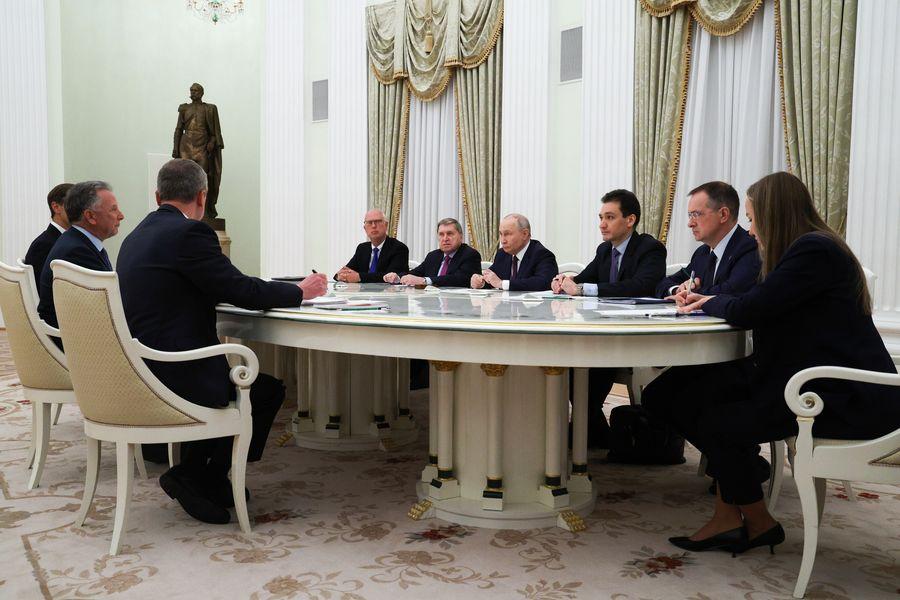
Russian President Vladimir Putin, fourth right, speaks to U.S. special envoy Steve Witkoff, second left, and Jared Kushner, U.S. President Donald Trump's son-in-law, behing Witkoff at the Senate Palace of the Kremlin, Moscow, on Thursday, Nov. 12, 2026.
The Missing Seats at the Table
Published Nov. 24, 2026 • Read time: 7m
Join the Conversation
0A recent photograph of Jared Kushner seated at the end of a negotiating table concerning the war in Ukraine brought an earlier gathering to my mind. What struck me about that photograph was not who occupied the chairs. It was who was missing.
Nearly three decades earlier, I sat at a long conference table at the headquarters of Russia's Ministry of Internal Affairs in Moscow. As the FBI's Legal Attaché, I was introducing colleagues from FBI Headquarters to senior Russian officials to explore opportunities for joint law enforcement training. The Soviet Union had collapsed only a few years earlier, and relations between our countries were still taking shape. Despite considerable differences, there was a genuine willingness to cooperate on matters of mutual interest.
European leaders are now demanding their own places at the negotiating table. They have legitimate interests in the outcome. But what about the other independent republics that emerged from the dissolution of the Soviet Union? If negotiations are intended to establish not merely a ceasefire, but a broader security arrangement, why are the nations whose futures may be directly affected largely absent?
Recent reporting suggests that Moscow's ambitions extend well beyond the territory of Ukraine. According to accounts of a Russian negotiating paper reportedly circulated during talks in Abu Dhabi, Moscow is seeking restrictions on NATO military activity not only in Eastern Europe, but also in the South Caucasus and Central Asia. The proposals reportedly revive demands concerning NATO's military posture dating to the period before the alliance's eastward enlargement.
Russia Says Its Defenses Intercepted Over 1,300 Ukrainian Drones
How Seoul’s Break With Kyiv Serves Trump’s Russia Turn
The First Test of Peace Lies in Ukraine's Borderlands
Ukraine Abandons Truce and Attacks Russian Oil Refinery
These are not simply questions concerning the war in Ukraine. They reach into regions populated by independent states that emerged from the Soviet Union's dissolution. Yet those governments are conspicuously absent from negotiations that could affect their future security relationships. The question is no longer simply whether these countries deserve a voice. It is why their participation has not become an essential part of the diplomatic discussion.
The arrangement is reminiscent of an earlier era of great-power diplomacy.
At the Congress of Vienna in 1815, Europe's leading powers gathered to reconstruct the continent's political order following the Napoleonic Wars. The resulting settlement helped preserve a balance of power for decades, but it also reflected a world in which the interests of smaller nations were frequently subordinated to those of larger states.
At Yalta in 1945, Roosevelt, Churchill, and Stalin reached understandings that would profoundly influence the postwar order. The circumstances were different, but the practice of great powers shaping the political futures of other nations remained.
We are no longer living in 1815. Nor are we living in 1945.
The Soviet Union dissolved in 1991 into fifteen independent republics. Each confronted the difficult task of establishing its political identity, securing its borders, and determining its relationship with Russia and the wider international community.
During my years in Moscow, I witnessed the uncertainty and competing expectations that characterized Russia's relationship with the West. Cooperation between American and Russian law enforcement and security agencies was not merely theoretical. It occurred regularly, even as profound disagreements persisted over the direction of Russia's political and economic transformation.
Many Russian officials believed their country had been weakened and marginalized following the Soviet collapse. Those perceptions, whether justified or not, helped shape the political environment in which Vladimir Putin rose to power. Understanding them is important. Accepting Moscow's claim to a privileged sphere of influence over its neighbors is quite another matter.
Russia's security interests deserve consideration. So do those of the fourteen other former Soviet republics.
Nowhere is that distinction more important than in Central Asia.
During my subsequent work across the region, including years managing border security and management programs for the Organization for Security and Co-operation in Europe, I witnessed the painstaking process through which the independent republics sought to consolidate their sovereignty. Border delimitation and demarcation, regional cooperation, and the resolution of territorial disputes were not abstract diplomatic exercises. They involved communities, national identities, competing historical claims, and the practical responsibilities of independent governments.
I spent years working with the independent republics of Central Asia as they sought to define and secure their borders. It would be a remarkable contradiction if their future security were now discussed without their participation.
Kazakhstan, Kyrgyzstan, Tajikistan, Turkmenistan, and Uzbekistan have spent more than three decades developing their own political identities and relationships with Moscow, Beijing, Washington, and Europe. Their governments understand the complexities of dealing with Russia, but they also understand the importance of preserving their independence.
Central Asia is hardly alone.
The Baltic states experienced Soviet occupation and subsequently chose membership in NATO and the European Union. Moldova continues to confront the unresolved conflict in Transnistria. Georgia has lived with the consequences of Russian military intervention and the unresolved status of Abkhazia and South Ossetia. Armenia and Azerbaijan have their own experiences with territorial conflict, Russian influence, and the limitations of externally negotiated security arrangements.
These countries do not share identical interests. Some maintain close relationships with Moscow, others regard Russia as their principal security threat, and still others pursue carefully balanced foreign policies.
They share one fundamental characteristic: They are sovereign states, not remnants of a vanished empire.
For the independent republics of the former Soviet Union, exclusion from discussions concerning their future security arrangements is more than a diplomatic oversight. It risks becoming an affront to the sovereignty they have spent thirty-five years establishing and defending. The nations of Central Asia, the South Caucasus, and Moldova are not subordinate parties whose interests can be negotiated by Moscow, Washington, or Brussels. They have their own histories, national interests, and legitimate security concerns.
If negotiations concern an immediate ceasefire, the principal parties must remain Ukraine and Russia. Ukraine alone must determine what terms it is prepared to accept concerning its territory and sovereignty. The United States and European governments have legitimate roles in mediation, security guarantees, sanctions, and reconstruction.
But if negotiations extend to the future security architecture of the former Soviet space, the diplomatic configuration must be considerably broader.
I would propose convening a conference of all fifteen former Soviet republics, including Russia and Ukraine, to address the principles upon which a durable regional settlement must rest. The United States and European Union should participate in supporting roles, offering diplomatic assistance and security commitments where appropriate, but not determining the outcome on behalf of the participating states.
Such a conference would not replace direct negotiations to end the war. Nor would it be another OSCE-led process, although the organization's experience and principles could prove useful. Its purpose would be to give the successor states themselves a voice in shaping the political and security relationships that will follow.
Agreement would not come easily. Indeed, some participants might refuse to attend. But diplomatic difficulty is hardly a justification for excluding those whose futures are at stake.
Russia would participate not as the inheritor of authority over its former Soviet neighbors, but as one of fifteen independent states. Its legitimate security interests would be heard, just as those of Ukraine, Moldova, Georgia, Kazakhstan, and the others.
A durable peace cannot emerge from an arrangement that merely substitutes one great-power understanding for another. It must recognize that the political transformation begun in 1991 was not simply the collapse of a superpower, but the emergence of fourteen other independent nations alongside Russia.
The photograph of the negotiating table may change as more representatives are invited to participate. But adding a few European chairs will not resolve the more fundamental problem.
The Soviet Union ended thirty-five years ago. The nations that emerged from its dissolution should not have their futures negotiated in their absence.
The world has moved beyond 1815 Vienna and 1945 Yalta. It is time for the negotiating table to reflect that reality.
Dennis T. Cosgrove is a former FBI Special Agent and Legal Attaché, and former Head of the Border Security and Management Unit at the Organization for Security and Co-operation in Europe in Vienna. He worked extensively in Central Asia, the former Soviet Union, and the Balkans in a variety of law enforcement, diplomatic, and international security roles, including numerous assignments with U.S. Embassies overseas. He writes on geopolitics, transnational threats and strategic affairs, and is the author of two published books with a third currently in progress.

A Sweet American Original
By Greg Maresca • RealClearDefense
South Korea's OPCON Debate Is a Test of Alliance Readiness
By Daewon Cho • RealClearDefense
When Does Peacetime Access Become Wartime Capability?
By Alp Cenk Arslan • RealClearDefense
The Missing Seats at the Table
By Dennis T. Cosgrove • RealClearDefense
We Exported Our Arsenal Manufacturing, Now We Must Rebuild It.
By Justin Fulcher • RealClearDefense

Sign of the Times: CCAs Dominate a Major Fighter Conference
By Bill Sweetman • The Strategist (ASPI)
Marines Want Naval Strike Missiles With Double The Range
By The WarZone
U.S. Navy Targets 79 New Cutter-Based FF(X) Frigates
By A. Servaes, Global Defense
The Hegseth Grenade: A Sea Change at Newport
By Robert C. RubelSign of the Times: CCAs Dominate a Major Fighter Conference
By B. Sweetman, ASPI