
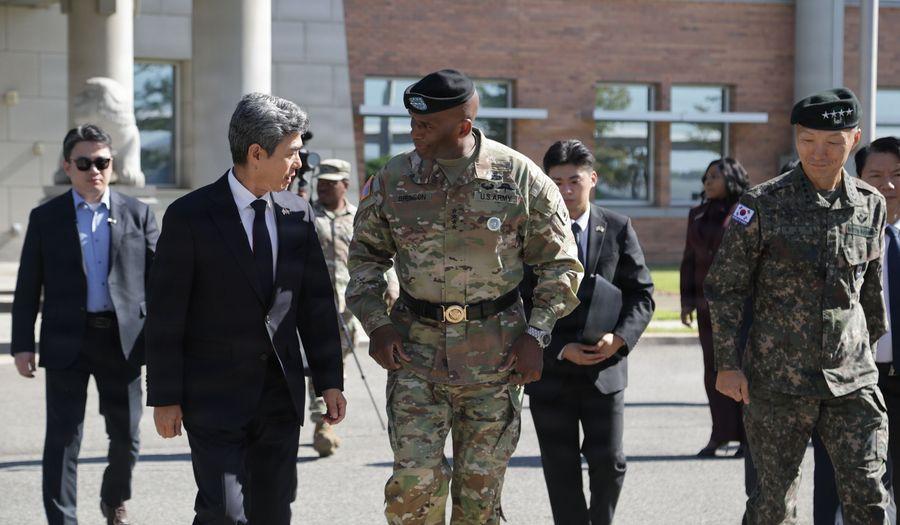
The Hon. Kang Shin-chul, Republic of Korea minister of national defense, walks with Gen. Xavier T. Brunson, commander of United Nations Command, Combined Forces Command and U.S. Forces Korea, and Gen. Kim Seong-min, deputy commander of Combined Forces Command, during a visit to Camp Humphreys, Republic of Korea, Oct. 2, 2026. The visit marked Kang’s first visit to Camp Humphreys since taking office and highlighted the strength of the ROK-U.S. Alliance.
South Korea's OPCON Debate Is a Test of Alliance Readiness
Published Nov. 24, 2026 • Read time: 7m
Join the Conversation
0Washington and Seoul need a shared strategic vision—not a political timeline—for the future of their deterrence posture.
South Korea's debate over wartime operational control (OPCON) is no longer just a question of national sovereignty. It is a test of whether Seoul and Washington share a clear understanding of the threats facing the alliance—and of what it takes to deter them.
The U.S.-South Korea alliance is approaching a quiet reckoning. Seoul wants greater autonomy in its national defense, while Washington expects South Korea to become a more capable pillar of its Indo-Pacific strategy. These goals are not inherently incompatible. But they raise a question both capitals have yet to answer convincingly: Are they still moving toward the same strategic horizon?
Recent developments have exposed the strain. The visa dispute involving Jin Sung-joon, chairman of South Korea's National Assembly Defense Committee, emerged just days before the allies announced that their annual Security Consultative Meeting (SCM) would be postponed until early 2027. The two issues are not known to be connected. Both, however, have drawn attention to the state of bilateral communication and trust.
At an October 31 press conference in Atlanta, U.S. Secretary of State Marco Rubio said one individual visa case involved conduct dating back several decades and would be handled through bilateral consultations. Jin subsequently received his visa. There is no basis to portray the episode as a deliberate diplomatic affront by Washington. But it is also unwise to dismiss the concerns it raised, particularly when a senior lawmaker responsible for overseeing South Korea's defense establishment was involved. "Rubio's remarks" (https://www.koreajoongangdaily.com/korea/visa-denial-for-korean-lawmaker-down-to-individual-issue-rubio-says/12948548) deserve to be read in that context.
Washington Built the Hub-and-Spokes – Australia and Japan Are Rewiring It
By Prodding Taiwan, Russia Takes Its Alignment With China to New Heights
Watch What Trump Does in Asia, Not What He Says
How the Quad Can Work With Southeast Asia
The SCM postponement also requires care in interpretation. Both governments cited scheduling considerations, while reporting has pointed to differences over the pace of OPCON transfer as part of the broader context. The delay does not prove a rupture. It does, however, make it harder to ignore questions about whether the allies have a sufficiently shared strategic agenda.
The deeper problem is the divergence of priorities.
For the Trump administration, countering China's growing power and strengthening trilateral cooperation with Japan are central priorities. U.S. Forces Korea is part of a broader regional security framework. President Lee Jae-myung's administration, meanwhile, places considerable emphasis on reopening dialogue with Pyongyang and managing relations with Beijing.
Seoul has legitimate diplomatic and economic reasons to maintain communication with China. It should not provoke confrontation for its own sake. But diplomacy cannot obscure hard security realities. North Korea continues to expand its nuclear and missile capabilities, while China is reshaping the regional military balance.
If Seoul hesitates to support core security initiatives that Washington considers essential to regional stability, friction is inevitable. An ally is not simply a country that hosts American military bases. It is a partner that shares an assessment of threats and accepts tangible responsibilities.
This divide is most visible in the OPCON debate.
There is nothing wrong with South Korea seeking a greater leadership role in its own defense. Its military is modern and capable. But the transfer of wartime operational control must be based on demonstrated military readiness, not domestic political pride.
The conditions-based transition framework is intended to assess whether a future, Korean-led Combined Forces Command can operate effectively. That requires more than political agreement. It requires credible command-and-control systems, intelligence, surveillance and reconnaissance capabilities, missile defense, and the ability to fight alongside U.S. forces in a high-intensity conflict.
The Lee administration wants to complete the transfer before its term ends in 2030. Washington has emphasized that the agreed conditions must be met first. The allies remain in the process of verifying South Korea's Full Operational Capability (FOC), the second stage of the three-phase transition process. Seoul has argued that the process should move forward, while U.S. officials have stressed that the required conditions have not yet been fully met. U.S. Forces Korea Commander Gen. Xavier Brunson has also warned that changing regional threats require the allies to account for new conditions and standards, not simply proceed on the basis of an earlier assessment.
This is not a contest between Korean sovereignty and American oversight. It is about whether the combined force can deter—and, if necessary, fight—a war effectively when command arrangements change.
The danger is that domestic politics will take precedence over military readiness. In South Korea, OPCON transfer is often presented as the restoration of national defense sovereignty. The slogan resonates with voters, but it can reduce a complex military assessment to a test of political loyalty. Questioning readiness should not be equated with opposing sovereignty.
A rushed transfer would risk weakening the combined command structure and undermining deterrence, placing both American and South Korean troops at greater risk. But Washington must also avoid using verification as a reason to postpone the transition indefinitely. It should identify capability gaps clearly, establish transparent standards, and help South Korea close them. If the conditions are met, the transfer should proceed. If they are not, neither side should pretend otherwise.
A shared vision requires three practical steps.
First, Washington and Seoul should produce a joint assessment of the threats their combined forces are expected to deter. It should guide force planning and operational priorities, not become another diplomatic statement.
Second, they should agree on a conditions-based roadmap for OPCON transfer, with dated milestones for FOC verification and a clear explanation of what constitutes readiness. This would give both governments and their publics a way to measure progress—and make it harder for either side to manipulate the process for political convenience.
Third, they should involve Japan wherever trilateral coordination is essential to regional defense. This does not mean every alliance issue must become a trilateral one. It means that the allies should be honest about the areas in which cooperation with Tokyo is indispensable.
North Korea demands the same realism. President Donald Trump has expressed openness to meeting Kim Jong Un. Dialogue can be useful, but it is a tool, not a concession. Seoul should pursue engagement without allowing it to substitute for deterrence or become detached from the goal of verifiable denuclearization.
Washington, for its part, should recognize that South Korea is not a subordinate partner to be given orders. It is a major democracy, an industrial power, and a linchpin of East Asian security. A more capable and self-reliant South Korean military strengthens the alliance, provided the two countries remain aligned on the strategic purposes it serves.
As a South Korean reform conservative and a graduate of the Korea Military Academy, I served as an Army officer along the Demilitarized Zone before studying in the United States. I see no future in blind dependence on Washington, but neither do I believe in slogans of self-reliance divorced from strategic reality. Autonomy comes with responsibility. If Seoul wants a greater role in wartime command, it must build the capabilities to assume it. If Washington expects South Korea to contribute more to regional defense, it must define the shared strategy that contribution is meant to serve.
The costs of strategic drift are not abstract. Pyongyang may see an opportunity in any gap between the allies; Beijing may interpret their differences as evidence that they can be divided. Deterrence rarely collapses in a single dramatic moment. It erodes gradually, in the space between allies who can no longer finish one another's sentences.
The visa incident and the SCM delay do not prove that the alliance is breaking apart. They are reminders, however, that trust cannot be taken for granted. Washington and Seoul should not ask only when South Korea will take over OPCON. They must ask whether, when a crisis comes, both countries will still see the same threat—and stand together.
Daewon Cho is a former member of the Supreme Council of South Korea's Reform New Party and a political commentator. A graduate of the Korea Military Academy (49th Class), he served as an Army officer along the Demilitarized Zone before earning master's degrees in economics from Texas A&M University and political science from New York University.

A Sweet American Original
By Greg Maresca • RealClearDefense
South Korea's OPCON Debate Is a Test of Alliance Readiness
By Daewon Cho • RealClearDefense
When Does Peacetime Access Become Wartime Capability?
By Alp Cenk Arslan • RealClearDefense
The Missing Seats at the Table
By Dennis T. Cosgrove • RealClearDefense
We Exported Our Arsenal Manufacturing, Now We Must Rebuild It.
By Justin Fulcher • RealClearDefense

Sign of the Times: CCAs Dominate a Major Fighter Conference
By Bill Sweetman • The Strategist (ASPI)
Marines Want Naval Strike Missiles With Double The Range
By The WarZone
U.S. Navy Targets 79 New Cutter-Based FF(X) Frigates
By A. Servaes, Global Defense
The Hegseth Grenade: A Sea Change at Newport
By Robert C. RubelSign of the Times: CCAs Dominate a Major Fighter Conference
By B. Sweetman, ASPI