
Record Defense Budget Flunks the China Test
Last updated 04:04 PM EST • Read time: 4m
One consolation of the $1.7 trillion 2023 spending bill was a bipartisan Congress providing several tens of billions of dollars over the President’s narrow defense request. While most lines of that $858 billion defense appropriation are necessary, it fails in its totality. The record budget folds before our most important national security test: to rescue our precarious Pacific posture.
The bill rightly seeds pioneering capabilities that will be fielded in quantities in the 2030s. It refills Ukraine-depleted stockpiles, but these weapons, however, are generally short-range and of lesser utility vis-à-vis China.
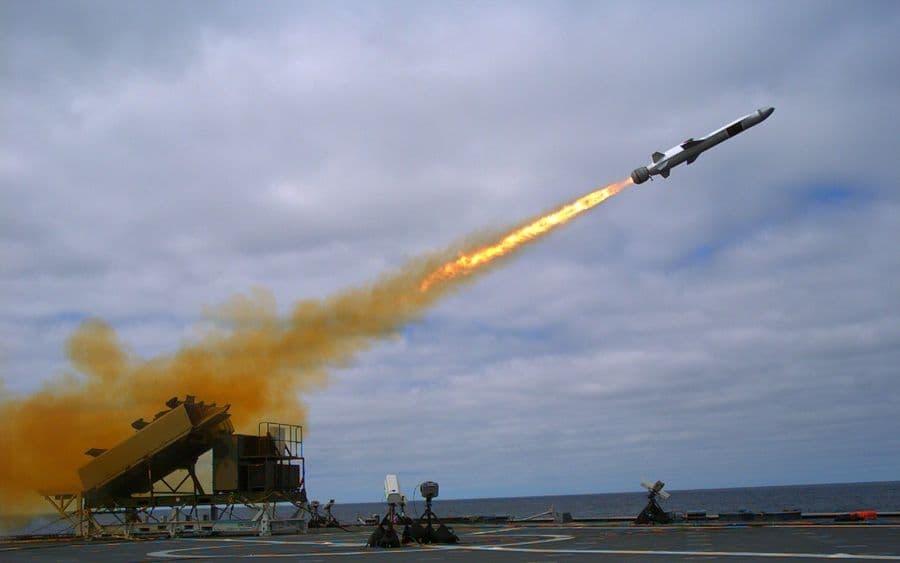
In the vast waters between Hawaii and Shanghai, mid-to-long range strike forms the sine-qua-non of deterrence. Our current stores are miserable, the planned step increases off the mark. The 2023 budget funds just a little more than a thousand new mid-to-long range conventional missiles, to add to our inventories: approximately 80 Long Range Anti-Ship Missiles (LRASMs), 600 Joint Air-to-Surface Standoff Missiles (JASSMs), 90 Extended Range HARMs (AARGM-ERs), 100 Naval Strike Missiles (NSMs), and 150 Tomahawks.
That calculation is the best-case scenario making considerable assumptions: the Military Services fully use their new appropriations, negotiate highly advantageous price per missile deals with the primes, and get the dollars under contract in Fiscal Year 2023 (which ends just nine months from now, on September 30th). The ultimate 2023 numbers could -- and are apt to -- be substantially lower. As an aside, the FY23 Congressionally funded upgrades to some of our existing stocks of older cruise missiles, however essential, do nothing to expand our limited inventories. Quantity, not just quality, matters when facing high-tech China.
This year’s new cruise missile appropriation covers a mere few days to few weeks of combat. Beijing understands our numbers. Does Washington? To deter China, we require months-worth of the long-bolts. Xi and the Politburo need to know that U.S. magazines have depth and will not exhaust. No quick victories against the United States.
China has built massive air, naval, missile, and space forces -- the likes of which we have not faced since the days of the Warsaw Pact. At 340 capital ships and growing, China’s navy outnumbers ours by several dozen. The danger is “during this decade, in fact in the next six years,” as Admiral Philip Davidson testified in 2021 and our Chief of Naval Operations, Admiral Michael Gilday, recently reaffirmed. China possesses the homefield advantage, concentration in the first island chain, anger, and luxury of surprise.
If our desire is to deter a Chinese attack on Taiwan or against our other vital Pacific interests, no solution exists but to quadruple the purchase of the requisite mid-to-long range missiles: Tomahawks, LRASMs, NSMs, JASSMs, and AARGM-ERs. Double the construction of the warships to carry them to battle stations. Start now.
Enough handwringing about the inadequacy of our defense industrial base. The market, with some creativity on the government’s part, will respond, as it repeatedly has, defying the pessimism. From a cold start, private industry developed and produced COVID vaccines and medical supplies in a sliver of the time many expected. The outcome was in keeping with the World War II public-private partnership.
Let’s use tools FDR employed and Congresses of differing parties have sensibly kept in law: Washington buys the plant and equipment. The contractors make them spin. Require as a condition of contracts something fresh: the large defense firms form joint ventures with the new crop of radical aerospace small- and mid-sized businesses. Hundreds have emerged with breathtaking abilities, yet slight access to the ponderous defense budget process. They will bring innovation, per-unit cost-reduction, and competition to an overly consolidated sector.
Whatever one may say about Elon Musk, SpaceX has driven down the price of launch over 85%. When he began, a comfortable, conformist sentiment settled throughout the industry: his rocket wouldn’t reach orbit with any reliability, accuracy, or economy. In fact, SpaceX’s record exceeds anything the incumbents ever achieved in a similar period.
The young Turks engineer differently. They revolutionize products because they are racing up the Schumpeter curve, not standing atop it. They make moonshots, not just respectable earnings per share. They do not bow to stock markets or government administrators, but are funded by founders and VCs risking their own capital and livelihoods.
Putin wrecked the European peace. Xi’s China shows signs of belligerence, ambition, and volatility on our Pacific defense perimeter. Zelensky’s pleas testify to the danger of a nation leaving its defenses undersupplied. We need a mass of what the military calls “fires” and the ships to deliver them. Then we will dampen Chinese temptations. Place the orders, pay on delivery.
Jeffrey Jeb Nadaner is the former Deputy Assistant Secretary of Defense for Industrial Policy and Stability Operations, Director of the USMC Krulak Center, and Lockheed Martin Vice President of Engineering & Technology

Is It Déjà vu All Over Again: The 2012 Report on Global Zero
By Peter Huessy • RealClearDefense
As Private Investment Pours Into Defense, the Clock Is Ticking
By Elaine McCusker • RealClearDefense
The First Test of Peace Lies in Ukraine's Borderlands
By Dennis T. Cosgrove • RealClearDefense
The VFW’s Gambling Addiction Victimizes Veterans
By Jack Yoest • RealClearDefense
Superintelligence Exposes a Gap in the Law of Delegated Authority
By Sue Ghosh Stricklett • RealClearDefense

When Your Navy is too Small, the Bill Comes Due Bigly
By CDR Salamander
Quo Vadis MCU?
By Marine Corps Compass Points
When the Network Goes Dark, Who Controls the Battlefield?
By Jonathan K. Corrado • RealClearDefense
Air Force Should Buy 250 Blended-Wing Tankers, as 2027 Demo Looms
By A&SF Mag.
Long Deployments to Be Navy Standard For Next Couple Years
By Mongilio, USNI News