
Strategies, Diversions, and Trump's Smoke-Screen Policy
Last updated 05:51 PM EDT • Read time: 8m
So far President Trump's foreign policy has been nearly impossible to predict. As we saw this past week, some of the President's choices, particularly the decision to strike the regime of Syrian President Bashar al-Assad, have created strange bedfellows among America's foreign policy watchers. Traditional foreign policy thinkers on the right and left, the so-called "Establishment," publicly lauded the strikes, albeit for somewhat different reasons. Meanwhile, Trump's core supporters, who rallied around his isolationist campaign promises, have been sharply denouncing the strikes as warmongering. Everyone in Washington appears to have been caught off-guard by the President's decision to intervene in the world's most protracted conflict, while analysts, journalists, and policymakers are scrambling to determine what it all means. The President's speech after the strike, as well as statements from the White House, argue this decision was tied to Syrian regime use of chemical weapons late last month.
Presidential decisions do not happen in a vacuum. Recall, the President and his staff are dealing with a full-fledged FBI and Congressional investigation into the Trump campaign's relationship with Russia, as well as the worst approval ratings of any first-term President since 1953, when Gallup began keeping tabs. Then President-elect Trump's pledges to work more closely with Russian President Putin seem to have left President Trump in a bind, especially after FBI Director James Comey’s testimony before the House Permanent Select Committee on Intelligence and spotlight media coverage of a dramatic Congressional inquiry into the matter. Politically, Trump's position on closer cooperation with Russia seems to have reached a brick wall, and the White House may have successfully been forced to distance themselves from Russia at all costs. The more fundamental question is whether the President has fundamentally changed his policy on Syria or is politically maneuvering away from the Russia scandal which is impeding his early incumbency.
If we think critically about the factors influencing the President's decision to strike in Syria, we can discern three primary motivators. First, the President’s perspective may have completely changed since assuming the role of U.S. Commander-in-Chief, and his advisers have successfully convinced him to act more "presidential" to accomplish his other policy goals. Second, as reported in the media, the President may have been emotionally compelled to retaliate against Bashar al-Assad, after he was shown images of Syrians suffering from an alleged sarin gas attack. Third, the President and his staff seized on the chemical attacks as an ideal opportunity to shift public attention away from the FBI's Russia investigation by appearing to strike a Russian ally and publicly deriding Russia's support of Assad. Unfortunately, while any of the options presents a rather alarming picture of decision making at the White House, the President's history vis-a-vis the Russian issue seems to lend the most credence to the third.
Just a few years ago former President Obama weighed an almost identical decision, and Donald Trump spoke out harshly against further U.S. involvement in the Middle East, most infamously in a spat of abrasive Twitter posts. Years later, as a candidate for president, Mr. Trump claimed foreign wars only wasted money which could be used to “Make America Great Again.” In fact, only days before the Syrian regime purportedly attacked its citizens with sarin gas, two members of Trump's cabinet – Secretary of State Rex Tillerson and US Ambassador to the UN Nikki Haley – went on the record to say that Assad was no longer a concern for the US, and that the U.S. was now content with allowing the Syrian crisis to resolve without any sincere U.S. involvement. What we saw, in less than 72 hours, was a complete 180 in the U.S. position toward one of the world's worst humanitarian crises of this generation.
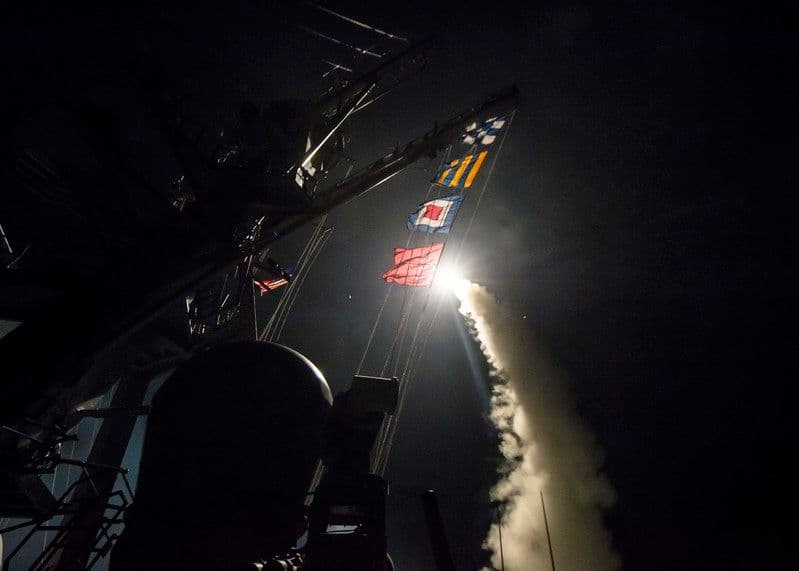
There is no love lost for the Syrian regime and, at about $1 million a pop, the only real lasting impact of the Tomahawk cruise missile strike seems to be the U.S. taxpayer, stuck with a bill to the tune of about $60 million. The heavy firepower only took out carefully identified targets at Shayrat Airbase and left the runway largely intact; which was interestingly retrofit by Russia in 2015 and is used as a forward operating base for their military. Only hours after the strikes on Shayrat Airfield, it was reported that Syrian jets were again taking off from the same base. If the U.S. wanted to ground Syrian aircraft, they would have focused on military infrastructure (e.g. runways) opposed to equipment (e.g. aircraft), but doing so would simultaneously limit Russia’s mobility in the region. Since the strike does not appear to fit into some larger strategy for Syria, it seems readily apparent that the White House seized on the sarin gas allegations for political gain. A prime opportunity to deflect criticism, appear strong, and refute the President's harshest critics who accuse him of being a Russian puppet.
Without devolving into conspiracy theory, one can assume that when senior U.S. officials rang their Russian counterparts to inform them of impending military strikes in Syria, they may have also had the opportunity to tip their Russian counterparts to an impending increase in anti-Russia statements coming from the White House over the next few days. Thus preserving diplomatic relations between the world's two largest nuclear powers behind closed doors, work toward minimizing a Trump-Russia connection, boost the waning U.S. public image, and not make any party worse-off than they were before. President Trump could begin to put the Russia investigations behind him, while still maintaining the ability to work with Putin through shadowy diplomatic channels. Weary allies in the EU and NATO are lauding the strikes, and already seem more apt to work with the U.S. on security and humanitarian concerns of mutual interest. Conversely, the Russian spheres of influence have already proclaimed an abuse of power regarding the recent strikes and a violation of international law. The result of these recent strikes in Syria and successive diplomatic handlings essentially prove that status quo will largely be maintained, with very little change except a slight boost in President Trump’s support. The only party to lose in this scenario is Syria, branded as a geopolitical mule.
While the Washington Post is reporting only narrow support for the recent airstrikes, realistically this is the least bad thing President Trump could be doing right now. No one can deny that President Assad got what he deserved from the U.S. military, which is far better than the White House putting forth controversial legislation or another Executive Order. The President may have an image issue to deal with, but he is no amateur. At the end of the day, striking the regime does send a stern message to the Syrian government, those who support it, and to the global theater which has certainly felt somewhat baffled over how to interpret this renewed U.S. foreign policy strategy. The strikes were well within the President’s constitutional authority, show the world and the American people the President’s willingness to act when contemplating unforgivable atrocities, and deliberated restraint by carefully targeting the responsible Syrian military units.
However, the U.S. and its President lack a clear strategy for Syria and the greater region. Shrouded behind the curtain of a select few White House confidants is a still-unclear overarching U.S. foreign policy and what it hopes to accomplish. These tactically-oriented strikes are of only marginal strategic benefit to U.S. interests; rather the decision to strike lends itself to a public relations boost more than anything else. President Trump spoke of no “Red Line,” nor has he made the Assad regime and Syria crisis a focal point of his boisterous Presidency thus far – other than lessening the intake of its refugees. These punitive strikes serve a limited purpose in any grand scheme; however, they do promote U.S. image as a powerful nation.
Small geopolitical victories are important when building and maturing a President’s foreign policy doctrine, but doing so to garner public support should not overshadow political and geopolitical realities. The ultimate question begs whether the President Trump’s U.S. military intervention in Syria was a legitimate action against a despotic regime, or a politically-driven public relation exploits to distance the Administration from Russia and gain a few approval points.
Alexis Lavi is a cybersecurity technology and policy professional with experience conducting risk assessments, planning offensive engagements, and designing cyber governance programs for government and industry partners. Alexis is a graduate of American University and University College London.
Matthew Flug spent nearly seven years in the U.S. Intelligence Community, focusing primarily on counterterrorism in Europe and the Middle East. Despite a recent transition to the private sector, Matthew continues to follow and share insights on U.S. foreign policy. He holds degrees from both American University and Johns Hopkins University.
The Unfinished Reform
By Mark W. Castillon • RealClearDefense
Winning the Data Advantage
By Turin Pollard • RealClearDefense
The Pentagon’s Quantum Race Needs a Warfighter’s Scorecard
By Burak Oktenli • RealClearDefense
The F/A-XX and the AIM-260 Reclaim the Perimeter
By Bruce Allen Lubbering • RealClearDefense
Iranian Cyber Operations
By Michael Groen • RealClearDefense
Winning the Data Advantage
By Turin Pollard • RealClearDefenseThe F/A-XX and the AIM-260 Reclaim the Perimeter
By Bruce Allen Lubbering • RealClearDefenseWinning the Data Advantage
By Turin Pollard, RealClearDefenseThe F/A-XX and the AIM-260 Reclaim the Perimeter
By Bruce Allen Lubbering, RCD
F-22 Pilot Directs CCA in Flight as ‘Airborne QB’
By Stephen Losey, Air & Space Forces