
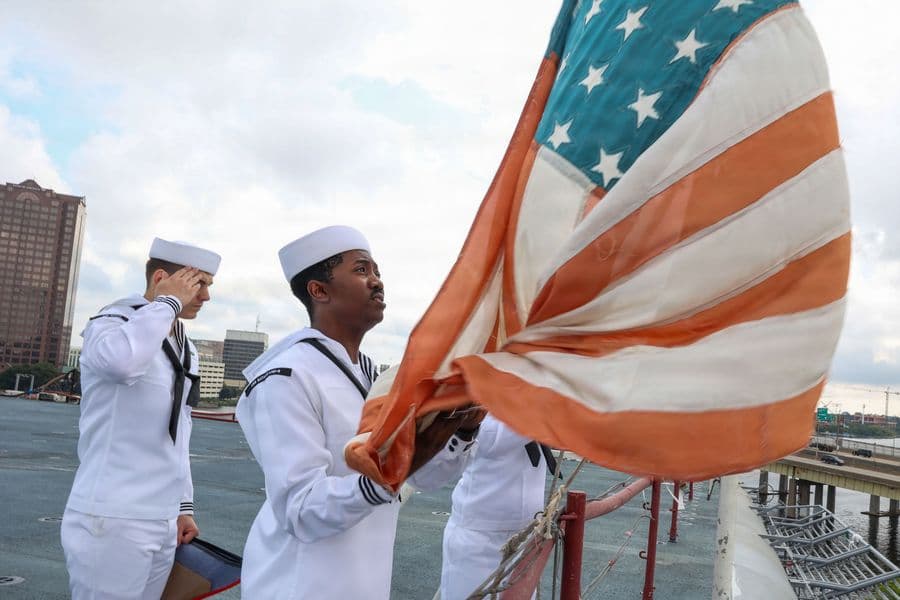
From left, Hospital Corpsman 3rd Class Burton Allen and Hospital Corpsman 1st Class Terrance Little, Sailors assigned to the Wasp-class amphibious assault ship USS Bataan (LHD 5), raise a 48-star flag made out of parachute silk by American POWs to commemorate the 81st anniversary of V-J Day, Aug 15, 2026. Bataan is currently undergoing regularly scheduled maintenance in the General Dynamics National Steel and Shipbuilding Company (NASSCO) shipyard in Norfolk, Virginia. (U.S. Navy photo by Mass Communication Specialist Seaman Apprentice Jackson C. Rott)
The Readiness Cliff: Pacific Lessons Drawn from the Middle East
Last updated 06:32 AM EST • Read time: 9m
Across three years of 5th Fleet combat, from the Red Sea to Operation Epic Fury, the Navy’s surface force has logged over 1,000 offensive engagements with a near 98 percent accuracy, and more than 300 defensive engagements without the loss of a ship or significant battle damage. The combat experience to prevail in a potential Pacific conflict is being built right now in the Middle East. That record is real, but so is the bill. In the months since Iranian strikes damaged Naval Support Activity (NSA) Bahrain, the fleet has kept operating, and often fighting, inside the weapons engagement zone (WEZ) by spending on credit the one currency the U.S. government cannot print: readiness. Unless the Navy and Pentagon act before the ships come home for shipyard maintenance, that debt arrives in 2027 through 2029 as a readiness cliff, just as Washington asks the same yards and welders to accelerate shipbuilding.
Bahrain was never just a port call for Navy ships on deployment. It combined 5th Fleet and NAVCENT command functions, the busiest overseas U.S. Navy port, Task Force 53 logistics that coordinated resupply of ships underway, and a regional maintenance center that performed operational and depot-level repair, warehousing, contracting, and personnel support. Concentrating all those lines of effort bought real efficiency when America owned the air. Once Iranian drone and ballistic missiles overwhelmed layered defenses, they took down command and control, communications, and logistics in a single strike package. Peacetime efficiency is wartime concentration, and concentration is a target.
The loss of NSA Bahrain as a logistics hub led to a workaround through Diego Garcia, roughly 2,200 miles from the ships operating near the Gulf of Oman. A replenishment cycle of five to seven days from Bahrain now takes 14 to 18 from Diego Garcia. Supply officers triage fuel first, then munitions, parts, food, hygiene items, and mail. Every shuttle mile across the Indian Ocean burns oiler days, crew endurance, and logistics margins no other theater can use. With roughly 30 percent of the Navy’s warships tied to the Iran campaign, this is a global constraint wearing a Central Command uniform.
Before Epic Fury, destroyers in the Gulf operated under assumed air and sea superiority. A crew could take a gas turbine offline for the freshwater wash that is required every 100 to 200 operating hours, or take the SPY radar down for monthly preventative maintenance, without leaving station. Under a persistent drone and missile threat, taking an engine or combat system offline weakens the ship’s defense at the moment of greatest exposure. The choices remaining are to transit out of theater and take a shooter from the screen, to tie up a second destroyer as bodyguard during the maintenance, or to defer. Navy leaders acknowledge the third choice has become routine.
Captain Eric Kellum, Chief of Staff of Naval Surface Force Atlantic, framed the scale in September, “We are sustaining 15 warships in the [weapons engagement zone]. That’s almost four carrier strike groups’ worth of destroyers.” Admiral Karl Thomas, Commander of U.S. Fleet Forces, warned that “you can’t defer maintenance indefinitely without paying the bill.” Major availabilities for USS Thomas Hudner, USS Donald Cook, and USS St. Louis slipped from 2026 to 2027, and 18 smaller maintenance periods were cancelled outright. USS Abraham Lincoln went 265 days without a port call, a modern record, and came home with a rust-ringed hull that needs a month of preservation before her drydock period even starts.
Deferred maintenance is not paused maintenance; interest is accruing. A skipped engine wash degrades compressor efficiency, raising fuel burn and wear, which can result in an engine casualty. Corrosion that cannot be addressed at sea becomes growth work in the shipyard. Expanded scope stretches the length of availabilities, and longer availabilities delay training and push the next deployment to the right. All of this jeopardizes the Navy’s 36-month force generation cycle built around an eight-month deployment. Against the Navy’s goal of 80 percent combat surge readiness, cruisers and destroyers stood at 66 percent in 2026 and amphibious ships at 47 percent.
Deferred maintenance forms the bow wave; the industrial base decides how high it grows. When availabilities slip, private yards go hungry. BAE Systems’ Jacksonville yard warned of 400 layoffs and Hampton Roads repair yards projected 2027 drydock usage at an all-time low. Admiral Thomas counted more than six concurrent availabilities stacked into peak hurricane season and said that the “feast or famine dynamic is going to break our shipyards.” GAO has documented the patterns for years with unsustainable lows, unmanageable highs, and a skilled workforce bleeding out between all of them.
New construction turns the bow wave into a cliff. The August Presidential memorandum on rebuilding the Navy calls for a fifth public shipyard, a submarine component repair center, and a surge in new construction. The Navy estimates the construction and repair missions will require recruiting and training roughly 140,000 skilled workers over a decade, in an industry where first-year attrition runs 50 to 60 percent. A repair yard idled in 2026 loses its skilled workforce to jobs with predictable work and steady paychecks. Meanwhile, the public yards cannot absorb the additional work without displacing carriers or submarines. Carrier refuelings, scoped at four years, are running upwards of six to seven, and GAO puts public yard recapitalization at more than $200 billion over 50-plus years.
The money runs in the wrong direction as well. Absent a dedicated appropriation, the services have financed Epic Fury from their existing operations and maintenance accounts that pay for training and depot level maintenance, while the $67.1 billion supplemental remains stalled in the Senate. CBO estimates that U.S. forces expended between one half and two thirds of certain interceptor inventories since June 2025 and rebuilding them will take at least five years. The sum of all this equals fewer surge-ready hulls, yards idled now and overwhelmed later, and magazines half empty by 2027. That is the cliff. The hulls that come out of those availabilities in late 2028 are the same hulls Pacific Command would call first.
For Admiral Samuel Paparo at Pacific Command and Admiral Stephen Koehler at Pacific Fleet, who face a PRC navy built for a regional fight across an ocean of time and distance, the loss of NSA Bahrain offers three lessons. Two belong to the theater, the third is the responsibility of Washington. First, any hub that bundles command, fuel, ordnance, repair, and contracting is a single point of failure and will be struck early. Guam, Yokosuka, Sasebo, and Okinawa all qualify. PACOM should disaggregate hub functions into geographically separated primary, alternate, and emergency sites. They should convert access agreements into executable playbooks covering port operations, customs, fuel suppliers, and payment. They should make defense of the combat logistics force and Military Sealift Command a principal operational mission.
Second, maintenance inside the WEZ is a maneuver problem. Unless maintenance is built into the operational plan, mission demand will override materiel condition until a casualty occurs. PACFLT should write maintenance thresholds into their operational plans. Those thresholds should address when a ship stays forward in the WEZ, when it gets a protected window for maintenance, and when it rotates back to port. They should establish fly-away teams, containerized machine shops, employ additive manufacturing, push battle damage kits forward, and make magazine replenishment at sea a funded planning assumption rather than a demonstration.
Third, the Navy must plan for force regeneration inside existing budgetary toplines because no one should assume a supplemental will arrive on demand. A third carrier strike group and an amphibious ready group are heading to CENTCOM now. The Navy must reset maintenance planning while ships are still deployed. They should reserve drydock and private yard capacity now, while 2026 and early 2027 slots sit empty, order long lead time materials, award multi-availability contracts, and put interceptor and strike munitions production on multiyear contracts within the base budget. They can employ robotic hull, tank, and flight deck inspections on deployed ships to scope the work before a ship returns, rather than discovering growth work in drydock. The Navy should work with industry and standards bodies like ASTM to qualify additively manufactured parts faster and empower program acquisition executives to own the risk of accepting them.
The plans directed by the Presidential memo must protect repair capacity and expand the skilled workforce alongside construction growth. The risk is regional and not uniform; where construction and repair draw upon the same labor pool, a yard that builds new destroyers by hiring away the people who fix the current ones, shifts capacity rather than adding it. Across all regions, expansion plans must show how they will develop additional skilled workers while sustaining the workforce that maintains the existing fleet.
Readiness is the one currency the government cannot print, but it can be budgeted, scheduled, and protected. The Red Sea and Epic Fury proved the fleet can fight for three years on that currency. The Pacific will demand it be spent again, over longer distances, and against a navy that can reach the shipyard as well as the ship. The maintenance bill from Epic Fury comes due as early as 2027. Two deadlines land on December 11: the fifth yard plan the President ordered is due, and the continuing resolution that has frozen FY27 spending at last year’s levels expires. Behind both sits a FY28 budget in final Pentagon review. Together they will show whether anyone learned the Bahrain lesson, or whether the Navy intends to find out how far down the cliff goes.
Brian McSorley is a director at Pallas Advisors and a retired U.S. Coast Guard Captain. In addition to multiple leadership positions at sea and ashore, he served for over two years as a Special Assistant to the Chairman of the Joint Chiefs of Staff and has extensive experience in military budgeting and leading legislative negotiations.

Eight Months of Epic Fury and Still No Internal Alternative
By Stephen D. Cook • RealClearDefense
The Readiness Cliff: Pacific Lessons Drawn from the Middle East
By Brian McSorley • RealClearDefense
The Pentagon’s Real Modernization Problem Is Time, Not Technology
By Bruce Allen Lubbering • RealClearDefense
The World His Mother Opened
By Carlo J.V. Caro • RealClearDefense
Wake Island Lessons for Expeditionary Advanced Base Operations
By Brian J. Dunn • RealClearDefense
Wake Island Lessons for Expeditionary Advanced Base Operations
By Brian J. Dunn • RealClearDefense
U.S. Navy Expands Unmanned Mine Hunting
By Global Defense News
MRF-SEA Will Maintain Continuous Presence in the Philippines
By Mahadzir, USNI News
Space Force Weighs Proliferated Cislunar Satellite Constellation
By C. Albon, A&SF
America-Class Amphibs Enable New Ship-to-Shore Attack Strategies
By Warrior M.