
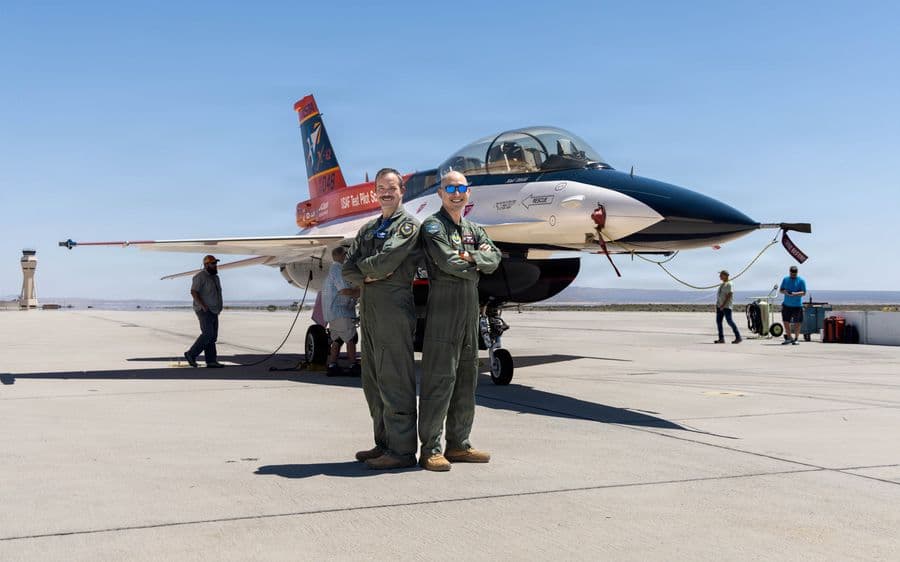
Lt Col Philip Downing, 370th Flight Test Squadron commander, and Wei Lee, senior flight test engineer, 418th FLTS, pose after completing a test mission for HAVE HOLIDAYS at Edwards Air Force Base, California, April 29, 2026. HAVE HOLIDAYS saw simultaneous integration and evaluation of a wide suite of modular technologies into the X-62’s Enterprise Open Mission System Architecture computer. This included the integration of a non-prime, third-party autonomous agent onto the X-62, testing of enhanced safety rules to prevent autonomous vehicles from violating user-established operational limits, and further chip integration for advanced sensor exploitation. The research is part of ongoing efforts the U.S. Air Force Test Pilot School and industry partners. (U.S. Air Force photo by Lindsey Gordon)
The Pentagon’s Real Modernization Problem Is Time, Not Technology
Last updated 06:30 AM EST • Read time: 7m
In the halls of the Pentagon and across testing ranges, the national security conversation centers on technological superiority. High-profile modernization initiatives showcase autonomous systems, hypersonic propulsion, and artificial intelligence models designed to outpace adversaries. Yet government audit data and procurement metrics point to a different conclusion. The military’s primary vulnerability is not a shortage of advanced technology. It is a procurement architecture that moves too slowly to field that technology at scale.
The core issue is temporal. The commercial sector runs on rapid software updates, continuous delivery pipelines, and iterative hardware manufacturing. Defense acquisition remains tethered to a rigid, industrial-era process. Major programs now routinely take more than a decade to deliver an initial capability. By the time complex hardware and software reach frontline service members, the state of the art has moved on, and newly fielded equipment becomes a candidate for expensive retrofits and redesigns.
The Twelve-Year Delivery Gap
Independent oversight data paints a consistent picture of delay. The Government Accountability Office (GAO) reported in its July 2026 annual weapon systems assessment (GAO-26-108457) that the overall average time to deliver a capability has risen to more than 12 years, and it warned that the average will keep climbing as programs push back milestones. That figure covers the costliest major defense acquisition programs, and the clock starts at program start, so the years spent defining and validating requirements beforehand are not even counted.
This window contrasts sharply with commercial technology lifecycles:
- Hardware refresh cycles: Commercial electronic components and microprocessors typically refresh every 18 to 24 months (a common industry rule of thumb).
- Software lifecycles: Commercial software moves to continuous deployment, with major revisions arriving in months or a few years rather than decades.
Set against those cycles, a program that takes more than 144 months to move from program start to initial operational capability is effectively delivering equipment built around several generations of obsolete components.
This gap feeds the persistent problem of Diminishing Manufacturing Sources and Material Shortages (DMSMS). Program offices regularly discover that commercial manufacturers stopped producing required microchips or circuit boards years earlier. Substantial funding must then be redirected to source legacy replacement parts or to redesign subsystems mid-development around current-generation components.
The Bureaucracy of Requirements and Risk Avoidance
A major cause of delay, though not the only one, lies in the administrative layer built under the Department of Defense Instruction 5000 series and the joint requirements process. For decades, a major program had to clear the Joint Capabilities Integration and Development System (JCIDS) before formal engineering development could begin. The process demanded multi-service coordination, exhaustive cost validation, and layered threat assessments. It was designed to ensure fiscal oversight, prevent duplication, and promote interoperability. In practice, defining and validating requirements alone could consume years.
Once a program enters development, it is bound to strict baseline requirements. Suppose a breakthrough in autonomy, micro processing, or encrypted communications arrives three years into a decade-long effort. Adopting it requires contract modifications, budget reprogramming, and re-baselining. Because changing scope risks cost overruns and further slippage, program managers are structurally incentivized to field the technology originally specified rather than integrate something better.
Process is not the whole story, and speed and technology maturity are linked. GAO’s latest assessment found that almost half of the Middle Tier of Acquisition (MTA) programs it reviewed entered the pathway with immature technologies. Faster pathways will not close the gap unless programs also start with technology ready to field.
Operational Costs of Schedule Slippage
Extended lead times spill directly into fleet sustainment, force structure, and total ownership costs.
Because new equipment takes longer to reach the field, legacy platforms must stay in service well past their planned retirement dates. Maintainers sustain aging airframes, surface ships, and armored vehicles with custom-fabricated spare parts, and operating and support (O&S) costs keep climbing.
Contractors face their own constraints. Non-standard electronic assemblies, specialized titanium forgings, and radiation-hardened circuitry can take 18 to 24 months or longer to produce, by industry estimates. Long program timelines and uncertain funding make it harder for suppliers to justify investing in spare capacity, which makes rapid production scaling difficult in a crisis.
Recent Efforts to Reform and Streamline the Architecture
Recognizing that slow acquisition compromises readiness, Congress and the Department of Defense have built alternative mechanisms to bypass traditional bottlenecks. In January 2020, the Pentagon restructured DODI 5000.02 to replace the single-path acquisition model with six pathways tailored to specific technology types. Two stand out:
- Middle Tier of Acquisition (MTA): Intended to bypass full JCIDS reviews and deliver rapid prototyping and rapid fielding, with each path capped at five years from program start absent a waiver. GAO has found that some MTA programs end without delivering a fieldable capability, and others plan to deliver years after the MTA phase ends.
- Software Acquisition Pathway: Built for software-heavy systems, allowing continuous integration and delivery akin to commercial practice rather than treating software like heavy hardware.
To engage non-traditional contractors who avoid Federal Acquisition Regulation constraints, the Pentagon expanded its use of Other Transaction Authorities (OTAs). The Defense Innovation Unit (DIU) uses them to move prototype contracting from years to months, by its own account, speeding technology transition from commercial markets to military users.
Launched in August 2023, the Replicator Initiative aimed to field thousands of attritable, autonomous systems within 18 to 24 months. Rather than starting decade-long programs of record, it focused on mature commercial technology and accelerated manufacturing. The results were mixed. A DIU official said the effort delivered hundreds of systems to warfighters, with thousands more on contract by the August 2025 target. Around that deadline, Replicator’s functions moved into a new Defense Autonomous Warfare Group. The model showed that commercial technology can reach operators faster than a traditional program of record, but it has not yet proven repeatable at the scale originally promised.
The most sweeping change came in November 2025, when Secretary Hegseth announced that JCIDS would be eliminated, that the Defense Acquisition System would become the Warfighting Acquisition System, and that program executive offices would be restructured into Portfolio Acquisition Executives. JCIDS policy has since been replaced by the Joint Forces Requirement Process. It is too early for schedule data to show whether these changes work.
Shifting from Fixed Platforms to Modular Architecture
Beyond administrative reform, oversight agencies and defense analysts advocate broader adoption of Modular Open Systems Architecture (MOSA). Congress has already directed its use in major programs, so the challenge is implementation. Under a modular approach, the hull, airframe, or vehicle chassis is decoupled from its internal avionics, sensors, and software.
With standardized hardware interfaces and software protocols, the services can swap out radars, radios, and targeting algorithms without redesigning the underlying platform.
The Department’s recent reforms show clear recognition of the speed deficit, but audit findings indicate that adoption across traditional major programs remains a challenge. GAO has recommended since 2022 that DoD revise its acquisition, test, and engineering policies to incorporate iterative development. Optimistic schedules are still set during early planning, and legacy budgeting structures still favor multi-year platform programs over continuous, iterative deployment.
The technical capabilities engineered by American laboratories and defense firms remain formidable. The Pentagon does not lack technology; it lacks speed. Until core acquisition processes can deliver innovations to operational units at commercial speed, time will remain the critical constraint on military preparedness.
Bruce Allen Lubbering held several management positions with aerospace manufacturing companies in a career that lasted over 30 years.

Eight Months of Epic Fury and Still No Internal Alternative
By Stephen D. Cook • RealClearDefense
The Readiness Cliff: Pacific Lessons Drawn from the Middle East
By Brian McSorley • RealClearDefense
The Pentagon’s Real Modernization Problem Is Time, Not Technology
By Bruce Allen Lubbering • RealClearDefense
The World His Mother Opened
By Carlo J.V. Caro • RealClearDefense
Wake Island Lessons for Expeditionary Advanced Base Operations
By Brian J. Dunn • RealClearDefense
Wake Island Lessons for Expeditionary Advanced Base Operations
By Brian J. Dunn • RealClearDefense
U.S. Navy Expands Unmanned Mine Hunting
By Global Defense News
MRF-SEA Will Maintain Continuous Presence in the Philippines
By Mahadzir, USNI News
Space Force Weighs Proliferated Cislunar Satellite Constellation
By C. Albon, A&SF
America-Class Amphibs Enable New Ship-to-Shore Attack Strategies
By Warrior M.