
At Shangri-La, Washington and Southeast Asia Talked Past Each Other
Last updated 08:02 PM EDT • Read time: 4m
The Dialogue’s starkest divide wasn’t between Washington and Beijing – it was between Washington and its own partners.
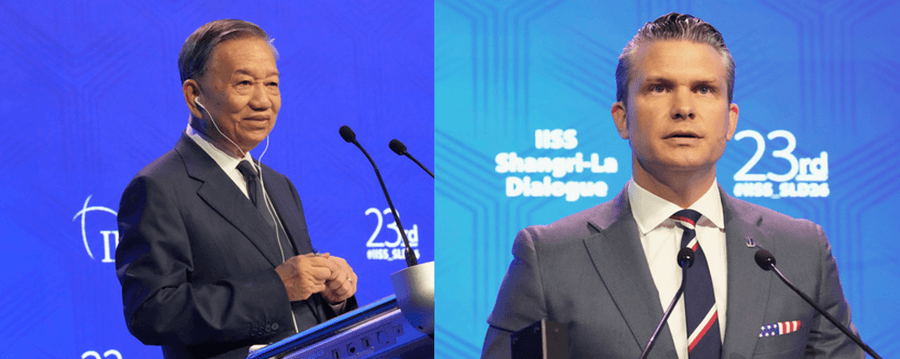
Asia watchers are typically accustomed to hearing opposing perspectives from the United States and China at the annual Shangri-La Dialogue, Southeast Asia’s premier defence conference, which this year brought together officials and analysts from 29–31 May. But with China’s Defence Minister Dong Jun absent for the second year in a row, the clearest divergence was not between the two superpowers. The most revealing contrast was that between U.S. Secretary of War Pete Hegseth – as he now styles the role – and Vietnam’s General Secretary of the Communist Party To Lam, who delivered the keynote address.
Read together, Hegseth and To Lam’s speeches expose a widening gap between how the United States and Southeast Asia view regional security – and what each side wants from it. To Lam’s emphasis on preserving the rules-based order to maintain peace and development contrasted sharply with Hegseth’s rhetoric about American military power and defence spending.
To Lam sought in his remarks to warn against “uncontrolled competition” and urge nations to work together to achieve “peace, trust, and development”. He repeatedly argued that rules and dialogue were essential to maintaining a just international order, and cautioned that the subjective interpretation and selective use of international law facilitated a “big fish eat small fish” world in which small states were pressured to choose sides. To Lam cast Vietnam as a defender of the rules-based order, a stark contrast from Hegseth’s speech the following morning.
Hegseth instead decried the “utopian idealism” of the old order and declared, “the era of the United States subsidising the defence of wealthy nations is over”. According to Hegseth, U.S. President Donald Trump expected American allies to carry their fair share of the burden to defend their interests.
Hegseth struck a very different note on China from his speech last year, when he warned that a Chinese invasion of Taiwan was “imminent”. This year he boasted, “Under President Trump’s leadership, relations between the United States and China are better than they’ve been in many years,” and echoed the concept of “constructive strategic stability” which emerged from Trump’s meeting with Xi Jinping in Beijing last month. He did not mention Taiwan once in his speech this year.
Hegseth’s remarks betrayed a fundamental tension between adopting a softer line on China and demanding allies and partners increase their defence spending to 3.5% of GDP.
Insisting that America’s allies and partners spend more on security even as the Trump administration seeks to stabilise the U.S.-China alliance puts most Southeast Asian states in an uncomfortable position. Increasing defence budgets will inevitably play into Beijing’s claims that it is being encircled and that Chinese military objectives are purely defensive. In essence, Washington is fuelling an arms race at a time when doubts about its commitment to the region continue to grow, especially given the U.S. attention and resources being reallocated to the Middle East and Western Hemisphere.
Hegseth sought to assure listeners that the United States seeks “a genuinely stable equilibrium … in which no state, including China, can impose its hegemony and hold the security or prosperity of our nation and our allies in question.”
He struck a more positive tone than last year. But policymakers and analysts put more stock in actions than in words. The Trump administration’s unilateral and destabilising moves around the world have fuelled anxieties that the United States is no longer a reliable superpower. Many Southeast Asian leaders are already planning for a scenario in which they are left on their own, and they are right to question the wisdom of ramping up arms spending if Washington will not come to their defence.
The region would overwhelmingly prefer the worldview espoused by To Lam, in which small and medium-sized states have as much say as larger powers, and where order is underpinned by rules and dialogue rather than brute force.
Hunter Marston, Ph.D. is the Director of the Southeast Asia Program at the Lowy Institute and Project Lead for the Asia Power Index.
This article appeared originally at Lowy Institute's the interpreter.

In Pursuit of Nuclear Abolition
By Peter Huessy • RealClearDefense
Innovation Alone Won’t Prepare the U.S. for the Future Battlefield
By Joshua Segal • RealClearDefense
The sUAS Tactical Trifecta
By Bryan T. Woody • RealClearDefense
The Revolutionary War: When Strategic Options Share the Same Weakness
By Henry Yep • RealClearDefense
The Houthis Are Testing the Limits of Collective Defense
By Saima Afzal • RealClearDefense

Who Shoots Down the Drone Over the Shipyard?
By John Ferrari & Dillon Prochnicki • RealClearDefense
Northrop Grumman Breaks Out the Big Guns at AUSA
By Daniel Terrill, Defense News
Army Pursuing Diverse Array of New Anti-Air Interceptors
By Trevithick, The WarZoneWho Shoots Down the Drone Over the Shipyard?
By John Ferrari & Dillon Prochnicki, RCD
F-35C Lands for the First Time on a Ford-Class Aircraft Carrier
By The Aviationist