
Great Powers Line Up To Congratulate the Philippines' New Leader
Last updated 04:57 AM EDT • Read time: 8m
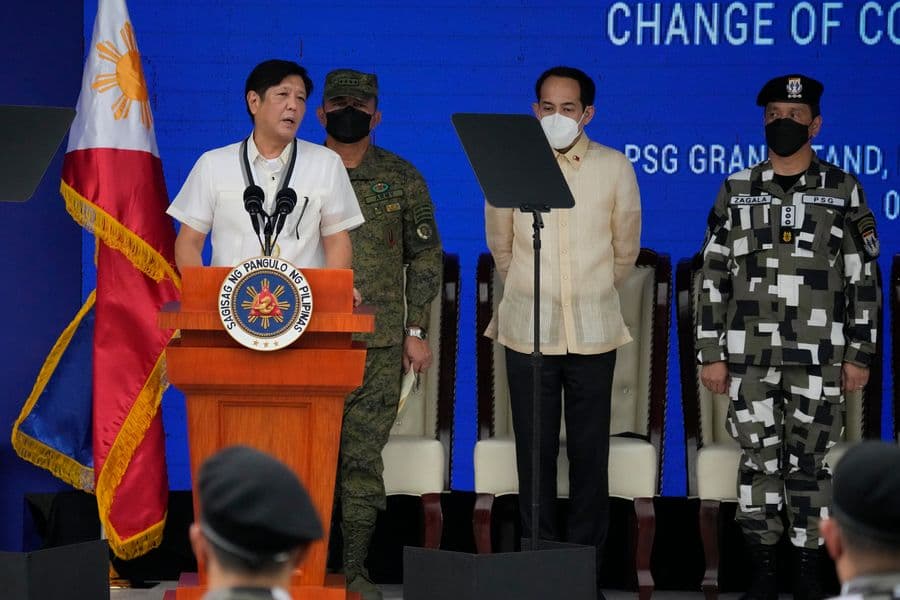
On June 30th, a White House delegation led by U.S. Second Gentleman Douglas Emhoff, attended the inauguration of President-elect Ferdinand “Bongbong” Marcos Jr, who on May 11th, claimed victory over his opponent Leni Robredo in an electoral rout. This seven-member delegation included the current U.S. director of the Asian Development Bank and the former Vice Chairman of the Joint Chiefs of Staff, reflecting two of the United States’ chief interests in the archipelago nation. This transition of power might appear as a welcome sight for U.S. policymakers, who for the previous six years watched relations strain significantly as the mercurial Rodrigo Duterte manned the helm. While the incoming President Marcos Jr. is likely to refrain from the bluntly offensive rhetoric about the United States of his predecessor, their foreign policy stances may align regrettably alike.
The election of Duterte in 2016, along with the rise of Bongbong Marcos Jr., the namesake of the former disgraced dictator Ferdinand Marcos, represent a greater societal shift in the Philippines not dissimilar to the United States “Make America Great Again” movement, in which invocations of populism and nostalgia for past prosperity captivated millions. This tidal shift in Filipino politics has already suffused its increasingly independent foreign policy, which the United States should consider as it looks to court the newly elected leader.
Conflicting with the ideal of an independent Filipino foreign policy, however, is the fact that the Philippines finds itself squarely on the frontlines of Great Power competition between the U.S. and China. After Marcos Jr.’s declared victory last month, the first two heads of state to congratulate him were Presidents Joe Biden and Xi Jinping. As the Philippines longstanding defense guarantor, the United States has been the traditional backer of the archipelago nation’s defense interests and security. However, despite China’s military ambitions in the South China Sea which have led to the continual encroachment of the Philippines’ Exclusive Economic Zone, the CCP possesses its own advantages in fostering greater economic ties with Bongbong’s administration. Marcos Jr. has stated before that the Hague’s 2016 arbitral tribunal ruling favoring the Philippines was “not effective” and that the “only practical option” for ending the enduring standoff was a bilateral agreement with the Chinese. Ignoring the Hague’s decision and adopting a unilateral diplomatic approach with the Chinese to settle the dispute in the Spratly Islands could produce disastrous consequences for preserving a free and open Indo-Pacific region. A solution brokered exclusively between the Philippines and China could undermine the international consensus that refutes China’s nine dash claim and begin to legitimize Chinese gains in the Spratly Islands, thereby compromising America’s position on the issue and preparing the way for other states in the region to make their own accommodations to China. Regarding the dispute over the Spratlys, Bongbong recently asserted that “If you let the U.S. come in, you make China your enemy.” He continued by saying that “we can come to an agreement (with China). As a matter of fact, people from the Chinese embassy are my friends. We have been talking about that.”
Marcos Jr. has shown a penchant for inking deals with the Chinese in his political past. In 2007, while presiding over his family’s home province of Ilocos Norte as governor, Marcos Jr. successfully lobbied the Chinese to open a consulate in Laoag. The agreement led to a dramatic growth in tourism in the northern region of the country. Prior to the pandemic, tourism as a share of the Philippines total GDP reached a considerable 12.9 percent, with Chinese tourists spending reaching $2.3 billion dollars in 2019, second only to South Korea. With an economy saddled by pandemic-induced debt and a declining peso, the Philippines is looking to rebound in a big way after consecutive years of borrowing. Bongbong could look to negotiate an agreement with China over the disputed islands to facilitate greater trade and tourism in the region, a far more vital interest of the administration’s than keeping relations on an even keel with the Americans.
Although Marcos Jr. has shown an apparent willingness to engage with the Chinese over maritime claims, he will need to corral his defense and foreign ministries which continue to dispute China’s illegal activities within the Philippines’ EEZ. Just this month, the foreign ministry launched a new diplomatic protest against China’s coast guard and maritime militia, who continue to interfere in the Philippines’ attempts to resupply its own military personnel on the Second Thomas Shoal. Outgoing Foreign Secretary Teodoro Locsin reminded China that such property is covered by the Philippines-United States Mutual Defense Treaty. These recurring protests underscore the uphill battle Bongbong faces if he believes that he can bilaterally settle disputed claims in the Spratly Islands without capitulating to China or incensing the Americans. Perhaps his earlier remarks suggesting engagement with China will prove to be too naïve to pursue.
Amid the protracted uncertainty over the Spratlys, U.S. policymakers must not bank on an assumption that Marcos Jr. will err on the side of reason and avoid settling with China bilaterally to further open trade. To ensure that the Marcos administration does not acquiesce to China in the maritime domain, the U.S. should present a range of attractive economic opportunities for the Philippines as an alternative to Chinese investment offers. Unfortunately, the United States trails mightily behind the Chinese in terms of development assistance. For instance, in November of 2021, China pledged $1.5 billion in assistance to ASEAN countries over a span of three years to assuage the financial blow from the pandemic. In contrast, President Biden promised to spend just $150 million on ASEAN stakeholders, with $40 million focused on decarbonizing infrastructure, a tertiary concern at best for the incoming Filipino President.
Additionally, the recently rolled-out Indo-Pacific Economic Framework (IPEF) does not match up to the Trans-Pacific Partnership (TPP), which the Trump Administration pulled out of in 2017. The IPEF is designed as a platform to promote trade agreements based on four key pillars: trade digitization, supply chain resilience, clean energy, and anti-corruption. Participant countries can “opt in” to any of the four major pillars, which theoretically grants them greater flexibility in arranging trade relationships with other stakeholders. However, it remains difficult to gauge the enthusiasm of the 12 participant nations. Barriers to entering the agreement were low, and any mention of creating incentives to draw market access for trade partners is conspicuously absent. Moreover, under the trade pillar of the agreement, it only mentions that the U.S. “will engage comprehensively” with partners without including any specific provisions for negotiations. Unclear is how the Philippines will respond to this new trade arrangement, but between its historically thorny protectionist policies and pervasive corruption, opting into the “fair economy” pillar seems a tough sell – in 2019, the World Bank ranked the Philippines 124th in ease of doing business. What participant countries like the Philippines are truly looking for are reduced barriers to market access in the U.S.. However, the Biden Administration is currently hamstrung by purported public aversion to expanding global trade, even though polls suggest otherwise. The United States seems more focused on enforcing trade rules and promoting better practices than actually galvanizing trade itself.
If the U.S. wants to be serious about preserving its influence in the Indo-Pacific, it must lead by promoting proactive trade and investment policies that address the concerns of regional partner countries like the Philippines. Bongbong’s appeals to working-class citizens and desire to continue the Duterte administration’s “Build, Build, Build” infrastructure program, can be stimulated by greater U.S. participation. Filipino officials believe that China has not made good on its original pledge in 2016 to provide $24 billion in support of infrastructure projects. The time is ripe for the United States to capitalize on the Philippines’ skepticism over China’s reliability as an investment partner. Furthermore, U.S. officials should table a free trade agreement with the Philippines, which would help to fulfill Bongbong’s promises to generate jobs and give assistance to farmers. American investors have shown mild optimism that such an agreement could possibly materialize.
On the surface, the election of Marcos Jr. might seem like a harbinger of bad things to come between the Philippines and the U.S. – Bongbong has flouted a U.S. contempt of court judgment against him stemming from his father’s human rights abuses, which could complicate a potential visit to the United States. His past dealings with China as well as his family’s own history of flagrant corruption raise alarm as well. However, too much is on the line for both parties to disrupt the delicate balance of power against China. Having been educated in the United States and being exposed to the powers of the president for his entire life, Bongbong should have an intuitive understanding of this dynamic – time will tell if he acts accordingly.
John Kraus is a graduate student in International Relations at the Johns Hopkins School of Advanced International Studies (SAIS) and is currently a Research Assistant at Yorktown Institute.

Iranian Cyber Operations
By Michael Groen • RealClearDefense
Reflecting on an Epic Horse Campaign in the Mountains of Afghanistan
By Brian Glyn Williams • RealClearDefense
The Godfather of American Foreign Policy Realism Speaks to Today’s World
By Francis P. Sempa • RealClearDefense
In Pursuit of Nuclear Abolition
By Peter Huessy • RealClearDefense
Innovation Alone Won’t Prepare the U.S. for the Future Battlefield
By Joshua Segal • RealClearDefense

26th MEU – U.S. Needs Crisis Response MAGTF
By Marine Corps Compass Points
The Influence of History on a Sea Power
By CDR Salamander
Navy Civilianizes Six Former Flag Billets, Reduces Six to Captains
By Mongilio, USNI N.
Raytheon's $8B Contract for Strategic Comms Terminal Modernization
By M+A El
America’s Maritime Moment Will Not Wait
By CDR Salamander