
Indo-Pacific Recalibration, Not Retaliation, Against U.S. Tariffs
Last updated 01:48 PM EDT • Read time: 5m
The latest round of tariffs imposed by the Trump administration was hardly unexpected, but that does not make them any less unsettling for some of America’s staunchest allies in the Indo-Pacific. With even more tariffs expected to be introduced by the White House even as it expects domestic pushback, the targeted countries too will be recalibrating their responses. While a tit-for-tat response to the U.S. tariffs is unlikely by most Asian nations, readjustment of expectations as well as strategies for doing business in the United States is underway.
Leveraging tariffs continues to be seen as an answer to bolster U.S. industrial capabilities by the Trump administration, a conviction that remains unshaken even after the February 2026 Supreme Court ruling that the International Emergency Economic Powers Act (IEEPA) does not authorize the president to impose tariffs. While the court’s ruling invalidated the April 2025 “Liberation Day” tariffs that effectively levied a tax on goods from almost all countries between 10 and 50 percent, the White House was quick to pivot and invoke Section 122 tariffs that were to expire after 150 days on July 24.
The threat of imposing Section 301 of the 1974 Trade Act—which allows the U.S. Trade Representative (USTR) to investigate and then to remedy unfair trade practices, which includes imposing tariffs—had been looming since the Supreme Court ruling in February. As a result, the only real surprise was the exact number of countries that were hit and the tariff rate that would be imposed. The latest round of tariffs is ostensibly to tackle the issue of forced labor in the global supply chain, which is undoubtedly a challenge that warrants greater international attention, especially in the textile and apparel industries. At the same time, labor rights violations worldwide are also an area that the United States itself can improve in enforcing.
A total of 60 U.S. trading partners, including the European Union, Britain, and Canada, have been hit with a 10 percent rate, while Japan, South Korea, Singapore, and Thailand have been levied with the same rate of 12.5 percent as China. Ordinarily, the response by the countries that have been hit by the new round of U.S. tariffs should be to improve efforts to combat labor exploitation, and thereby not only negotiate a tariff reduction with Washington but also be part of the solution to the very real global challenge. But it is clear that the Trump administration’s goal with the latest Section 301 action is not about combating forced labor issues in the global economy. Rather, the priority for the White House remains to be able to levy tariffs to encourage reindustrialization at home whilst reducing unfair trade barriers overseas. At the same time, the administration is increasingly turning to tariffs as a tool for economic statecraft to achieve its broader national security goals, rather than simply seeking to address the U.S. trade imbalances. The White House is no doubt expecting renewed opposition from within the United States to the latest round of tariffs under Section 301, as had been the case under invoking IEEPA. But as the administration continues to regard leveraging tariffs as a tool to address its national security and foreign policy concerns as much as its trade objectives, it is expected to continue seeking new ways to impose tariffs to renegotiate economic relations.
Thus, America’s critical economic partners in the Indo-Pacific are bracing for more pain to be inflicted by the White House. Indeed, USTR launched a Section 301 investigation in March to target structural excess manufacturing capacity in targeted governments including the European Union, Japan, South Korea, Taiwan, Thailand, Vietnam, Singapore, Indonesia, Malaysia, and Cambodia as well as China. Yet so far, no country is declaring any intention of taking retaliatory action against the United States. Japan, for instance, remains the world’s fourth-largest economy and one of the biggest owners of U.S. debt, and it has considerable economic leverage of its own. Yet far from withdrawing from its commitment to invest up to $550 billion in critical U.S. industries including data centers and shipbuilding before the end of Trump’s second term in office, Japan continues to move forward with the agreement made following Washington’s April 2025 tariff announcements. South Korea, which has similarly committed to investing in the United States to the tune of $350 billion, is also expected to adhere to Washington’s expectations.
Still, the trade volatilities caused by the 2025 U.S. reciprocal tariffs ranging from 10 to 50 percent cannot be ignored, and the ongoing Section 301 investigations against countries (including Vietnam and Malaysia, which have been key to drawing investment in critical technology sectors including semiconductors) are encouraging countries to diversify their risk exposure to U.S. trade policy uncertainties. While there was no notable concerted effort to push back against the Liberation Day tariffs, the momentum for greater inter-regional trade and investment is on the rise. At the same time, China’s efforts to promote itself as a more predictable partner cannot be ignored. For the United States, strong partnerships with countries across the Indo-Pacific will remain at the heart of its economic competitiveness moving forward. A U.S. trade policy that acknowledges the need to work more closely with governments that are critical for U.S. supply chain resilience as well as innovation must be made clear for its own economic future.
Shihoko Goto is the Vice President of Programs and Director of the Asia Program at the Foreign Policy Research Institute (FPRI).
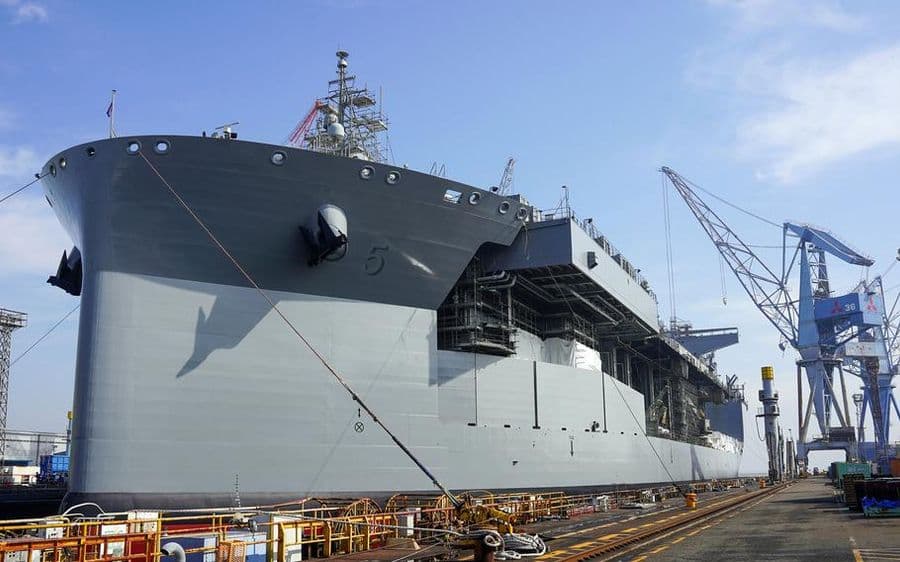
image: The U.S. Navy expeditionary mobile base USS Miguel Keith completed a five-month overhaul at Mitsubishi Heavy Industries in Yokohama, Japan, April 15, 2025. (Randall Baucom/U.S. Navy)
This article appeared originally at Foreign Policy Research Institute (FPRI).

In Pursuit of Nuclear Abolition
By Peter Huessy • RealClearDefense
Innovation Alone Won’t Prepare the U.S. for the Future Battlefield
By Joshua Segal • RealClearDefense
The sUAS Tactical Trifecta
By Bryan T. Woody • RealClearDefense
The Revolutionary War: When Strategic Options Share the Same Weakness
By Henry Yep • RealClearDefense
The Houthis Are Testing the Limits of Collective Defense
By Saima Afzal • RealClearDefense

Navy Civilianizes Six Former Flag Billets, Reduces Six to Captains
By Mongilio, USNI N.
Raytheon's $8B Contract for Strategic Comms Terminal Modernization
By M+A El
America’s Maritime Moment Will Not Wait
By CDR Salamander
Armor Up?
By Marine Corps Compass Points
Who Shoots Down the Drone Over the Shipyard?
By John Ferrari & Dillon Prochnicki • RealClearDefense