
Probing Palau's Waters: Chinese Ships Are Increasingly Active in the Pacific
Last updated 05:25 AM EDT • Read time: 4m
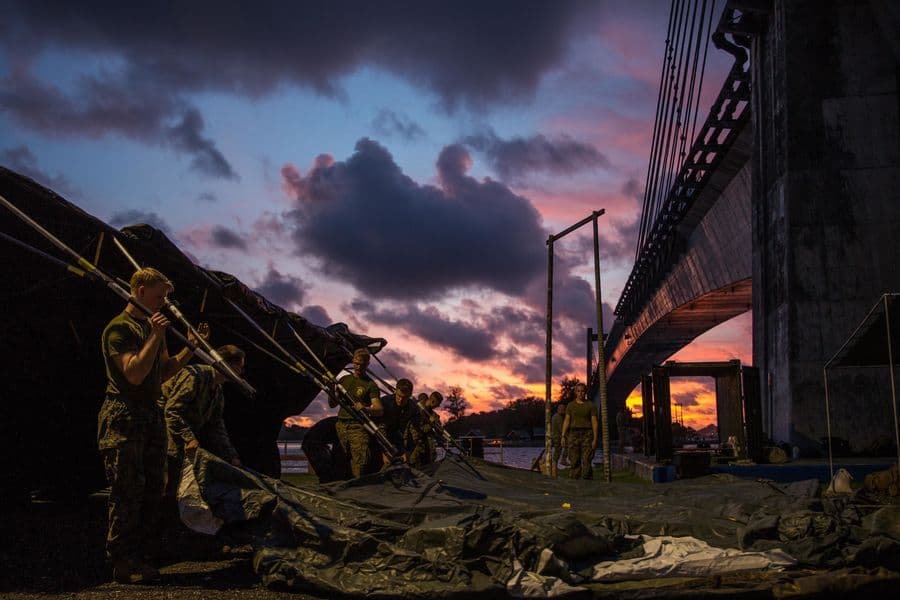
AIRAI, Republic of Palau - U.S. Marines with Task Force Koa Moana set up a combat operations center tent under the Koror–Babeldaob Bridge, Airai, Republic of Palau, Nov. 26. TFKM deployed to Palau to continue multilateral engagements designed to strengthen and enhance relationships among the U.S. and partner nations in the Indo-Pacific and South Pacific regions. (U.S. Marine Corps photo by SSgt Gabriela Garcia)
Risky Chinese behavior in the South China Sea is nothing new, but under Chinese Communist Party General Secretary Xi Jinping, Beijing’s maritime reach has increasingly extended into Oceania. That includes an uptick in Chinese naval activities in the waters off Palau, one of America’s key Pacific Island security partners.
In one recent example, the Chinese vessel Haiyang Dizhi Liuhao entered Palau’s 200 nautical mile exclusive economic zone. The vessel reportedly conducted “questionable maneuvers” over the fiber optic cables that provide Palau with internet and telecommunications. The U.S. Coast Guard, stationed in Guam, was busy responding to a typhoon and thus lacked the resources to devote to Palau’s request for assistance.
This isn’t the first time Chinese vessels have entered Palau’s waters. In late 2021, a survey vessel moved through Palau’s exclusive economic zone in a manner consistent with underwater mapping. Such data, if it was collected, could expose natural resources valuable to China or provide an advantage for military vessels especially submarines. A U.S. Coast Guard plane did travel to the area and establish contact, but only confirmed that the research ship was not in distress.
In the summer of 2022, a Chinese vessel designed to track objects like satellites and missiles crossed into Palau’s waters within 90 nautical miles of the Southwest Islands. As with the other two incursions during the tenure of Palau’s current president, neither local nor U.S. authorities were able to intercept the ship by sea.
Undersea cables are of growing strategic significance. In February 2023, Chinese vessels cut two cables used by Taiwan’s Matsu Islands. During a potential Taiwan Strait or South China Sea conflict, undersea cables can be targeted to disrupt commerce and communications. For isolated Pacific Island nations, these cables are vital for daily public and private activities that keep the nations, quite literally, “plugged” into the rest of the world.
In response, Palau President Surangel Whipps Jr. said that China’s does “not respect the rules-based order” and called on the U.S. to support Palau in promoting “deterrence through presence.” His predecessor, former President Tommy Remengesau, previously invited the United States to establish bases in Palau through a bilateral agreement. In his 2020 letter to former U.S. Secretary of Defense Mark Esper, Remengesau pointed out that “the US military’s right to establish defense sites in the Republic of Palau has been under-utilized for the entire duration of the compact.”
Formally called a Compact of Free Association (COFA) agreement, the U.S. has exclusive military access to and authority over Palau. That means the U.S. can construct military facilities and conduct military operations within Palau’s territories at will. The U.S. also has the right of strategic denial, which allows the U.S. to “foreclose access” of Palau by “military personnel or for the military purposes of any third country.”
From sending ships into Palau’s waters to forging secret security agreements with the Solomon Islands, it is clear that China’s ambitions extend far beyond Taiwan. By renewing Palau’s COFA, set to expire on Sept. 30, 2024, the U.S. will maintain its exclusive defense ties with Palau, in the face of Chinese expansionism and its commitment to defending long-standing treaty allies in the Indo-Pacific. Success, however, depends on Congress.
To ensure strategic denial rights can be efficiently executed, Congress must fund and sustain long-term investments in the Navy and Coast Guard. News ships, notably for the Coast Guard, improve our ability to respond rapidly to Chinese incursions and expand the number of areas that the U.S. can patrol at once.
Palau possesses just a small number of short-range patrol boats. In an interview during a visit last month to Japan, President Whipps not only requested additional U.S. maritime patrols, but also expressed interest in hosting troops and military facilities. Given Palau’s strategic location in the Pacific, a stronger U.S. Coast Guard presence would allow the U.S. to quickly respond to monitor Chinese maritime activities and respond to any aggressive or unlawful operations.
Palau is eager to collaborate with the United States. By renewing the COFAs and investing in key maritime assets, Washington can protect its national interests, defend its Pacific allies, and take steps to win the New Cold War.
Andrew J. Harding, co-editor of “Winning the New Cold War: A Plan for Countering China,” is a researcher at The Heritage Foundation’s Asian Studies Center. Wyatt Greco is a member of the Heritage’s Young Leaders Program.

In Pursuit of Nuclear Abolition
By Peter Huessy • RealClearDefense
Innovation Alone Won’t Prepare the U.S. for the Future Battlefield
By Joshua Segal • RealClearDefense
The sUAS Tactical Trifecta
By Bryan T. Woody • RealClearDefense
The Revolutionary War: When Strategic Options Share the Same Weakness
By Henry Yep • RealClearDefense
The Houthis Are Testing the Limits of Collective Defense
By Saima Afzal • RealClearDefense

Who Shoots Down the Drone Over the Shipyard?
By John Ferrari & Dillon Prochnicki • RealClearDefense
Northrop Grumman Breaks Out the Big Guns at AUSA
By Daniel Terrill, Defense News
Army Pursuing Diverse Array of New Anti-Air Interceptors
By Trevithick, The WarZoneWho Shoots Down the Drone Over the Shipyard?
By John Ferrari & Dillon Prochnicki, RCD
F-35C Lands for the First Time on a Ford-Class Aircraft Carrier
By The Aviationist