
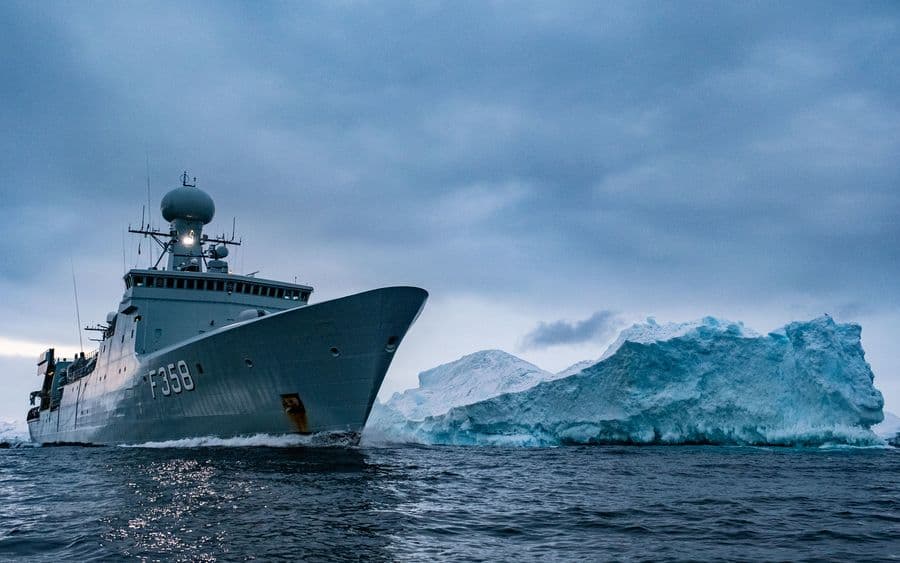
The Arctic Is the New Global Hotspot
Last updated 05:27 PM EDT • Read time: 5m
For centuries, the Arctic was considered the exclusive domain of polar bears, exotic marine life and the occasional intrepid explorer. However, as climate change has thawed the polar ice, it has also opened up new shipping lanes and access to the region’s vast natural resources. And U.S. President Donald Trump’s threats to take over Greenland for national security reasons have catapulted the Arctic onto the global stage.
As a result, Kenneth Rosen’s latest book, Polar War, could hardly be more timely. Rosen is an investigative journalist whose articles on a range of political and social issues have been published in The New Yorker, The New York Times and The Atlantic.
The struggle for control of the Arctic has a long history. With an eye on the longer-term economic gains, in 1867 U.S. secretary of state William Seward convinced a reluctant Congress to approve the purchase of an economically unprofitable Alaska from a deeply indebted Russia. The price was U.S.$7.2 million (equivalent to about U.S.$160 million today), a deal that one must assume Russia now regrets.
The outbreak of World War II highlighted the strategic importance of Greenland, with the United States establishing a large network of bases there, staffed by up to 15,000 personnel. In 1946, as part of his doctrine of containing the Soviet Union, president Harry Truman even tried to purchase Greenland. Denmark turned him down, but a 1951 defence agreement gave the U.S. freedom to maintain bases there.
For all Trump’s bluster, Rosen highlights how ill-prepared Washington is for the race to control the Arctic. Russia is by far the dominant power, with massive military bases on the Kola Peninsula and more than 50 military installations along its Arctic coastline.
Murmansk is home to Russia’s northern fleet, which includes an aircraft carrier, heavy missile cruisers, and nuclear and diesel-powered submarines. Russia also has about 50 icebreakers, of which eight are nuclear-powered.
In contrast, U.S. military bases in the Arctic are modest and their facilities and hardware are often dated and poorly maintained. The U.S. has no permanent naval fleet in Alaska; rather, Alaskan installations host vessels on a rotational basis. Not all are well-suited for the hazardous Arctic conditions. And in Greenland, the U.S. has only the Pituffik Space Base, an observation post with fewer than 200 personnel.
The U.S. is currently operating just two heavy icebreakers and lacks an established capacity to build more. Consequently, it rushed last year to order new ones from Finland. In contrast, Canada has 18 icebreakers, and even China has four large icebreakers in service with at least two more nearing completion.
Despite being far from the region, China assertively claims to be a ‘near-Arctic nation’ and has observer status in the eight-member Arctic Council. In 2018, China approved an Arctic policy which includes a plan to open a Polar Silk Road.
Rosen’s field work was thorough, taking him to Alaska, Canada, Finland, Greenland, Iceland, Sweden and the Norwegian archipelago of Svalbard. He also spent time on two U.S. Coast Guard vessels and a Norwegian icebreaker, taking careful note of the U.S. ships’ extensive shortcomings.
Comparing Russian and U.S. capabilities, the captain of the Norwegian icebreaker confirmed to Rosen that Russia is ‘the boss in the Arctic.’ The U.S. Coast Guard captain described the U.S. as ‘an Arctic nation that doesn’t know how to be an Arctic nation.’
Russia’s war on Ukraine was a wake-up call for the far north. In response, Finland joined NATO in 2023, and Sweden followed in 2024. Both have stepped up their military presence in the region. Finland has maintained compulsory military conscription for more than a century and has a large and well-equipped reserve, whereas Sweden abandoned conscription in 2010 and has a lot of catching up to do.
Rosen reminds us that the race for the Arctic is about much more than national security. Russia currently dominates the Arctic Sea route which, if fully opened, would allow ships to circumvent the Suez Canal, shortening maritime travel between East Asia and Europe by around two weeks. The region also has large untapped oil, gas and mineral reserves. However, Rosen hastens to add that if these resources are poorly managed, they could cause untold environmental damage.
Part travelogue and part strategic analysis, Polar War would have benefitted from a few maps and tables setting out the strategic assets of the major political players. Rosen’s prose is occasionally chatty, but this in no way detracts from the importance of his message.
The U.S. has neglected the Arctic for too long and needs to catch up in a hurry. To do so, it would be well advised to work closely with its Arctic allies, who have far more experience and are better prepared. Polar War is essential reading for anyone wishing to understand this rapidly emerging geopolitical hotspot.
Robert Wihtol is an adjunct faculty member at the Asian Institute of Management and former Asian Development Bank country director for China and director general for East Asia.
AI contributed no ideas to this article – Robert Wihtol.
This article appeared originally at The Strategist (ASPI).

In Pursuit of Nuclear Abolition
By Peter Huessy • RealClearDefense
Innovation Alone Won’t Prepare the U.S. for the Future Battlefield
By Joshua Segal • RealClearDefense
The sUAS Tactical Trifecta
By Bryan T. Woody • RealClearDefense
The Revolutionary War: When Strategic Options Share the Same Weakness
By Henry Yep • RealClearDefense
The Houthis Are Testing the Limits of Collective Defense
By Saima Afzal • RealClearDefense

Who Shoots Down the Drone Over the Shipyard?
By John Ferrari & Dillon Prochnicki • RealClearDefense
Northrop Grumman Breaks Out the Big Guns at AUSA
By Daniel Terrill, Defense News
Army Pursuing Diverse Array of New Anti-Air Interceptors
By Trevithick, The WarZoneWho Shoots Down the Drone Over the Shipyard?
By John Ferrari & Dillon Prochnicki, RCD
F-35C Lands for the First Time on a Ford-Class Aircraft Carrier
By The Aviationist