
The Taiwan Readiness Trap
When 'Do More' Starts to Weaken Deterrence
Last updated 04:44 AM EDT • Read time: 6m
Washington should press Taipei to strengthen its defenses without suggesting that American support depends on Taiwan passing an ever-moving readiness test.
This month, Taiwan's Cabinet approved a record defense budget proposal for 2027. At NT$1.1225 trillion, about $35 billion, it is the first to cross the trillion-NT-dollar mark and runs roughly 18 percent above this year's spending. Yet in Washington a familiar question is already circulating: has Taiwan done enough?
Let me concede something at the outset: Washington is right to demand more from Taiwan. But there is a difference between telling Taipei it must do more and allowing Beijing to hear, however unintentionally, that American support depends on Taiwan having done enough. The first strengthens deterrence. The second quietly undermines it.
Washington Has a Point
Taiwan cannot treat American support as an entitlement, and spending figures alone do not equal readiness. Reserve training remains uneven. Munitions stockpiles are thinner than a protracted conflict would demand. Procurement execution has been slow, and civil defense is only beginning to be taken seriously as a whole-of-society task. When American officials press on asymmetric capabilities over prestige platforms, they are pressing on real weaknesses, and Taiwanese who care about their country's survival should welcome the scrutiny rather than resent it.
Pressure is necessary. Conditionality is something else.
The Trap of an Undefined "Enough"
The problem is that "enough" has never been defined, and the benchmark keeps moving. For years, American officials and analysts pressed Taiwan toward defense spending of 3 percent of GDP. Taiwan budgeted NT$949.5 billion for 2026, a 22.9 percent jump in a single year that works out to 3.32 percent of GDP under NATO-standard accounting. President Lai Ching-te has pledged 5 percent of GDP by 2030, and this month's record 2027 proposal is a step toward it. In November 2025, his government proposed an eight-year, NT$1.25 trillion (roughly $40 billion) special budget devoted to the very asymmetric capabilities and resilience Washington has asked for. The opposition-controlled legislature approved NT$780 billion of it in May, a reminder that Taiwan's defense debate is contested at home too, and the government has since moved to restore the remainder through annual and supplemental budgets. The benchmark was moving all the while. At his March 2025 confirmation hearing, Elbridge Colby, now the Pentagon's under secretary for policy, argued that Taiwan should be spending "more like 10 percent" of GDP.
Each individual demand is defensible. Two percent, three, five, ten — a case can be made for any of them, just as cases can be made for better reserves, deeper stockpiles, harder infrastructure. The trap lies in letting these demands accumulate into prerequisites. If every reform surfaces a new deficiency that must be remedied before support is merited, there is no finish line. There will never be a militarily perfect Taiwan, any more than there will be a perfectly prepared Japan, Poland, or America. Deterrence conditioned on perfect readiness is deterrence never quite extended.
What Beijing Hears
Deterrence across the Strait rests on two beliefs in Beijing: that Taiwan will resist, and that the United States and its partners will impose unacceptable costs on aggression. Public discourse that frames American support as contingent eats away at the second belief. It invites Beijing to conclude that American commitment is not a fixed obstacle but a variable that can be manipulated. If Washington's resolve depends on Taiwan passing a readiness test, then persuading Americans that Taiwan has failed the test becomes a cheaper path to victory than defeating Taiwan's military.
And Beijing is already working that path. In February 2025, Taiwan's coast guard detained the Chinese-crewed freighter Hong Tai 58 after an undersea cable linking Taiwan and Penghu was severed; a court sentenced the captain to three years in prison for intentionally damaging it, the first conviction of its kind, and the sentence held up on appeal. Last December, Beijing staged its largest war games yet around the island, the "Justice Mission" exercise, rehearsing a blockade and firing rockets that landed within Taiwan's 24-nautical-mile contiguous zone. The Taiwan-Matsu No. 3 cable broke again this April. Warships and aircraft press in almost daily; the disinformation never stops.
But the campaign targets more than cables, airspace, and supply chains. It targets perceptions, through a steady stream of cognitive warfare designed to convince Taiwanese that resistance is futile and Americans that Taiwan is indefensible, unserious, or unworthy. The readiness debate itself is part of the attack surface. When American pressure is framed, or received, as a test of whether Taiwan is worthy of support, Beijing's information operators get free ammunition. No U.S. official has declared that support hinges on a spending threshold; the risk lies in the accumulated signal, not in any single statement. Beijing does not need to win the argument. It only needs the argument to continue.
The strongest objection deserves a direct answer. Conditionality, its defenders argue, is the leverage that produced results: American pressure helped drive the 3.32 percent budget and the special procurement package. True. But that pressure worked through consultations, defense reviews, and hard conversations behind closed doors. It did not require a public doctrine that support is contingent. Private pressure disciplines a partner. Public doubt informs an adversary. The United States can keep the first without paying the strategic cost of the second.
Reciprocal Responsibility, Not a Loyalty Test
What should replace the readiness test is reciprocal responsibility. Taiwan commits to things that can be measured: asymmetric procurement over prestige purchases, munitions and energy stockpiles, reserve reform on a published timeline, hardened critical infrastructure. The United States commits in parallel: working down the nearly $30 billion backlog of Foreign Military Sales notified to Congress but not yet delivered, pre-positioned stockpiles, sustained intelligence sharing, and joint planning against the blockade and gray-zone scenarios that are likelier than an outright invasion. Both sides hold each other to the ledger in closed channels, where accountability belongs, not in public messaging, where Beijing is the most attentive audience.
None of this is a plea for unconditional charity. The demand signal and the deterrence signal travel on different frequencies, and Washington has been letting them interfere.
Push Harder, Signal Steadier
Taiwan's reforms are incomplete, and American impatience is legitimate. Washington should keep pushing Taipei, harder and more specifically, while making one point unmistakable to Beijing: Taiwan's imperfections are not an invitation. Deterrence means demanding more from Taiwan without ever letting "not enough" sound, in Beijing, like a green light.
Hong-Yu Harper Chen, J.S.D., is a U.S.-licensed attorney admitted in New York and Washington, D.C., and an adjunct assistant professor at the Institute of China and Asia-Pacific Studies, National Sun Yat-sen University in Taiwan, where she teaches international law.
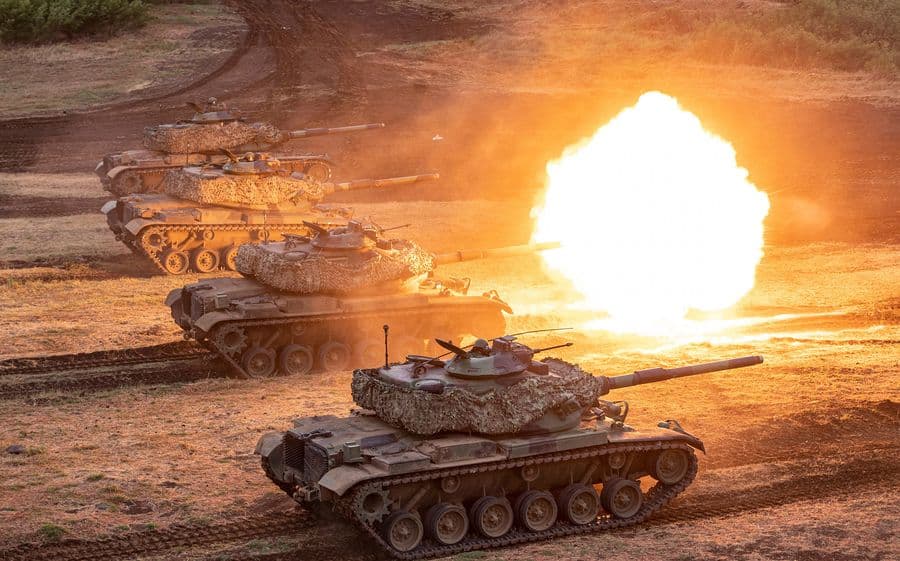
image: In this photo released by Taiwan Military News Agency, Taiwan's M60A3 Patton main battle tanks fire during the annual Han Kuang military exercises in Penghu County, Taiwan, Wednesday, July 24, 2024. (Taiwan Military News Agency/Taiwan's Defense Ministry via AP, File)

In Pursuit of Nuclear Abolition
By Peter Huessy • RealClearDefense
Innovation Alone Won’t Prepare the U.S. for the Future Battlefield
By Joshua Segal • RealClearDefense
The sUAS Tactical Trifecta
By Bryan T. Woody • RealClearDefense
The Revolutionary War: When Strategic Options Share the Same Weakness
By Henry Yep • RealClearDefense
The Houthis Are Testing the Limits of Collective Defense
By Saima Afzal • RealClearDefense

Who Shoots Down the Drone Over the Shipyard?
By John Ferrari & Dillon Prochnicki • RealClearDefense
Northrop Grumman Breaks Out the Big Guns at AUSA
By Daniel Terrill, Defense News
Army Pursuing Diverse Array of New Anti-Air Interceptors
By Trevithick, The WarZoneWho Shoots Down the Drone Over the Shipyard?
By John Ferrari & Dillon Prochnicki, RCD
F-35C Lands for the First Time on a Ford-Class Aircraft Carrier
By The Aviationist