
The Urgent Legal Imperative for the U.S.-India Defense Pivot
Last updated 06:19 AM EDT • Read time: 4m
From Frameworks to Statutes: The Urgent Legal Imperative for the U.S.-India Defense Pivot
As the United States increasingly seeks integrated Indo-Pacific defense-industrial coordination, this legal asymmetry becomes more strategically consequential.
The International Organization Affairs Bureau's (IO) Challenge: Strategic Multilateralism
The next phase of U.S.-India defense integration requires more than bilateral diplomacy. It also requires modernization of the multilateral export-control architecture that continues to shape global technology-transfer policy.
Historically, regimes such as the Wassenaar Arrangement were designed primarily to constrain proliferation risk and manage sensitive technology transfers. However, today’s geopolitical environment increasingly centers on strategic competition with state-directed industrial powers capable of integrating military production, advanced technology, and supply-chain leverage at enormous scale.
As a result, democratic nations now face a different challenge: how to preserve nonproliferation safeguards while enabling trusted industrial coordination among strategic partners.
This is where the State Department's IO Bureau becomes increasingly important.
IO’s role can no longer remain limited to traditional multilateral coordination. It must evolve toward what may be described as “Strategic Multilateralism” — ensuring that export-control frameworks do not become secondary barriers to democratic defense-industrial integration.
Such modernization would not weaken nonproliferation objectives. Rather, it would recognize that trusted democratic supply chains, resilient industrial coordination, and secure technology-sharing networks have themselves become essential pillars of Indo-Pacific deterrence architecture.
The United States cannot realistically pursue resilient allied supply chains while simultaneously preserving multilateral compliance interpretations that impede strategic coordination among trusted democratic partners.
Core Policy Shifts
- Strategic Multilateralism: Expanding IO’s mandate to prioritize trusted democratic industrial coordination alongside traditional nonproliferation objectives.
- Modernized Proliferation Frameworks: Updating legacy export-control interpretations to address state-directed technology competition and integrated supply-chain warfare.
- Indo-Pacific Deterrence Architecture: Recognizing resilient democratic supply chains as a core national-security requirement.
- Regulatory Realignment: Reducing contradictory compliance interpretations that unnecessarily slow allied defense-industrial cooperation.
Congress Must Move From Symbolism to Codification
China is rapidly institutionalizing military-industrial scale, strategic technology integration, and supply-chain leverage across the Indo-Pacific. The United States cannot realistically compete with state-directed industrial coordination through temporary executive frameworks lacking durable statutory authority.
While the FY2026 National Defense Authorization Act introduced useful portfolio-based acquisition reforms, Congress stopped short of creating the legal architecture necessary to fully operationalize the U.S.-India defense partnership.
The era of symbolic strategic alignment is ending.
Washington can no longer rely primarily upon diplomatic frameworks, executive discretion, and ad hoc licensing flexibility to sustain a relationship increasingly central to Indo-Pacific deterrence strategy. Congress must now move beyond strategic signaling and modernize the partnership’s legal foundation through targeted statutory reforms designed to institutionalize long-term defense-industrial integration.
Necessary reforms should include:
- expedited licensing pathways for approved bilateral co-production programs,
- Section 38(j) ITAR exemptions for designated defense technology categories,
- expanded procurement authorities capable of operationalizing a permanent Reciprocal Defense Procurement Agreement (RDPA),
- and durable statutory safeguards protecting defense-industrial cooperation across changing presidential administrations.
Such measures would not constitute preferential treatment.
Rather, they would represent overdue alignment between American law and the strategic realities of twenty-first century Indo-Pacific competition.
Conclusion: Foundations for a Durable Strategic Pivot
Diplomatic frameworks may initiate strategic convergence, but only statutes can institutionalize it.
If Washington genuinely views India as indispensable to the future Indo-Pacific balance of power, then America’s legal architecture must evolve alongside its strategic doctrine. Congress can no longer leave the relationship dependent primarily upon executive continuity and bureaucratic discretion.
The U.S.-India defense partnership has outgrown symbolic alignment and temporary diplomatic momentum.
It now requires a durable statutory foundation capable of transforming strategic convergence into permanent institutional reality.
Sue Ghosh Stricklett is an attorney and national-security policy adviser specializing in international trade, export controls, and Indo-Pacific strategic affairs. She was nominated to serve as Assistant Administrator for the Asia Bureau at USAID and has advised presidential campaigns on Indo-Pacific policy and international trade.
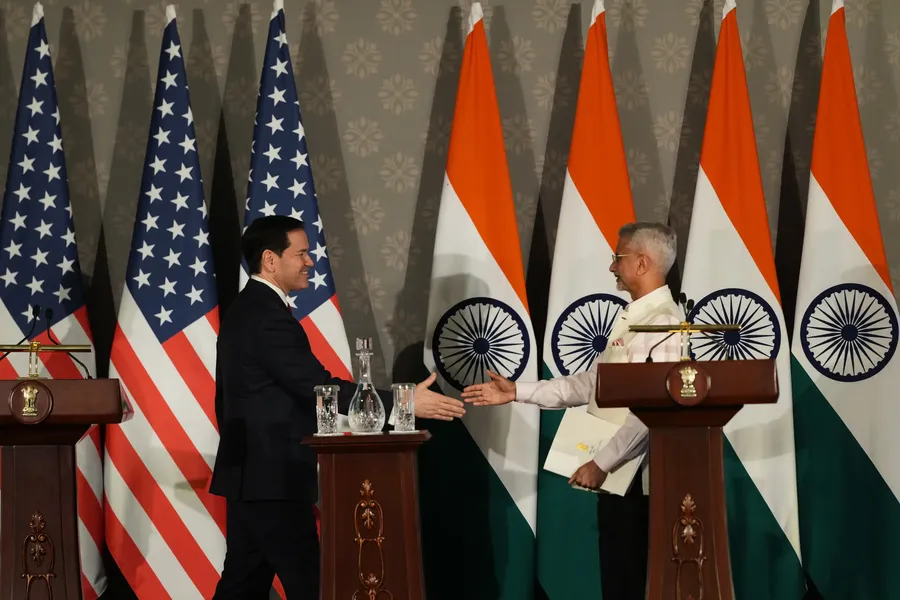
image: United States Secretary of State Marco Rubio, left, walks to shake hands with India’s Minister of External Affairs S. Jaishankar after addressing a joint press conference following their talks in New Delhi, India, Sunday, May 24, 2026. (AP Photo/Manish Swarup)

Innovation Alone Won’t Prepare the U.S. for the Future Battlefield
By Joshua Segal • RealClearDefense
The sUAS Tactical Trifecta
By Bryan T. Woody • RealClearDefense
The Revolutionary War: When Strategic Options Share the Same Weakness
By Henry Yep • RealClearDefense
The Houthis Are Testing the Limits of Collective Defense
By Saima Afzal • RealClearDefense
Radio Frequencies in the Intelligence Ecosystem
By Craig Brower • RealClearDefense

Who Shoots Down the Drone Over the Shipyard?
By John Ferrari & Dillon Prochnicki • RealClearDefense
Northrop Grumman Breaks Out the Big Guns at AUSA
By Daniel Terrill, Defense News
Army Pursuing Diverse Array of New Anti-Air Interceptors
By Trevithick, The WarZoneWho Shoots Down the Drone Over the Shipyard?
By John Ferrari & Dillon Prochnicki, RCD
F-35C Lands for the First Time on a Ford-Class Aircraft Carrier
By The Aviationist