
The U.S. National Security Implications of an Independent Greenland
Last updated 06:41 AM EDT • Read time: 10m
It’s not every day that a large mass of ice divides continents. Greenland has surfaced as no longer a peripheral issue discussed on the sidelines of NATO summits. It is now front and center of the future of the transatlantic alliance and has even led to a fellow NATO member, Denmark, to send troops in a dramatic show of force to safeguard Greenland (which it has administered for over 300 years) from any move by the U.S. military. Such a sequence of actions would have been unthinkable a decade ago.
Yet this is the new reality. President Trump recently predicted that the U.S. will control Greenland by 2029. That may or may not be a bluff. But what goes unsaid among security officials on both sides of the Atlantic is a likely scenario that could reshape the future of NATO, to say nothing of the world’s largest island: What if Greenland votes for outright independence?
An independent Greenland is not some far-fetched black swan event. Recent polls reveal that a majority of Greenland’s 57,000 residents support independence from Denmark but also vehemently oppose U.S. control. The prospect of greater riches lying deep beneath its ice, and the fear of allowing outside powers to pillage its riches and profit from them could compel its politicians to hasten a referendum. Perhaps more worrisome, an independent Greenland holds the potential to tear up existing basing agreements with both Washington and Copenhagen, something that keeps Trump administration officials up at night. It could also prompt Greenland to forge closer ties with Moscow or Beijing.
A high-level working group was convened to take up revising an agreement from 1951 that will determine the future of U.S. forces in Greenland. The United States should spell out in clearer language that maintains and even expands its broad access beyond the current base it operates at Pituffik and curtails adversaries from expanding their reach and influence on the island, yet do so in language that enshrines the right of Greenlanders to shape their own future while. As strategic competition intensifies in the High North, as well as the White House’s ambitions to build a Golden Dome missile defense project, Greenland’s importance will only grow.
President Trump’s fixation on Greenland, while quixotic and Putin-esque, is not without precedent – or merit. American interest in the island predates even Harry Truman, who in 1951 inked a defense agreement with Denmark that first positioned U.S. troops on the island. That agreement, designed primarily to monitor suspicious Soviet activity in the North Atlantic and Arctic, authorized the construction and operation of American military facilities, including what is now Pituffik Space Base. In this way, critics of the current administration’s preoccupation with Greenland are wrong to dismiss the island’s importance to U.S. national security. They are correct that fears of an imminent Russian or Chinese takeover are overblown, but Greenland’s strategic position along the Arctic approaches to North America, especially the so-called GIUK (Greenland, Iceland, UK) gap, makes it strategically significant. The island also hosts missile warning systems, space surveillance networks, communications nodes, and maritime monitoring operations.
But the strategic environment has changed dramatically since the 1950s and so the treaties signed during the Cold War require amending. Russia’s invasion of Ukraine ended any illusion that the Arctic could remain removed from geopolitical rivalry. With Finland and Sweden now in NATO, the alliance’s northern posture has been reshaped. China continues to exert influence through various scientific, commercial, and infrastructure projects across the Arctic, including on Norway’s Svalbard archipelago. Whether cyberattacks or space-based systems, hypersonic weapons or “hybrid” operations, the emerging threats bear little resemblance to the bomber fleets and ballistic missiles that defined Cold War planning.
A Greenland no longer under the rule of the Danish Kingdom could upset Arctic security by injecting greater uncertainty into the operational environment. Trump’s veiled threats to annex the island by force only add to the tension. To avoid a clash in the High North involving the archipelago, the existing 1951 agreement needs amending. It is a relic of a bygone era and is ill-suited to this multidimensional security environment.
Negotiated shortly after Denmark joined NATO, the arrangement reflected a moment when Greenland’s geography made it indispensable to North Atlantic defense. The rights granted to the United States were extensive: to construct basing facilities, station military personnel, store supplies, operate communications as well as meteorological systems, deepen harbors, control movements within defense areas, and transit by land, sea, and air. The installation at Pituffik (formerly Thule) satisfied a core objective: to keep tabs on the Soviets and give America a foothold in the Arctic.
Seventy-five years later, Greenland has become a self-governing Arctic polity with democratic institutions, growing international influence, and a population increasingly determined to chart its own course. Trump’s rhetoric aside, the result is a disconnect between Greenland’s strategic importance and the treaties governing its defense, a tension that has produced the current moment. The threat environment has also changed due to advances in technologies and Russian adventurism. Pituffik remains indispensable for missile warning and tracking, including space operations, as the key part of a chain of interlinked radar installations built to track ballistic missiles along relatively predictable trajectories. But advances in hypersonic weaponry pose a fundamentally different challenge for air defenses. They maneuver unpredictably, fly at lower altitudes, compress decision-making timelines, and defy traditional detection geometries. Whatever one thinks about the reliability of missile defenses, Greenland provides Washington a critical node for enhanced early-warning sensor networks and strengthening its maritime and air-domain awareness against a Russian hypersonic missile.
Geoeconomic interests in Greenland are also on the table for discussion. Although two-thirds of the island lies buried under permanent ice, and fishing dominates the local economy of its capital, Nuuk, Greenland is believed to hold substantial deposits of rare-earth elements and other critical minerals, like uranium and iron. Washington will almost certainly seek provisions in any revised agreement that facilitate U.S. access to those resources, as it has done in negotiations elsewhere, including Ukraine. Greenlanders are understandably wary of such arrangements, fearing that resource concessions could compromise their sovereign claim to the wealth beneath their territory.
A third concern of White House advisors is denial: to prevent Greenland from becoming a beachhead for U.S. adversaries. Beyond its role in missile warning, the island is valuable for monitoring maritime activity and tracking military exercises in the North Atlantic. Washington has long argued that Copenhagen has not done enough to deter Russian military activity in adjacent waters.
The Russian threat to Greenland, to be fair, should not be overstated. The island benefits from NATO’s Article 5 guarantee as a semi-autonomous territory of Denmark. Its formidable terrain, combined with the fact that Russian forces are bogged down in Ukraine, suggests that Moscow could not plausibly challenge Greenland’s sovereignty militarily for at least five years, if not longer. Greenland, in short, presents no imminent emergency for the United States. Securing a durable and legitimate agreement is preferable to rushing into a flawed one that leaves all parties unsatisfied.
That said, the Greenland question has come to haunt NATO summits and transatlantic relations, and indefinite delay serves no one. Denmark, which has administered the island for nearly 300 years – has a strong interest in a negotiated settlement that makes Washington happy. Though Danish leaders have bristled at being coerced by tariff threats from the White House, they have also signaled a genuine willingness to compromise. Copenhagen has pulled back from calling for NATO surveillance operations over Greenland and has publicly dismissed U.S. annexation talk as “fantasy.” Denmark stations roughly 150 troops on the island and contributes approximately $1 billion annually to its defense, a commitment that belies White House mockery of Danish dog-sled patrols.
Were Denmark to cede Greenlandic security to Washington, or were the island to vote for independence, Copenhagen would lose almost all strategic relevance in the Arctic (Denmark lies nearly 1,000 kilometers south of the Arctic Circle). What Denmark seeks is a burden-sharing arrangement that draws in Washington and other NATO partners without surrendering Danish influence. To date, Europe has mostly rallied behind Copenhagen, motivated partly by solidarity and partly by setting a bad precedent: If the United States can pressure a NATO ally into a unilateral basing agreement, what prevents Russia from invoking similar logic regarding, say, Svalbard? That said, most non-Scandinavian European governments regard Arctic security as a secondary priority, preoccupied as they are with Russia’s challenge along NATO’s eastern flank, immigration challenges, or fallout from the war in Iran.
Greenlanders have their own distinct concerns. Topping them is the so-called “forever clause” – treaty language that would entrench American influence in Greenlandic affairs indefinitely while permitting a semipermanent U.S. military presence beyond Pituffik. A 2004 framework updated the 1951 agreement but was premised on Pituffik remaining the sole American outpost. That assumption no longer reflects the direction of Arctic security planning in Washington. An alternative long-term lease arrangement is one analogous to the U.S. presence at Guantanamo Bay, though Greenlanders would rightly demand terms far more favorable than that 20th century relic.
Put bluntly, an independent Greenland cut off from Europe would not be able to survive economically without foreign direct investment. Any revised basing language must take provide Greenlanders with concrete financial benefits: infrastructure investment, workforce development, technology partnerships, and procurement opportunities. Defense payments will help, but Greenlanders may perceive them as compensation for acquiescence. Greenlanders also deserve clarity about what capabilities are being deployed on their territory, what the environmental risks are, and how outsiders will be held accountable. Like the rest of the Arctic, Greenland can be an unforgiving landscape.
None of these issues will be easy to resolve, particularly given the Trump administration’s penchant for sticks over carrots. Visits by the president’s son and White House envoy Jeff Landry were seen by some as exercises in intimidation rather than diplomacy. Others in Washington worry that revisiting the 1951 agreement could put defense rights the United States already enjoys at risk. That concern is misplaced. The gravest threat to American access in Greenland is not legal wiggle-room but a lack of political legitimacy. As Greenland heads toward greater autonomy, and eventually outright independence, Washington needs to secure a defense agreement with broad popular legitimacy across the island’s political spectrum but also one advantageous to America’s broader security concerns. An arrangement imposed through pressure will not hold. One negotiated in good faith, with genuine respect for Greenlandic self-determination, just might.
Dr. Troy Bouffard is the director of the Center for Arctic Security and Resilience at the University of Alaska Fairbanks and a former Arctic Congressional Fellow and advisor to U.S. Senator Lisa Murkowski.
Lionel Beehner is formerly research director of West Point’s Modern War Institute, a senior editorial director at Columbia University’s School of International and Public Affairs (SIPA), and coeditor of Reconsidering American Civil-Military Relations (Oxford 2020).
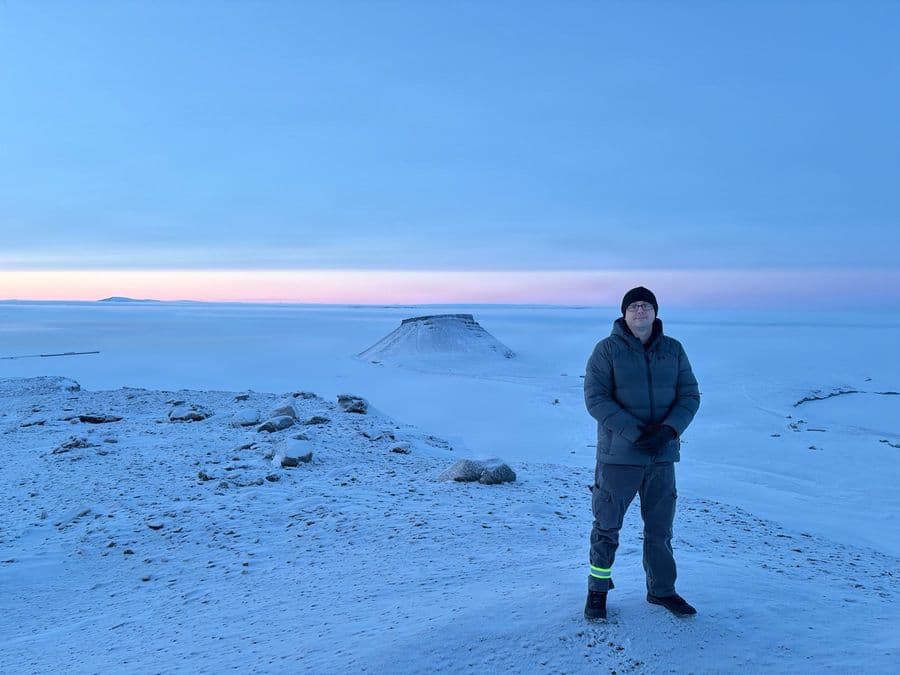
image: U.S. Space Force Col. Shawn Lee, Pituffik Space Base commander, poses for a photo atop North Mountain with Mount Dundas behind him, 2026. As the Department of War’s northernmost base, Pituffik stands guard at the edge of the world. It serves as a critical node in a layered defense network, providing continuous missile warning, space domain awareness, and satellite command and control. (U.S. Space Force Courtesy Photo)

In Pursuit of Nuclear Abolition
By Peter Huessy • RealClearDefense
Innovation Alone Won’t Prepare the U.S. for the Future Battlefield
By Joshua Segal • RealClearDefense
The sUAS Tactical Trifecta
By Bryan T. Woody • RealClearDefense
The Revolutionary War: When Strategic Options Share the Same Weakness
By Henry Yep • RealClearDefense
The Houthis Are Testing the Limits of Collective Defense
By Saima Afzal • RealClearDefense

Navy Civilianizes Six Former Flag Billets, Reduces Six to Captains
By Mongilio, USNI N.
Raytheon's $8B Contract for Strategic Comms Terminal Modernization
By M+A El
America’s Maritime Moment Will Not Wait
By CDR Salamander
Armor Up?
By Marine Corps Compass Points
Who Shoots Down the Drone Over the Shipyard?
By John Ferrari & Dillon Prochnicki • RealClearDefense