
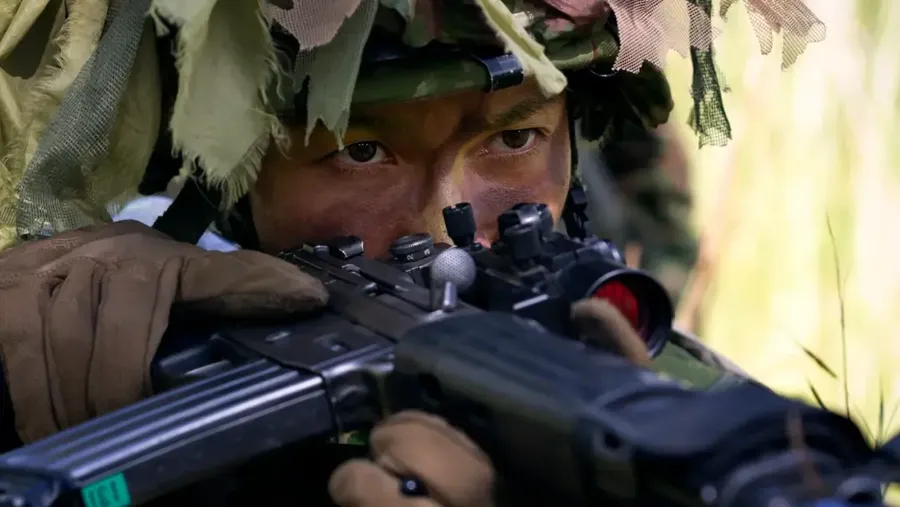
A Japan Ground Self Defense Force soldier during Exercise Southern Jackaroo at the Shoalwater Bay training area in Australia, July 2026 (Tristan Kennedy/Defence Imagery)
Washington Built the Hub-and-Spokes – Australia and Japan Are Rewiring It
Published Nov. 21, 2026 • Read time: 12m


Join the Conversation
0A decade of alliance-building has given middle powers a security architecture that no longer runs through one capital.
When regional leaders gathered in Manila for this week’s East Asia Summit, US President Donald Trump arrived to find America’s allies had been busy with one another.
In August, defence ministers from Japan and Australia met in Canberra and reported progress across almost every dimension of military cooperation. Their forces are sharing intelligence and training together in complex exercises, with Japanese F-35s already flying out of Darwin. Japan is building Mogami frigates for the Royal Australian Navy, with the first due in 2029. The two countries have completed field trials of their first jointly developed weapon, a high-energy laser, and are preparing to open Australia’s ranges to Japan’s next-generation strike weapons, hypersonic missiles included. Rotational deployments are currently in preparation.
A decade ago, much of this would have seemed far-fetched for two US allies whose security ran almost entirely through Washington.
Over the past few years, Australia and Japan have recalibrated their foreign policies to assume greater regional security roles, which signal a nascent but clear trend. The traditional “hub-and-spokes” model, with the US serving as primary guarantor through separate bilateral alliances, is gradually giving way to a middle-power-led “cross-bracing” architecture, where Canberra and Tokyo are building interconnected networks to maintain regional security and strategic balance.
Their partnership is extending outward through the use of “positive statecraft” to win the backing of smaller states. Facing these seasoned hedgers who are eager to diversify foreign ties and frequently play rival powers against one another for domestic gain, Australia and Japan recognise that ideological lecturing or wielding a “big stick” is counterproductive. Lacking the coercive weight of a true hegemon, they understand contemporary geopolitical competition runs on practical incentives. Whichever power that offers tangible buy-ins, whether through defence capacity-building or facility support, is best positioned to achieve network centrality.
By Prodding Taiwan, Russia Takes Its Alignment With China to New Heights
Watch What Trump Does in Asia, Not What He Says
How the Quad Can Work With Southeast Asia
Missile defence: Australian military’s $10 billion plan
By providing these enticements, Australia and Japan are weaving a regional security web that is distinctively more complex, decentralised, but interconnected.
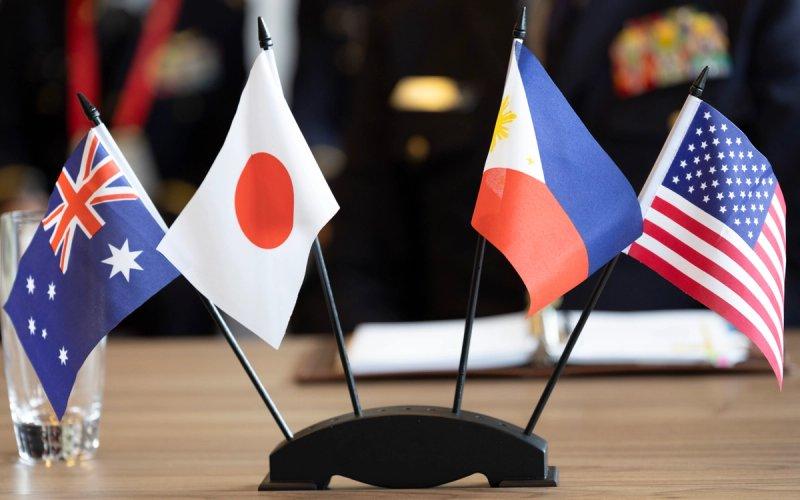
The Australia-Japan partnership is actively expanding outward, with the Philippines a prime example (Tristan Kennedy/Defence Imagery)
Tristan Kennedy/Defence Imagery
As Washington’s most critical regional allies, Australia and Japan form the centre of gravity of this new architecture, beginning with their own bilateral relationship. The convergence of their strategic interests is evidenced by the rapid expansion of high-level agreements, evolving from the 2022 Reciprocal Access Agreement (RAA) and upgraded Joint Declaration on Security Cooperation, to the 2025 Framework for Strategic Defence Coordination (FSDC) and a new Cyber Partnership. In 2026, marking the Nara Treaty’s 50th anniversary, both nations expanded alignments beyond traditional security to encompass economic security, critical minerals, and formal finance ministerial dialogues.
These high-level frameworks are already yielding the deepening operational and defence-industrial integration. Both defence ministers now view each other’s nation as vital to their own “strategic depth.” This sentiment is echoed by the public. A 2022 University of Sydney survey found over 60% of Australians believe a formal security treaty would make both nations safer. The 2026 Lowy Institute Poll found Japan recorded the highest ranking of trust for countries to “act responsibly in the world”.
Trust in global powers - Explore Data
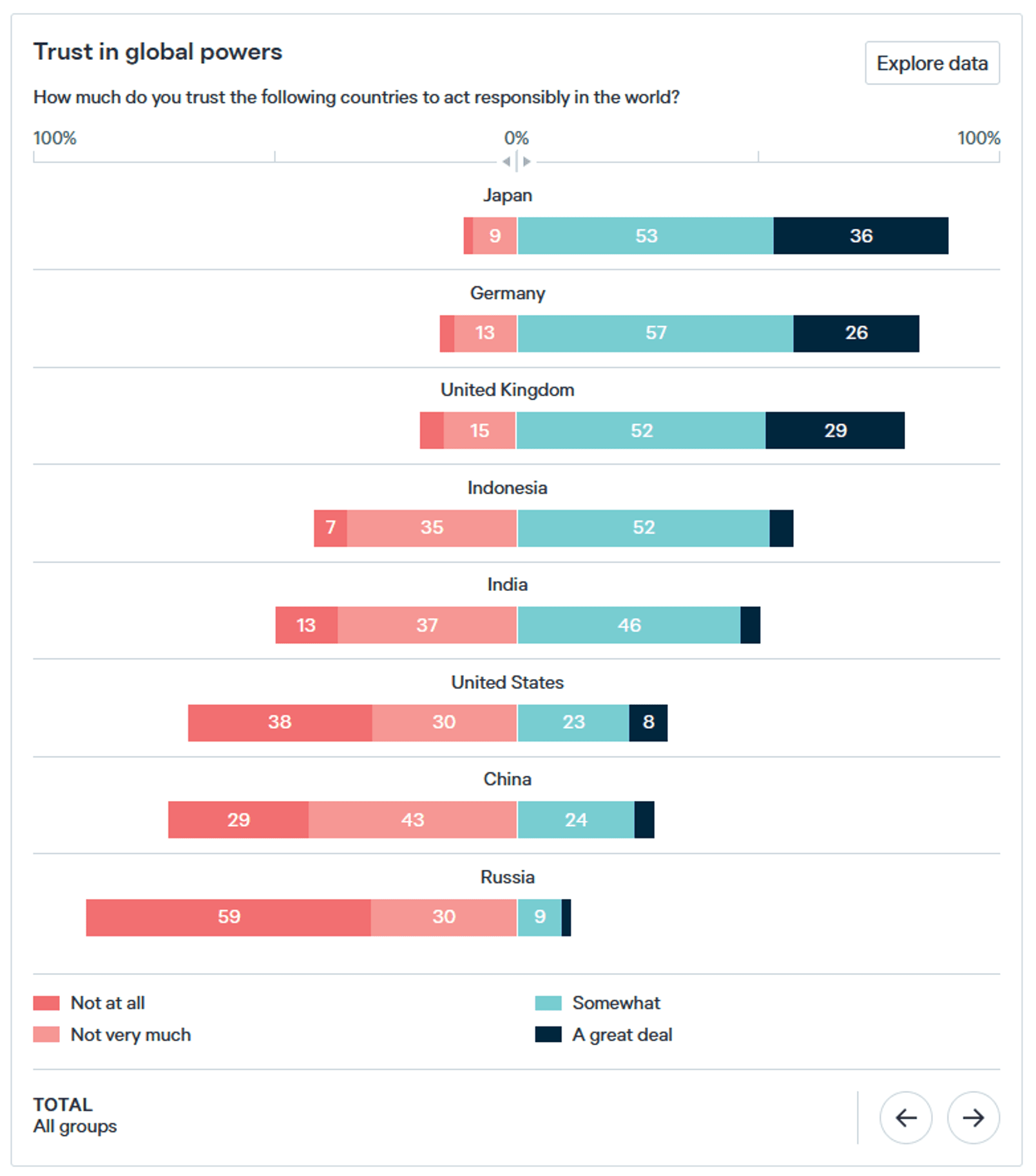
Lowy Institute
Australia and Japan represent the quintessential example of cross-bracing: two traditional spokes connecting directly, bypassing the hub. Yet, this architecture’s strength lies in its flexibility. The upgraded Joint Declaration commits Canberra and Tokyo to “consult each other on contingencies” and “consider measures in response,” stopping short of a mutual defence obligation. Upholding this flexibility, the two nations have created an adaptable framework capable of attracting other countries that welcome deeper security cooperation but are hesitant to commit to a formal treaty.
Expanding cross-bracing networks in Southeast Asia
The Australia-Japan partnership is actively expanding outward through implicitly synchronised diplomatic coordination, with the Philippines serving as a prime example.
Recognising the Philippines’ geostrategic significance, Canberra and Tokyo have been among the most vocal Indo-Pacific countries backing Manila’s 2016 South China Sea arbitral victory. Complementing this diplomatic solidarity is tangible material backing to form a strategic triangle, where Tokyo bolsters Philippine defence industries and technology, while Canberra provides training and logistical support to extend its strategic depth.
Japan’s security partnership with the Philippines with the 2025 RAA enabled the countries to advance military interoperability, joint deployments, and routine bilateral naval manoeuvres in the South China Sea. In May 2026, Tokyo and Manila upgraded to a Comprehensive Strategic Partnership (CSP), anchored by Japan’s Official Security Assistance (OSA) programs. Beyond advancing negotiations on military intelligence-sharing, it delivered vital defence acquisitions for the Philippines, including a historic agreement transferring five retired Abukuma-class destroyer escorts, alongside coastal patrol vessels and advanced air-surveillance radar systems.
Australia–Philippine maritime cooperation also expanded rapidly. Following the Japan-Philippines RAA, Canberra and Manila moved quickly towards their own formalised defence arrangement. Building on regular joint patrols, growing naval and coast guard training, and a September 2026 Maritime Security Dialogue focused on marine resource protection, illegal fishing, and operational synchronisation, the two sides finalised a comprehensive new defence pact on 15 November in the run-up to the East Asia Summit. The agreement not only covers intelligence sharing, drone transfers, and maritime infrastructure, but also streamlines bilateral mechanisms for more direct and effective action.
Moreover, Australia and Japan are extending the cross-bracing network to regional swing states, as evidenced by their overlapping defence diplomacy milestones. The February 2026 Australia-Indonesia Treaty on Common Security (the Jakarta Treaty) elevated bilateral ties to unprecedented levels, quickly followed by the Defence Cooperation Arrangement between Jakarta and Tokyo in May. Similarly, Japan and Vietnam convened their inaugural Foreign and Defence Vice-Ministerial 2+2 dialogue in December 2025, with Australia establishing a parallel dialogue with Hanoi months later.
These consecutive agreements demonstrate Tokyo and Canberra’s capability to strengthen regional security cooperation independently of the US participation.
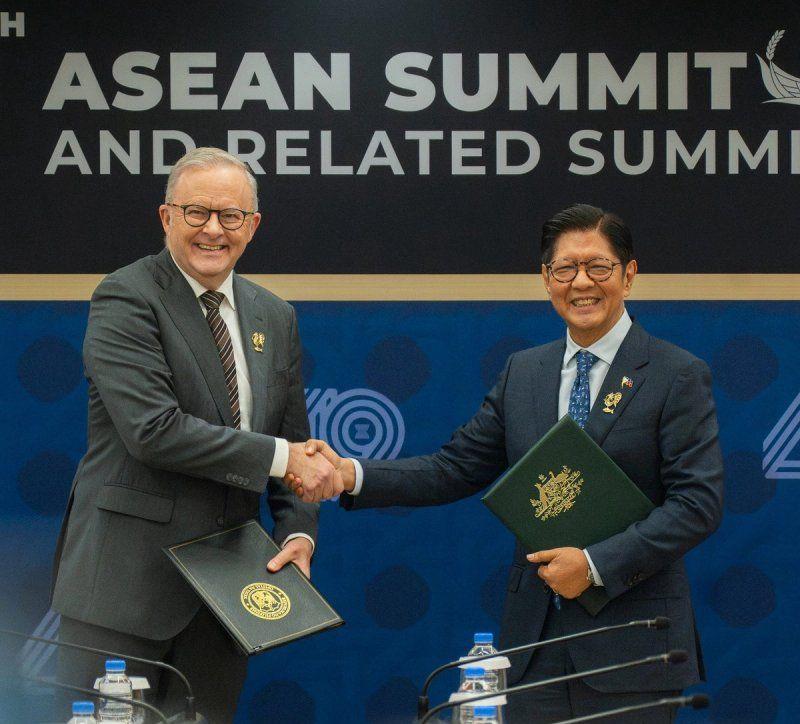
Expanded security and defence cooperation in a new deal between Australia and the Philippines (@AlboMP/X)
@AlboMP/X
While these cross-bracing arrangements aim to provide strategic ballast for Southeast Asia, they uphold the principle of host-country agency. As illustrated by the inaugural Japan–Australia–Indonesia trilateral dialogue in August, Australia sought to deepen interoperability and joint training as part of the Jakarta Treaty commitments, while Japan focused on facilitating its OSA program and defence transfers. These efforts aim to enable Indonesia’s defence capability without relying on a single power. Yet, as Indonesia’s Defence Minister Sjafrie Sjamsoeddin maintained, any defence proposals are assessed strictly against Jakarta’s national interests. Australia’s Defence Minister Marles reinforced this by emphasising the joint training facility on Morotai entirely under Jakarta’s control.
This position reflects Foreign Minister Penny Wong’s vision of cultivating a “strategic equilibrium” where no country dominates or is dominated. Cross-bracing serves as the practical expression of this aim, empowering regional states to control their strategic destiny.
To be sure, perspectives on this partnership vary. While Japanese observers framed the trilateral meeting as an effort to draw Jakarta closer amid Chinese maritime pressure, others characterised Indonesia’s participation as a move of “strategic convenience”, particularly as it simultaneously deepens military ties with Beijing. Yet, it is precisely this pragmatic acceptance of swing states’ hedging positions that allows cross-bracing to expand.
A cross-braced mini hub-and-spoke in the Pacific
Distinct from the flexible cross-bracing emerging in Southeast Asia, the Pacific’s evolving security architecture more closely resembles a hub-and-spoke system centred on Australia. While rooted in geography and history, this shift was accelerated by the 2022 Solomon Islands–China security agreement, which warned Canberra that a Chinese security presence could reach a region deemed as its primary strategic responsibility. Since 2023, Canberra has signed treaty-level agreements with Tuvalu, Nauru, Papua New Guinea (PNG), Vanuatu, and Fiji. Two of these, with PNG and Fiji, carry mutual defence obligations, representing a deliberate departure from the non-alliance cross-bracing seen in Southeast Asia.
For Canberra, this arrangement is necessary to support a region where most states have limited capacity for self-defence. Australia’s commitments span military supplies, budget support, and extensive police and military training. To integrate regional forces, Australia is developing a pathway for PNG citizens to enlist in the Australian Defence Force, with a pilot expected in 2027. Similarly, Fiji’s companion Vuvale Union adds the Pacific Australia Skills program to existing Australian support for the Blackrock peacekeeping hub.
For states with minimal or no defence forces, the commitments reach into domestic governance. Tuvalu’s Falepili Union, for instance, commits Australia to support climate mobility pathways, disaster assistance, and infrastructure funding. Meanwhile, Nauru receives substantial budget and policing funds, and Vanuatu’s Nakamal Agreement makes Australia its primary policing partner backed by considerable financial commitments.
Where Australia anchors this security hub, Japan supplies much of the vital cross-bracing through primarily non-traditional security. Lacking Australia’s extensive Pacific defence relations, Tokyo focuses its capital, equipment, and technical expertise in practical areas rather than direct deterrence. Even Japan’s nascent defence engagement follows this pragmatism, with the Japan–Pacific Islands Defence Dialogue centring on humanitarian assistance and climate resilience.
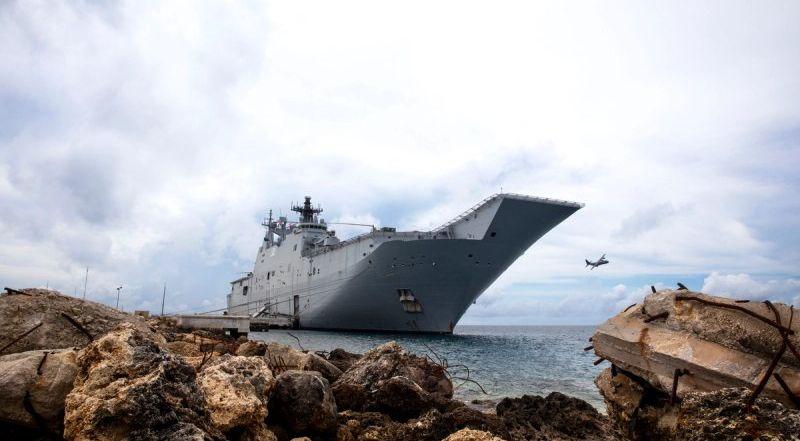
Nuku`alofa, Tonga, during Operation Tonga Assist 2022 (Susan Mossop/Defence Imagery)
Susan Mossop/Defence Imagery
Pooling Australian and Japanese resources has already provided support across several areas. Following the 2022 Hunga Tonga–Hunga Ha’apai eruption, Japanese relief operations integrated with Australian coordination hubs, complementing Japan’s broader backing of the Pacific Humanitarian Warehousing Program (Opens in new window). In critical infrastructure, Australia and Japan, alongside the United States, financed the Palau and East Micronesia undersea cables (Opens in new window), ensuring every Pacific state is connected by 2026. In financial security, as co-chairs of the Asia/Pacific Group on Money Laundering, both countries are boosting efforts (Opens in new window) to help Pacific states strengthen compliance and anti-money laundering controls, thereby preserving critical correspondent banking relationships that international banks frequently abandon.
While Pacific states are more dependent on Australia within this arrangement, the asymmetry produces varied diplomatic outcomes. Careful not to overwhelm its smaller counterparts, Canberra recognises that national interests often diverge. Consequently, while structural dependence shapes what Australia requests, host-state bargaining determines what it actually gets. Nauru must reach a mutual agreement with Canberra (Opens in new window) before entering third-party security or telecommunications partnerships, whereas Vanuatu received a lighter obligation merely to consult Australia on infrastructure deals. Similarly, PNG and Fiji secured narrower security terms applicable only to Pacific armed attacks and subject to domestic constitutional processes, a framing that notably allows PNG’s leadership to signal potential neutrality (Opens in new window) in an Australia-China conflict.
Canberra’s pragmatic acceptance of non-alignment extends into multilateral diplomacy. At the recent Pacific Islands Forum in Palau, Australia pushed to condemn China’s July missile test (Opens in new window)but settled with the statement of concern after Kiribati and Nauru objected. Tokyo adopts a similarly measured posture, framing its engagement around “regional solidarity” under the 2050 Strategy for the Blue Pacific Continent (Opens in new window).
This regional architecture combines both models: Australia’s treaties form the hub, Japan’s non-traditional contributions brace it, and Pacific states negotiate the terms of both. The architecture should ultimately be judged by whether it leaves those states better able to determine their own futures, and the more central Canberra and Tokyo become to regional security, the more their partners’ freedom of action will matter.
Challenges and limitations – and implications for Washington
While the Australia-Japan cross-bracing network is taking shape rapidly, its long-term impact on Indo-Pacific stability remains uncertain. To reach its full potential, this framework must work through immediate challenges.
Despite their unprecedented strategic alignment, Canberra and Tokyo must reconcile divergent geographic priorities. Japan remains intensely focused on maritime East Asia, while Australia’s strategic gaze is fixed on the Pacific and the southern flank of maritime Southeast Asia. Establishing joint planning and operational leadership in these domains will require complex, deliberate coordination.
Moreover, they face the delicate task of managing China consistently without making their network appear as a containment strategy, which could alienate most states they seek to attract. Beijing’s missile test, conducted mere hours after the Australia–Fiji security pact, served as a stark reminder of this challenge.
Further complicating this dynamic is the distinct bilateral relationships Australia and Japan have with Beijing. Australia’s “stabilisation policy (Opens in new window)” followed an intense period of diplomatic deep freeze and economic coercion after a series of measures that annoyed Beijing, culminating Australia’s call for an international inquiry into the origins of Covid-19. For its part, Japan’s relations have been frozen since late 2025, when Prime Minister Sanae Takaichi’s remarks regarding Taiwan triggered Chinese export controls (Opens in new window) and prompted Beijing to frame Japan’s expanding security network as aggressive remilitarisation (Opens in new window). Any move by Canberra to further formalise its security partnership with Tokyo thus risks Chinese pressure.
None of this makes American power dispensable. Washington remains both capitals’ indispensable partner and the only actor capable of bringing high-stakes military power to bear across the Indo-Pacific. Groupings like the “SQUAD, (Opens in new window)” joined by the US, Japan, Australia, and the Philippines – and the “Quad (Opens in new window),” revived at the leader’s level with India at the East Asia Summit after a two-year pause – illustrate how Canberra and Tokyo are deliberately plugging their webs into broader minilateral frameworks that still rely on American muscle to counter coercion and anchor credible deterrence.
The real friction, however, is political: aligning with a volatile Washington has become as much a diplomatic conundrum as a defence challenge. Faced with a Pentagon pushing for firmer deterrence (Opens in new window) against Chinese aggression and a White House signalling political détente (Opens in new window) with Beijing, as the January National Defence Strategy (Opens in new window), the sequence of Trump–Xi summits (Opens in new window), and the delayed US$14 billion Taiwan arms package (Opens in new window) each made plain, America’s closest allies find themselves stepping out in front with shrinking strategic cover.
Middle powers may do the heavy lifting to build regional resilience, but Washington cannot expect them to hold the line if its own mixed signals undercut the ground beneath their feet.
Jessica C. Liao is an associate professor of Asian studies in the Department of National Security and Strategy at the US Army War College, a non-residential senior fellow at the Foreign Policy Research Institute, and an adjunct professor in the Asian Studies Program at Georgetown University’s Walsh School of Foreign Service.
Christopher Johnson is an Australian Army officer with experience in the Middle East, Southeast Asia, and the Pacific. He is currently an International Fellow at the US Army War College. The views expressed here are his own and do not reflect those of the Australian Defence Force, the Australian government, or the US Army War College.
This article appeared originally at Lowy Institute's the interpreter.
The Pressure Is the Message: What Xi and Putin Faced in Shenzhen
By Emzari Gelashvili • RealClearDefense
China’s Revised Mobilization Law and the Expanding Reach of National Defense
By Muhammad Shoaib • RealClearDefense
U.S. Putting Weapons in Space: A Strategic Blunder?
By Ajey Lele • RealClearDefense
The Clearance Myth Is a Readiness Problem
By Elijah Fernandez • RealClearDefense
The Pentagon's Next Readiness Test Should Begin When the Cloud Goes Dark
By Colton Overcash • RealClearDefense
U.S. Putting Weapons in Space: A Strategic Blunder?
By Ajey Lele • RealClearDefense
U.S. Senate Seeks to Exchange Shipbuilding Funds for More Munitions
By Naval News
F-35C Completes First Launch and Recovery Trials on a Ford-Class Carrier
By Navy T.
USS George Washington Leaves Mideast As Trump Mulls Ending Iran War
By S&S
ULA’s Latest Launch Failure Spells Trouble for Space Force
By Greg Hadley, A&SF