
Winning Taiwan With Weather Intelligence
Last updated 05:57 AM EDT • Read time: 5m
Last week the trailer for a government backed Taiwanese TV show depicting a Chinese invasion captured international attention. The ten part series Zero Day opens by identifying two totally unrelated factors as primary considerations by the People’s Republic of China (PRC) to move on the island nation. The first is political in nature and involves a power vacuum created by an election, leading to a lame duck period for a fictional incumbent President. The second is a geophysical consideration and might surprise many Americans as being important enough to mention in a TV show – the suitability of ocean currents in the Taiwan Strait for a People’s Liberation Army (PLA) landing.
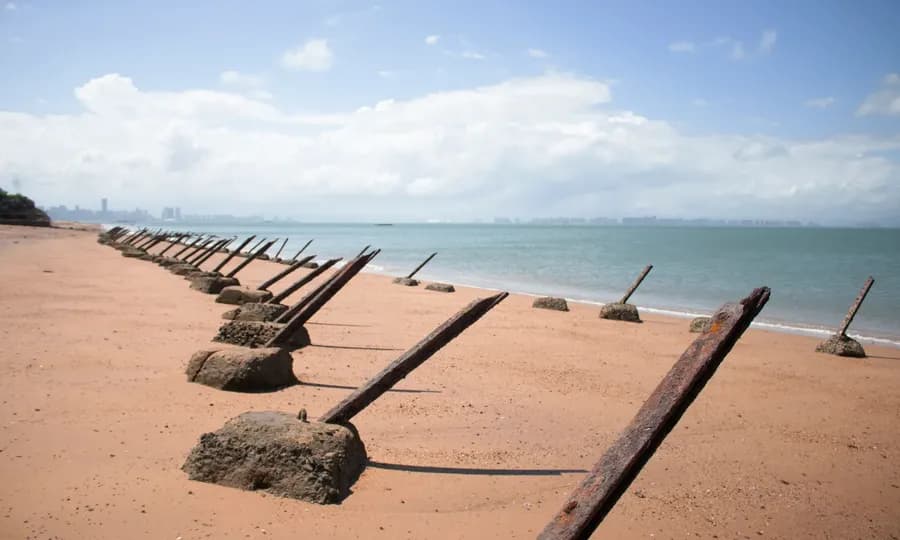
The writers of Zero Day did their research well, for the Allied Landings in Normandy during World War II were timed around ocean tide levels and currents, as well as weather conditions. A low tide and favorable weather were required for the landing craft to avoid the beach obstacles and safely deliver the Allied forces ashore. Because Supreme Allied Commander General Dwight D. Eisenhower had better weather intelligence than the Germans, he was able to exploit a brief drop in the sea state to launch the invasion on June 6, 1945, catching the opposing forces off guard.
Considering this historical foundation, and the fact that the U.S. has pledged to defend Taiwan in the event of an invasion by China, it is worth comparing the capabilities of the U.S. and the PRC to observe, predict, and plan for the environmental conditions which can determine the difference between victory and defeat on the battlefield.
Perhaps the most important assets in this area are weather satellites that provide high resolution images of the atmosphere. Again, historical examples are relevant. The Mongols under Kublai Khan made two attempts to invade Japan in the 13th century. They failed both times due to the destruction of their fleets by massive typhoons. Had Kublai Khan access to weather satellite data, he would have been able to track and avoid the storms.
China and the U.S. possess comparable civil and military weather satellites. However, progress in the latter for the U.S. has been less than stellar. Although the Department of Defense (DoD) successfully launched the Weather Satellite Follow-on Microwave spacecraft this year, the Air Force’s failure to prioritize this capability forced it to fall back on two spare satellites from the National Oceanic and Atmospheric Administration (NOAA) as gap fillers since 2020.
More concerning is the fact that the PRC is building cyberweapons and offensive space weapons to hack, hijack, and disable U.S. satellites in the event of a conflict over Taiwan. In view of China’s centuries-long appreciation for the role of weather in warfare, our environmental satellites will certainly be high on the target list.
The U.S. and China also have similar surface and upper air meteorological observing capabilities, and both countries follow the collection, reporting and dissemination standards of the World Meteorological Organization (WMO). The problem for America’s military meteorologists is that the most important observations for forecasting in the vicinity of Taiwan are upstream in China. Just as the Allies shut off the Axis powers’ access to weather data over England and North America upstream of the France - significantly degrading their forecast accuracy - so too would the PRC for the several thousand recording stations on their soil.
Weather observations, along with satellite data, are fuel for the numerical weather and ocean models used to predict the state of the environment in support of mission planning. Federally funded American atmospheric and computer scientists have long held a leadership role in this field, but now, the application of artificial intelligence (AI) by commercial weather companies is making the greatest gains in predictive skill, and this holds true for both the U.S. and China.
Unfortunately, American military meteorologists are also disadvantaged by this development when compared to their counterparts in China. All the top tech companies in the PRC are state-owned, so the transfer of AI-enabled numerical models to the PLA is seamless. Not so for the bureaucratically bloated DOD. Despite some promising partnerships between the Air Force and industry, the Pentagon has resisted embracing the rapid expansion of private sector weather and ocean data as a service (DaaS) and decision-support opportunities today. And this is only part of the larger problem that the U.S. military must make major organizational and process changes to adapt to today’s technology environment.
All of this matters because weather intelligence is necessary for more reasons than storm avoidance. It is also essential for: route optimization; scheme of maneuver development; intelligence, surveillance, and reconnaissance (ISR) collection planning; weapon, platform, and sensor selection, and personnel and equipment protection. The same is true for ocean intelligence in the maritime domain.
Considering a recent assessment indicating that the PRC has the strongest military in the Indo-Pacific, it should come as no surprise that Pentagon’s advantage over the PLA in understanding and predicting the physical environment has seriously eroded. While the TV series Zero Day does not air until 2025, the U.S. would do well not to wait until then and regain its winning hand in weather intelligence.
Rear Admiral Tim Gallaudet, U.S. Navy (ret.) is the former acting Administrator and Deputy Administrator of the National Oceanic and Atmospheric Administration (NOAA) and acting Under Secretary and Assistant Secretary of Commerce for Oceans and Atmosphere. Prior to NOAA Gallaudet served for 32 years in the U.S. Navy, completing his career as the Oceanographer of the Navy, Commander of the Naval Meteorology and Oceanography Command, and Director of the Navy’s Task Force Ocean.

In Pursuit of Nuclear Abolition
By Peter Huessy • RealClearDefense
Innovation Alone Won’t Prepare the U.S. for the Future Battlefield
By Joshua Segal • RealClearDefense
The sUAS Tactical Trifecta
By Bryan T. Woody • RealClearDefense
The Revolutionary War: When Strategic Options Share the Same Weakness
By Henry Yep • RealClearDefense
The Houthis Are Testing the Limits of Collective Defense
By Saima Afzal • RealClearDefense
Navy Civilianizes Six Former Flag Billets, Reduces Six to Captains
By Mongilio, USNI N.
Raytheon's $8B Contract for Strategic Comms Terminal Modernization
By M+A El
America’s Maritime Moment Will Not Wait
By CDR Salamander
Armor Up?
By Marine Corps Compass Points
Who Shoots Down the Drone Over the Shipyard?
By John Ferrari & Dillon Prochnicki • RealClearDefense