
China Is Turning the Waters East of Taiwan Grey
Published June 22, 2026 • Read time: 5m
China is using coast guard operations to assert jurisdiction east of Taiwan – just as it has in the South China Sea.
China’s opposition to Japan and the Philippines’ maritime boundary delimitation talks shows how China is using its “sovereignty narrative” to turn a normal bilateral maritime legal process into a pretext to extend its jurisdictional claims into the waters east of Taiwan.
On 28 May, after the Japan-Philippines Summit Meeting, both countries announced that they would begin formal delimitation talks over overlapping parts of their exclusive economic zones and continental shelves, in accordance with the United Nations Convention on the Law of the Sea (UNCLOS).
China’s Ministry of Foreign Affairs quickly issued a statement, claiming that the Japan-Philippines talks “seriously infringed upon China’s maritime rights and interests” and were “completely illegal and invalid”.
For Japan and the Philippines, this is a legal process for handling overlapping maritime boundaries. China, however, has repackaged it as part of an effort by Japan, the Philippines and their partners to link the waters north of Luzon, the waters east of Taiwan and the wider Western Pacific corridor.
The waters east of Taiwan have long been seen as a rear area in Taiwan’s defence system. It faces the Western Pacific and connects the Bashi Channel, the waters north of Luzon, Japan’s southwestern islands and the outer edge of the First Island Chain. It is also part of the maritime space through which Australia, Japan, the Philippines and the United States maintain sea lines of communication, security cooperation and crisis access in the Western Pacific. But China is now trying to erode this geographical and strategic “rear area” status through expanding air, naval and coast guard operations.
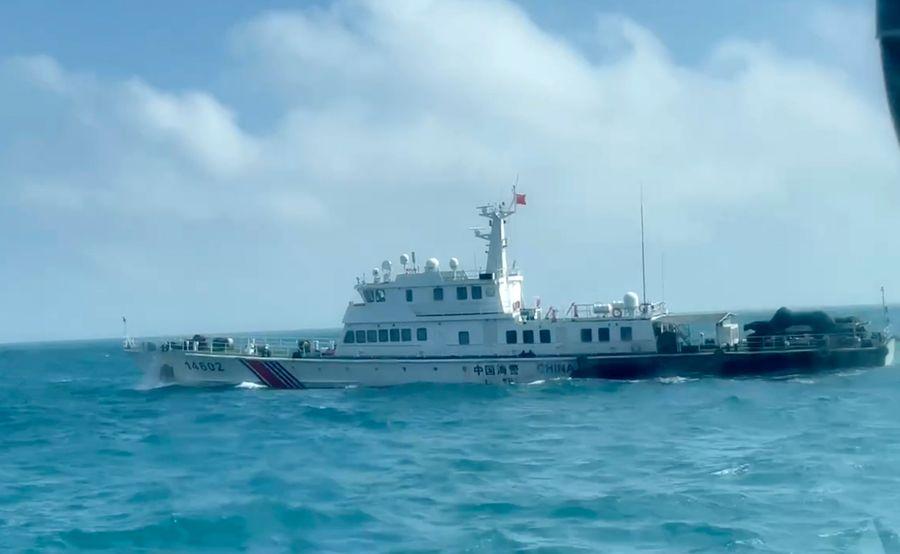
From 6 to 10 June, China’s Ministry of Transport organised what it called a “special maritime traffic law-enforcement and hydrographic survey operation” with several large vessels east of Taiwan, which involved the Fujian Maritime Safety Administration, the Guangdong Maritime Safety Administration, the East China Sea Navigation Support Centre and the East China Sea Rescue Bureau. According to Chinese authorities, the operation covered 1,030 nautical miles, inspected 198 passing vessels, and dealt with three so-called “violating” ships. However, Taiwan authorities condemned Chinese Coast Guard (CCG) personnel for harassing commercial vessels, asking them to state their ports of departure and destinations, in an attempt to create the appearance that China exercises jurisdiction over the waters.
Through these “maritime law-enforcement operations”, China is trying to turn the waters east of Taiwan into an area that can be administratively claimed and managed by it. It is seeking to normalise coast guard operations – which, compared with naval vessels, make it easier for China to present its cross-boundary activities as routine governance. If Chinese coast guard vessels begin appearing regularly east of Lanyu and Green Island or broadcast messages and question commercial vessels in the waters southeast of Taiwan, China can gradually recast waters that are not under its effective jurisdiction as areas where China can “enforce the law”, “manage” activity and “maintain traffic safety”.
This approach would replicate the “presence as claim” strategy China has used around the Senkaku Islands, in parts of the South China Sea and around Kinmen – a grey-zone tactic that is harder to respond to than traditional military exercises.
A Chinese coast guard ship sending a warning message on a scrolling digital message board (Ted Aljibe/AFP)
China is also sending maritime patrol and survey vessels into the waters east of Taiwan under the guise of navigational safety, maritime traffic management, undersea cable inspection and hydrographic surveying. Its purpose will be to collect basic data for future blockade operations and submarine activity. Because information on navigation routes, commercial shipping flows, undersea infrastructure, anchorage areas, water depth and sea conditions has both civilian and military uses, such information can provide China with the maritime data it needs to systematically prepare for more intense forms of coercion in the future.
The simultaneous presence of the People’s Liberation Army (PLA) Navy, the CCG, maritime safety authorities and rescue forces suggests that China is building a layered and coordinated maritime pressure structure. The PLA Navy maintains a presence in the outer layer and provides potential military deterrence. The CCG operates in the middle layer, carrying out so-called “law enforcement” and grey-zone missions to create facts of jurisdiction below the threshold of war. Maritime safety vessels, rescue ships and other administrative vessels operate in the inner layer, providing a technical, administrative and public-service cover that makes the entire operation appear more like “normal governance”.
This means that Taiwan and its partners are facing a cross-agency, sustainable maritime pressure system whose intensity can be raised or lowered at any time.
If this normalised grey-zone operation is not identified and disrupted in time, the waters east of Taiwan could become another testing ground for China’s coercive erosion of the regional rules-based order.
Jing Ge is an instructor at Florida International University.
This article appeared originally at Lowy Institute's the interpreter.

Iran’s Nuclear and Chemical Weapons Threat
By Ben Ollerenshaw • RealClearDefense
Europe’s Rearmament Paradox
By Daniel Darling • RealClearDefense
Pentagon’s Pursuit of Faster Acquisition
By Ben Harris • RealClearDefense
The Army’s AI Cyber Defenders Need a Proven Stand-Down Order
By Gleb Tsipursky • RealClearDefense
After the Silence
By Chase Skylar DeMayo • RealClearDefense
Hung Cao Facing Contentious Confirmation To Become Navy Secretary
By Konstantin Toropin • Associated Press
The First Surface Drone-v-Drone Fight
By CDR Salamander, CDR Salamander
Air Force Strengthens F-22 Raptor Combat Readiness in the Pacific
By Global DefenseAfter the Silence
By Chase Skylar DeMayo • RealClearDefense
Underwater Arms Race Puts U.S. Naval Supremacy at Risk
By Tom O'Connor, Newsweek