
Regaining Our Standing as a Maritime Nation
Last updated 05:59 AM EDT • Read time: 5m
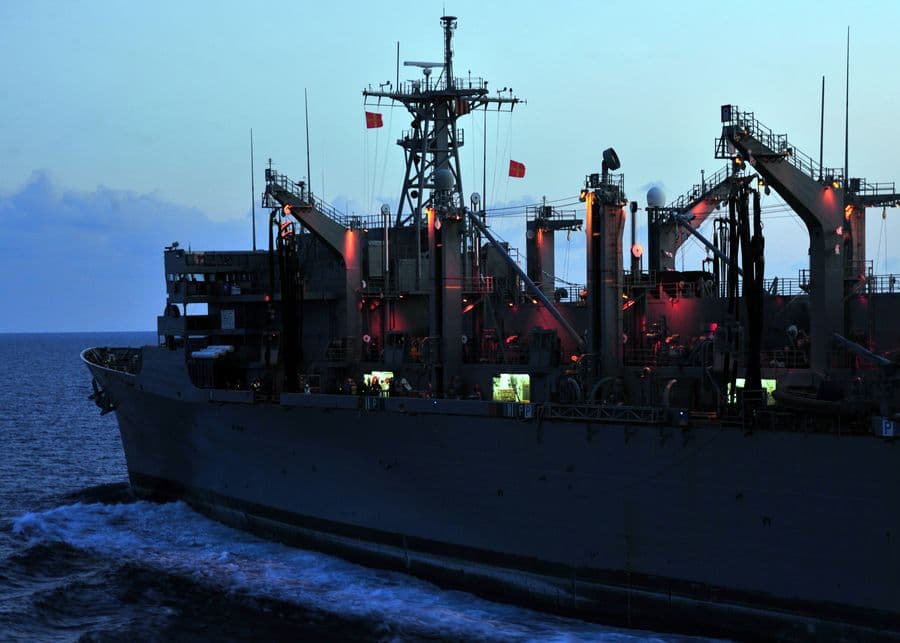
Photo: The Military Sealift Command fast combat support ship USNS Arctic (T-AOE 8) prepares to conduct a replenishment at sea. (Military Sealift Command)
Alternative historical fiction is a popular genre in America, where readers explore possibilities such as Napoleon deciding not to invade Russia or a Confederate victory in the Civil War, pondering the hypothetical impact on world history. In honor of Maritime Day 2024, let's consider what would have happened if the United States had fought the Second World War without a strong Merchant Marine and the tens of thousands of courageous mariners who delivered crucial supplies, troops, and weapons across dangerous waters.
It's clear: we would have lost the war or failed to achieve a decisive victory.
During WWII, an estimated 250,000 mariners served, and nearly 10,000 gave their lives, resulting in a higher per capita casualty rate than any of the armed services. Over 700 Merchant Marine ships were sunk by enemy attacks, and hundreds of mariners were held as prisoners of war.
FDR recognized the indispensable role of the Merchant Marine, which he considered the "fourth arm of defense" on par with the navy, army, and air force.
As we observe current global instability and brutal Eurasian conflicts, who will be the visionary leader and advocate who ensures the readiness of our Merchant Marine for the challenges ahead? Its current state is far from adequate.
The distinction between admirals, generals, and media commentators who freely opine on strategy and theory neglects or casually assumes away the hard reality of logistics. Lately, the strategists have not fared well in deterring conflicts, and the logistic shortcomings in Ukraine and the Middle East are glaring. While those deficiencies are apparent, they pale in comparison to a potential war in the Pacific.
Policymakers properly acknowledge China as the pacing threat, but so few seriously consider the critical importance of logistics and the availability of highly trained and militarily obligated maritime personnel. Decades of war in the Middle East have conditioned us to the luxury of uncontested sea and airspace. We enjoyed large support bases close to combat operations. Our fleet had uninterrupted access to intact and secure port facilities. Even as we flow supplies to Ukraine, it's along Europe's modern road and highway systems.
A war in the Western Pacific is a vastly different game, one difficult for Americans with a faded understanding of past conflicts to comprehend. Our Merchant Marine will operate in vast contested waters. The potential ship and human loss will be staggering. Instead of moving supplies short distances on well-established road systems, our mariners will face a 6,000-mile journey across the Pacific, scores of enemy submarines, and barrages of missiles far in excess of the sporadic Red Sea attacks. If the war is over Taiwan, in addition to military supplies, sealift will be vital to the survival of that democracy, delivering fuel and food through a formidable gauntlet.
The People's Liberation Army knows that sealift is key to our success. While many debate the vulnerability of our aircraft carriers, they gloss over that our combat power will be short-lived without robust sealift and persistent combat logistics in a war at sea.
Regrettably, we are no longer a true maritime nation; we are now a naval nation.
China, now a bona fide maritime nation, has made significant investments in its merchant fleet and can call on over 5,000 merchant vessels during war. The US has around 80. We must expand our commercial fleet to align with our strategic interests. That means acquiring more ships and enhancing our ability to build, maintain, and quickly repair them. Above all, we cannot prevail without a significant number of merchant marine officers who are ready and obligated to serve the nation when called upon.
To that end, there must be a thorough and honest assessment of current merchant mariner capacity. Our pool of mariners is aging, and there is a decline in the number of young men and women pursuing maritime careers. Building more ships will make a difference, but greater focus, effort, and coherence by the Administrations and Congress on the logistical realities of our time are needed.
At the top of the list should be the U.S. Merchant Marine Academy (USMMA) at Kings Point, New York. As a former commandant of the U.S. Naval Academy, I know that Kings Point must receive sufficient investment for programs and facilities that reflect its significance, placing it on par with the other federal service academies. Its infrastructure hasn't been upgraded since it was established by FDR during WWII. The outdated facilities discourage the brightest individuals from enrolling.
Like Annapolis, USMMA, which produces over 80% of our Strategic Sealift Officer Force, requires careful, thoughtful, and continuous attention. Like our other service academies, it is not just a college; it is an institution vital to our national security.
On this Maritime Day, let us remember the extraordinary contributions and sacrifices of our merchant mariners, past and present, the "fourth branch" of our citizens who go in harm's way. Beyond remembering, it's time to give them what's needed to deliver victory as they have so admirably and valiantly done before.
Admiral Roughead (U.S. Navy, ret.) is a graduate of the U.S. Naval Academy whose naval career culminated in serving as the Chief of Naval Operations, the senior officer in the U.S. Navy and a member of the U.S. Joint Chiefs of Staff. Previously he held six operational commands and is one of only two officers in the Navy’s history to have commanded both the Atlantic and Pacific Fleets.

From Siberia to Fairford: How Operation Spider’s Web Has Changed the Rules of Airpower
By Frank A. Rose • RealClearDefense
Faster Simulations, Better Defense Decisions
By Rut Lineswala • RealClearDefense
Will HASC Have an Oversight Subcommittee in the Next Congress?
By Christopher J. Bright • RealClearDefense
The U.S. is Overpaying for Missiles
By Alex Lee • RealClearDefense
The U.S. Nuclear Deterrent Umbrella
By Peter Huessy • RealClearDefense
From Siberia to Fairford: How Operation Spider’s Web Has Changed the Rules of Airpower
By Frank A. Rose • RealClearDefenseFaster Simulations, Better Defense Decisions
By Rut Lineswala • RealClearDefense
Bombers Could Have a Major Air-to-Air Combat Role
By Joseph Trevithick, The WarZone
Pentagon, Lockheed Agree to 10-Year Deal for 850 F-35 Jets
By M. Scanlon, Military T.
The Marine Corps Has a Boot Problem
By Travis Pike, Sandboxx News