
She Didn't Deserve It, but a CNO Did …
Last updated 06:08 AM EST • Read time: 8m
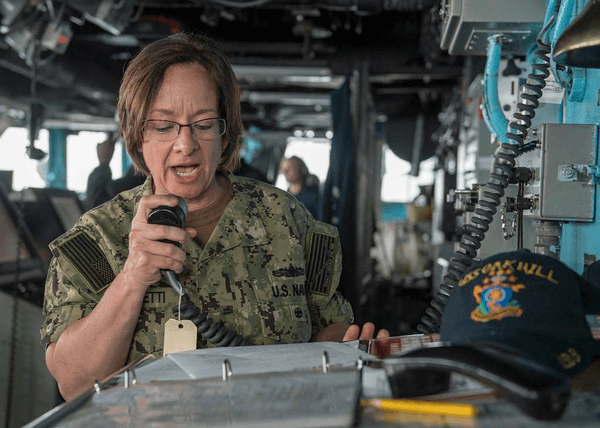
Admiral Lisa Franchetti did not deserve to be fired!
But, given the existing DoD process, a service chief’s job is almost impossible, and I am not surprised it finally caught up with a Chief of Naval Operations (CNO).
Full disclosure: I served with ADM Franchetti when I was on the Seventh Fleet staff, and I was a direct report to her and her boss, Admiral Jamie Foggo, when she was Commander of the Sixth Fleet; in fact, ADM Franchetti signed one of my last fitness reports (FITREPs). I like, admire, and respect ADM Franchetti, and I have never met anyone who did not.As one of my first Executive Officers (XOs) used to say, “let me repeat that for possible penetration”:
I like, admire, and respect ADM Franchetti, and I have never met anyone who did not.
No one has confided with me as to why she was fired, so we will have to go with the public explanation.[i] In my mind, ADM Franchetti’s only fault, which she shared with many CNOs, was trying to be a post-Goldwater-Nichols, post-9/11 CNO: the manager of a beast that defies management. No naval officer – rather, no U.S. military officer – would ever describe themselves as a “manager”: we are all “leaders”, not managers. Leaders lead people, and they lead “change”, but they don’t manage. Because the Department of Defense is the largest, most institutional bureaucracy in the world, and defies both management and leadership, it is hard to effect change when it has gotten way off course.
And with respect to the Navy, it was way off course. That wasn’t ADM Franchetti’s fault, problems had been developing for a long time, and like her recent predecessors, she tried to move the Navy in the right direction. But as I said in a very recent article, I tried to suggest that…
“…the swearing in of President Trump has ushered in not just a change in presidential administration, but a sea change in how the U.S. government will operate: no more “business as usual” – period, exclamation point, full stop.”[ii] … “… highlights the mantra that all general and flag officers understand, that they serve at the pleasure of the President – and the President is not pleased. I think he, and the American people in general, are not pleased with the status quo of how America works. The President has clearly indicated he wants to change how America works… So, what “status quo” issues exist in the Navy that need to be changed, and therefore might catch the attention of the new administration? One is clearly shipbuilding: the Navy has a recent track record, dating back at least 25 years of horrible combatant ship acquisition decisions. Another general problem is the shortage of personnel in at-sea billets.
The fault, as alluded to earlier, lies in two areas. The first is the Goldwater-Nichols Department of Defense Reorganization Act of 1986.[iii] Prior to this massive re-organization of DoD, the service chiefs actually had a say in the employment of their forces. The famous Maritime Strategy, for example, that described how the Navy would be employed to counter the Soviet Union, was written prior to the Act.[iv] Such a grand vision of Navy employment would be difficult to prescribe today, as the Goldwater-Nichols Act removed “operations” from the CNO’s list of duties and responsibilities, as the service chiefs were relegated to the Title X “man, train and equip” functions. Essentially, the CNO is tasked with providing ready forces to the Combatant Commanders (CCDRs), but it tis the CCDRs that determine when and where naval forces will be employed.
But does the CNO not get any say in employment of Navy forces? Under the Global Force Management (GFM) process they certainly do.[v] However, in general – and as you might imagine, this is necessarily a huge simplification of the actual process - the process consists of the Geographic Combatant Commands (GCCs) developing strategies to address the security situation in their respective areas of responsibility (AORs), the GCCs submitting these requests to the Joint Staff, the Joint Staff sending these requests to the services, and the services providing a response (concur, non-concur, etc.) to the Joint Staff. From this, a global employment plan is developing and forces assigned to the GCCs, “manned, trained and equipped” by the services. The GCC CCDRs decide how and when to operate assigned naval forces, with input and advice from their Naval Component Commander (NCC) – but not from the CNO – and a strict firewall is jealously maintained between the NCC (in some cases a “hat” worn by a numbered fleet commander) and the numbered fleet assigned to the GCC: the CNO’s staff (OPNAV) can talk to the numbered fleet commander, but not to the NCC.
The later stages of the Cold War were not affected much by this change, as inertia and the relatively short time period were the dominant characteristics. At the end of the Cold War, however, with the inevitable “peace dividend” combined with the growing realization that U.S. did, indeed, need to conduct military operations post-Cold War (Somali, the Balkans, Haiti, Iraq, etc.), DoD slowly adapted to the new system. The Navy, never a lover of staff assignment or doctrine, largely allowed the Army and Air Force to draft the new Joint doctrine, and how a fleet operates, and fights largely became lost in dense Joint-speak.[vi]
Post-9/11, however, this system got out of whack, for all the services: Afghanistan and Iraq had Central Command (CENTCOM) banging on the table for more and more capability, while Indo-PACOM and U.S. Forces Korea struggled to hold on to military capability in their part of the world. The Navy was under great pressure to help in multiple areas, including, finally, in providing ground personnel in both Afghanistan and Iraq. The force was stretched too thin, and operational tempo (OPTEMPO) – the amount of time ships were deployed overseas – kept being extended from the relatively predictable 6-month period of the late Cold War period to 8, 10, 11 months long.
This pace was not sustainable. Grossly speaking, the rule of thumb for the U.S. Navy has been “1/3, 1/3, 1/3”: one third of the force deployed, one third of the force in maintenance, and one third of the force “working up” for the next deployment period.[vii] While there are exceptions to every rule, during the late-Cold War period a ship could expect to be underway, on average, for approximately six months every year. This pace is sustainable, in terms of material readiness, warfighting readiness, and morale.
But the post-9/11 pace has not been sustainable, and the Navy, having operated for close to 25 years at an unsustainable pace, faces material, readiness, and manning shortfalls across the force. Coupled with absolutely horrible strategic decisions that began prior to the end of the Cold War, the Navy had sown the seeds for disaster. A few of these decisions include:
- Transitioning from the Regular Overhaul (ROH) to the Ship Repair Availability (SRA) maintenance model
- Decommissioning ship repair classes (destroyer tenders, repair ships, most of the submarine tenders)
- Transitioning to more “just in time” logistics
- Removing Sailors from Shore Intermediate Maintenance Activities (SIMAs)
- Closing the Surface Warfare Officer School (SWOS) Division Officer Course (DOC)
And disaster came, in the form of increased operational demands from the GCCs, as discussed above.[viii]
So, what needs to happen now? What should the next CNO do? First, the CNO needs support and backing from the rest of government:
- Goldwater-Nichols needs reform. Resource demands that do not respect the reality of resource availability does not work.
- In the meantime, when the CNO, or any other service chief, says “non concur”, the Joint Staff needs to back them up. Only the Secretary of Defense or the President should be able to override a service chief “non concur”, and that decision and the supporting reasoning should be reported to Congress. The Constitution charges Congress with “maintaining the Navy”, Congress was the entity that created the law that made the CNO directly responsible for much of that task, and if the CNO says “no”, Congress ought to know about it.
I am sorry that Admiral Franchetti was fired, she did not deserve it; I am not surprised that eventually a CNO was held accountable for the current state of the Navy. But without a team effort, the right support, another DoD reorganization act, and serious change leadership, all future CNOs will continue down a path of providing our nation with a Navy that is not as capable as this nation needs.
I wish the next CNO all the best!
Anthony Cowden is the Managing Director of Stari Consulting Services, co-author of Fighting the Fleet: Operational Art and Modern Fleet Combat, author of The Naval Institute Almanac of the U.S. Navy, and was a commissioned officer in the U.S. Navy for 37 years.
Notes:
[i] https://www.defense.gov/News/Releases/Release/Article/4074482/secretary-of-defense-pete-hegseth-statement-on-general-officer-nominations/
[ii] https://www.realcleardefense.com/articles/2025/02/04/unsolicited_advice_for_the_us_navy_1089144.html
[vi] For a refreshing change, read “Fighting the Fleet” for a naval discussion of fleet functions and considerations: https://www.amazon.com/Fighting-Fleet-Operational-Modern-Combat/dp/1682477274
[vii] This holds historically true for all navies: I was surprised to read this description of Napoleonic-era British naval operations in a historical novel – a novel, yes, but operationally accurate.
[viii] The observant leader will note that I use the acronyms “CCDR” and “GCC”, and not “COCOM”: “COCOM” is not an entity, it is an authority, and while you will hear senior military officers misuse this term all the time, I won’t. Pet peeve? Guilty as charged!

ICE Is Not a Four-Letter Word
By Meda Parameswara Reddy • RealClearDefense
The U.S. Can Draw Down in the Middle East Without Going Blind
By Cudi Zerey • RealClearDefense
America Needs a Joseph Directive
By Jeff Ballabon • RealClearDefense
Partnering Decides Whether Flexible Military Construction Can Work
By Matt Russell • RealClearDefense
Eight Months of Epic Fury and Still No Internal Alternative
By Stephen D. Cook • RealClearDefense

GE Aerospace to Supply Engines for Two US Navy Flight III Destroyers
By Defense Post
U.S. Air Force Asks Industry for New Cruise Missile for Ukraine
By Michael Peck, DNews
First Flight II San Antonio-class Amphib Completes Builder’s Trials
By Mongilio, USNI N.
LGM-35 Sentinel ICBM on Track for 2030
By Kris Osborn, Warrior Maven
On American Destroyers, Avoid a Self-Inflicted Wound in Spain
By Defense News