
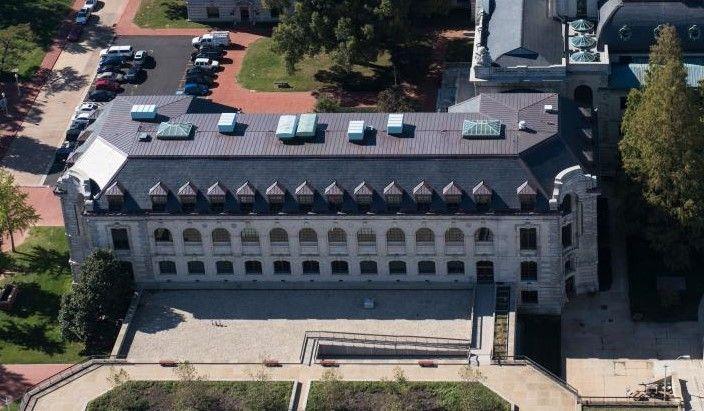
The Navy's Shipwreckers Scuttle Matthew Fontaine Maury's Legacy
Last updated 01:00 AM EDT • Read time: 5m
Recently, Secretary of the Navy Carlos Del Toro, following the recommendations of the congressionally-mandated Naming Commission, loftily proclaimed his rationale for the renaming of the USNS Maury: “As the history of our great nation evolves, we must put forth the effort to recognize figures who positively influenced our society.” While his renaming decision does recognize one – oceanographer Marie Tharp (1920-2006) – who created the first “comprehensive seabed maps of the Atlantic Ocean,” Del Toro’s statement implies that Maury somehow failed to make a positive contribution to society.
But is that actually the case?
I readily confess that in the fall of 1976 when I sat in Chemistry 101 in the Virginia Military Institute’s (VMI’s) Maury Hall, I had little knowledge of the career of Matthew Fontaine Maury (1806-1873) other than he was the scientist whose name adorned the chemistry and biology building.
In brief, here is an overview of his life and career:
Maury was born on a farm near Fredericksburg, Virginia, in 1806. Like many families in that era, the Maury family then moved west, settling south of Nashville, Tennessee. When he was 12 years old, young Matthew climbed high up in a tree but then fell 45 feet to the ground. He survived, but his back was so seriously injured that farming was out of the question. Instead, his father sent him to Harpeth Academy near Franklin. There he excelled, mastering languages – he learned the grammar of Latin in record time – and showing a particular aptitude and interest in science.
Influenced by his oldest brother, young Maury secured an “acting midshipman’s” appointment from Rep. Sam Houston of Tennessee. In August 1825 Maury began his naval service on the new frigate Brandywine, the vessel selected to carry Lafayette back to France following his tour of America. From the start, as naval historian and retired Navy Captain Miles P. DuVal subsequently wrote, “Maury impressed his superiors and fellow cadets as one resolved to master the theory and practice of the naval profession.” For most of the next nine years, he served at sea – including circumnavigating the earth – using the opportunity to undertake his own investigations into oceanography and meteorology, and progressing steadily in his own evolution as a naval scientist.
Space does not allow for details here, but a list of Maury’s most important accomplishments includes the following:
- 1836, authored the first book on nautical science by an American naval officer;
- 1843 to 1857, sought to create under his direction a “telegraphic meteorological bureau,” the precursor to the U.S. Weather Bureau;
- 1844 to 1861, first superintendent of the U.S. Naval Observatory and first hydrographer in the U.S. Navy;
- In the words of DuVal, he was “Founder of the science of oceanography. Father of world meteorology. Pathfinder of the seas. Locator of the first transatlantic cable. Advocate of naval reform and reorganization. Champion for establishment of the U.S. Naval Academy. Prophet of the Panama Canal. Planner for Amazonian, Mississippian, and Antarctic explorations. Leader for international cooperation in Antarctic research. Inventor of the first electrically controlled submarine mine successfully used in warfare [1860s]. Introducer of chinchona cultivation into Mexico. Author of public-school geographies. Father of Virginia Polytechnic Institute [VPI].”
As tensions increased between North and South, Maury did not wish to see disunion. “I may be too late,” he wrote his daughter while steaming back to America from England in early December 1860, adding, “Things I have no doubt have assumed many new phases since [November], but unless good [men] in each section muster themselves, I fear the Union is gone” (VMI Archives). Maury wrote appeals to the governors of Pennsylvania, New Jersey, Maryland, and Delaware encouraging them “to stand in the breach and stop this fratricidal strife.” Still, his native-son loyalty to the Virginia Commonwealth dictated that when, in April 1861, Lincoln called for 75,000 troops to invade the South – which were to pass through Virginia – Maury resigned his commission (on the same day as Robert E. Lee), offering his services to Virginia and, later, the Confederacy.
After the war, Maury lectured in physics at VMI and advocated for the establishment of a state agricultural college [later, VPI]. He died in 1873.
Today, a century and a half later, in 2023 we must acknowledge a sad and obvious reality:
for individuals of one generation to pass judgment on an earlier one, dismissing the differences of opinion among educated, principled men regarding the deep issues of their day – and to pretend that only one, simple, appropriate response existed at the time – is to reduce the complexities of human history to childish cartoonery.
Sadly, this is exactly what Woke Mob Ideology (WMI) is all about, buttressed by ahistorical foolishness such as Project 1619 and, most recently, nationwide calls and even proposed legislation for slavery reparations (even in states where slavery never was legal and probably never existed, like Minnesota).
There is clear evidence that Matthew Fontaine Maury “positively influenced” not only the U.S. Navy, but the scientific communities of America and the Western world, and societies worldwide. One distinguished military historian, who happened to know a relative of Maury’s, writes, “He was one of America’s most brilliant and influential scientists at a critical point in the formative era of American science and for the woke mob to achieve this [shipwrecking of his legacy] is a grotesque tragedy.” Indeed, it is.
Forrest L. Marion, Ph.D., is a retired U.S. Air Force officer and military historian. He is the author of Flight Risk: The Coalition's Air Advisory Mission in Afghanistan, 2005-2015 (Naval Institute Press, 2018), and (forthcoming), Standing Up Space Force: The Road to the Nation's Sixth Armed Service (Naval Institute Press).
The Gulf of Finland’s Forgotten Islands
By Ben Poulin • RealClearDefense
NATO’s New Spending Pledge Must Buy Real Energy Resilience
By Chuck Dockery • RealClearDefense
The Army Needs a Data Logistics Discipline Before the Next Surge
By Steve Ferenzi • RealClearDefense
2949 Marine Prisoners, Hostages, and Peacetime Governmental Detainees Since Our Corps' Founding
By Jon Couch • RealClearDefense
America Must Win the Biotech Race Against China
By Rob Maness • RealClearDefense
U.S. Air Force To Arm C-17 Cargo Aircraft With Cruise Missiles
By C. Jones, Defence Blog
How Marine Vet Ernest Langdon Became a Renowned Shooter & Gunsmith
By WATM
In First, Two CCAs Fly Air Combat Maneuvers Using Autonomy Software
By A&SF
Space Force Launches Mission Operations Center
By Jon Harper, DefenseScoop
Pentagon Mulls Placing Fleet of Military Satellites Around the Moon
By Ars Technica