
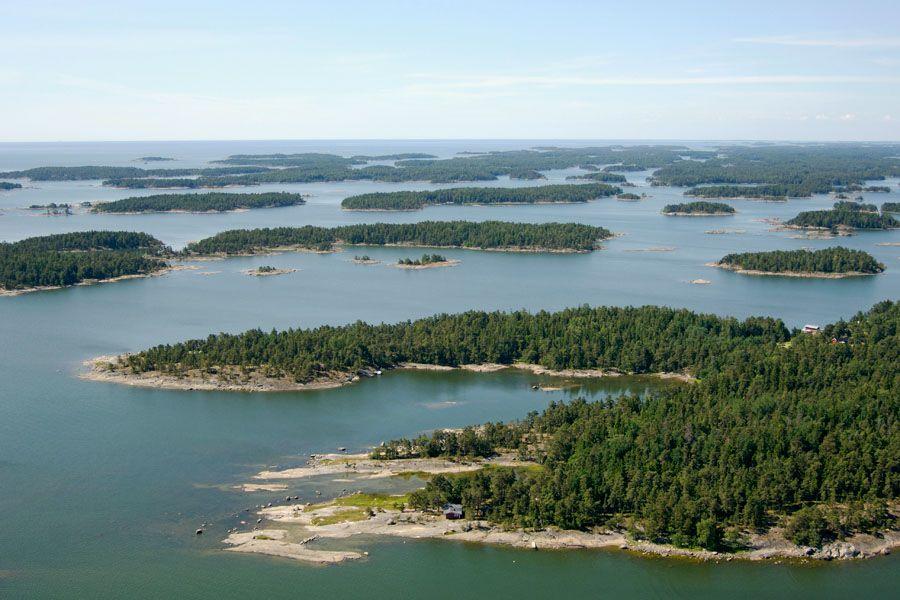
The Gulf of Finland’s Forgotten Islands
Overlooked Outposts of Strategic Significance
Last updated 04:23 AM EST • Read time: 6m
Join the Conversation
0In March 1942, Finnish soldiers launched an offensive to retake the island Gogland from the Soviets, not with boats, but by advancing across the frozen Gulf of Finland. The narrow waterway that in warmer months protected the island had become an avenue for assault. Soldiers swathed in winter camouflage clandestinely crossed the snow covered ice and took control of the island, constraining the sea route to Leningrad. In the modern day, the gulf’s scattered islands still remain part of a strategically sensitive maritime frontier. These often overlooked map dots exist on the very frontlines of geopolitics yet are virtually unknown to a wider world. Here, where Russia and NATO’s edges grind against one another, what happens on a few specks of land surrounded by sea can affect events around the globe.
The Gulf of Finland is a narrow passage bordered primarily by Finland to the north and Estonia to the south, both of whose capital cities are positioned directly on its shores. While its western edge opens into the wider Baltic Sea, the gulf’s eastern flank terminates in Russian territory around St. Petersburg. Far from a sleepy backwater, it is choked with shipping routes, ports, communications cables, and naval approaches which give this geography outsized importance beyond its modest size. Whoever controls the small islands speckled across this strategic space gains observation points, logistical nodes, or opportunities to extend operational reach.
History is full of examples as to why these islands have consistently attracted attention in one conflict after another. Naissaar, an Estonian island, near the gulf’s mouth, bears the remains of coastal fortifications left by successive military powers as documented by The Estonian War Museum. Installations like this were part of a larger system of defenses to protect Tallinn and the approaches to St. Petersburg. Naissaar’s batteries may have been abandoned long ago, but its geographic position remains as relevant as ever now that new tensions are rising to its east.
Russia’s Gogland remains an immediate example of the importance of these islands. In 2023, Finland’s public broadcaster Yle published satellite imagery showing a radar station and five helicopter landing pads on the island. With tensions high between NATO and Russia, a wary alliance could interpret infrastructure like this as support for surveillance and aviation activity. Former Estonian naval commander Jüri Saska compared this “stone in the sea” to another strategically important site, Ukraine’s Snake Island, noting that "It is a good place to own, but difficult to maintain and manage" and that its intelligence value was greater than its apparent offensive significance.
That balancing act between an island’s strategic position and the fundamental challenges that come with securing such an isolated outpost. Radar sites can improve awareness of passing activity and landing zones can extend the reach of aircraft, but neither can independently close a shipping lane or guarantee that an occupying force can hold the waters around it. Modern maritime power exists in a broader network of connected sensors, integrated communications, aircraft, ships, and human decisionmakers. A single island, while valuable, is only one part of that system that relies on its component parts to function.
Like its Ukrainian analogs, many of these islands would be difficult to retain if conflict were to break out in the gulf. Taking one of these islands would be a feather in the cap of any commander who would likely gain some measurable advantage by controlling the position, at least temporarily. However, as reality sets in, the prospect of occupying one of these “stones in the sea” begins to seem more like a white elephant as the costs required to maintain such a victory pile up. A force occupying an island needs fuel, ammunition, equipment maintenance, medical support, and reliable communications, not to mention the resources to keep its soldiers alive. Those demands become even more pressing when their positions become more vulnerable to aircraft, drones, and precision weapons. The same liminal location that makes an island useful for observation can complicate its reinforcement.
When calculating the islands’ strategic value, Baltic winters add a host of additional challenges. According to the Finnish Meteorological Institute, the Gulf of Finland was fully frozen over at the February 2026 seasonal maximum, when Baltic-wide ice extent reached 181,000 square kilometers. Far from a sure thing, the preceding winter’s maximum was only 85,000 square kilometers, and offshore ice in the central and eastern gulf appeared only briefly. This unpredictability matters tremendously to military planners deciding between launching open-water craft or ice-capable ships or contemplating sending their troops across the ice or inserting them via helicopter.
Even iced over, the gulf is not entirely closed to maritime traffic. Finnish authorities reported that commercial shipping continued during the colder 2025–26 season thanks to their icebreaker fleet. The 1942 assault on Gogland illustrates how winter can transform movement, but it does not mean that today’s soldiers could repeat such a daring crossing when faced with modern surveillance and firepower. When both sides of the NATO-Russia divide are faced with similarly challenging conditions, the strategic edge will go to whichever side can keep its island positions functioning as conditions change.
NATO for its part has already developed experience in this unique environment. During Freezing Winds 2022, U.S. Marines and Finland’s Nyland Brigade used Finnish landing craft, helicopters, and a forward supply hub to rehearse coastal logistics. The Gulf of Finland and its islands found themselves again in the strategic spotlight following suspicious damage to Baltic undersea infrastructure which prompted NATO to launch Baltic Sentry in January 2025, combining ships, patrol aircraft, and new surveillance technologies.
To defend its territory, NATO does not need to fortify every offshore position. This would be impractical and unnecessary. The alliance must determine which islands genuinely add capabilities that cannot be provided as effectively from sea, air, or the mainland. Those islands deemed worthwhile should be incorporated into wider allied surveillance and logistical architecture. Russia faces similar challenges for its own numerous island outposts in the gulf and is likely to consider the same sort of calculations.
The islands of the Gulf of Finland still retain the strategic value that sent troops marching across its frozen surface in 1942, even if their role in modern warfare has evolved. Today, the important question is whether an island strengthens a resilient allied network or becomes an isolated vulnerability too difficult to support. The side that best understands that distinction will get more military utility from the gulf’s geography than one that mistakes occupation for strategic gain.
Ben Poulin is an independent defense and geopolitical writer and former U.S. Army watercraft operator.
The Gulf of Finland’s Forgotten Islands
By Ben Poulin • RealClearDefense
NATO’s New Spending Pledge Must Buy Real Energy Resilience
By Chuck Dockery • RealClearDefense
The Army Needs a Data Logistics Discipline Before the Next Surge
By Steve Ferenzi • RealClearDefense
2949 Marine Prisoners, Hostages, and Peacetime Governmental Detainees Since Our Corps' Founding
By Jon Couch • RealClearDefense
America Must Win the Biotech Race Against China
By Rob Maness • RealClearDefense
U.S. Air Force To Arm C-17 Cargo Aircraft With Cruise Missiles
By C. Jones, Defence Blog
How Marine Vet Ernest Langdon Became a Renowned Shooter & Gunsmith
By WATM
In First, Two CCAs Fly Air Combat Maneuvers Using Autonomy Software
By A&SF
Space Force Launches Mission Operations Center
By Jon Harper, DefenseScoop
Pentagon Mulls Placing Fleet of Military Satellites Around the Moon
By Ars Technica